Facebook
 X
X
 Pinterest
 Copy Link
QR Codes Connecting Us to History
QR Codes Connecting Us to History
Coupeville:
It’s of no surprise to anyone that Whidbey Island is home to some fascinating and wonderful towns each with their own history and culture. Perhaps the most intriguing is Whidbey’s oldest town and home of the first Whidbey Island settlement, Coupeville.
Coupeville is an adorable waterfront community rich in history and culture. In 1850 Issac Ebey became the first official Whidbey Island settler when he applied for the first land claim on the island. Claiming over 600 acres of what is now Ebey’s Landing, Ebey was soon to be followed by his nephew and many others. By 1854 there were 29 settlement claims in Coupeville alone and in 1881 it officially became the Island County seat.
Preservation:
Although all of Whidbey is covered in fascinating history, Coupeville is unique in its preservation. Where many of the original buildings of Oak Harbor and Langley have been torn down or decimated by historic fires, downtown Coupeville’s original buildings remain intact and in use. In fact, the town of Coupeville has more historic buildings in a condensed area than anywhere in the Pacific Northwest.
Technology:
To celebrate this fact and educate people on these beautiful historic buildings, Island County’s 4-H club took on the project of using modern technology to connect us to the past. Next time you’re in downtown Coupeville, take a closer look at those historic store windows. You might just see one of these:
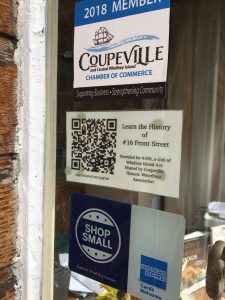
Scattered down Front Street are tons of these QR codes leading to the Coupeville Historic Waterfront Association website developed by the 4-H club in 2012. This website is full of information gathered from the Island County Historical Society, City Records, and over 100 personal interviews with people recounting memories and stories of the historic downtown. Each building’s QR code will lead you directly to that building’s history: when it was built, it’s original purpose, and the different stores that have occupied the space.
So, the next time you are strolling down Font Street whip out that smartphone of yours and learn a little bit of history along the way.
You Might Also Like:
History of the Penn Cove Mussel Fest

What’s with the Tulips?
What’s with the Tulips?

What’s with the Tulips?

April’s dawn breathes an awakening for this sleepy island. After months of cold gray clouds and dreary scenes, color finally breaks from the ground beneath. As the velvet grass returns it brings with it something a little more unique and exciting.
TULIPS!
These trumpet-like flowers can be found all across Whidbey Island in the month of April. Their beautiful rainbow hues grace countless flower beds and practically every floral shop.
Why the obsession with these bell-shaped buds?
The answer lies within Whidbey Island history and heritage.
In the earliest days of Whidbey Island settlement there were few Americans established on the island, even after the Donation Land Claim Act of 1850 which allowed for free land claim until 1855. In 1894 a man by the name of John “R.E.” Werkman gained the rights to market land on Whidbey Island for one of the recently developed land companies. He set off to Holland, Michigan where he displayed a foot-long potato to impress local farmers with the fruitfulness of Whidbey Island – it worked.
A few months later the steamer Idaho found its way to the Penn Cove dock with 18 Hollanders direct from The Netherlands. The Dutch population on Whidbey Island expanded rapidly on Whidbey and within two years there were over 200 Dutch immigrants populating the island. This drastic increase in population helped to recover the island from the 1893 financial downturn and build what would become a sustainable economic climate for Whidbey Island as a whole.
How we honor the heritage today:
View this post on Instagram
Many direct descendants of these original settlers remain on Whidbey to this day and their family names can be seen on street signs across the island.
Today the island honors these original settlers and their Dutch heritage with one of our most beloved events, the annual Holland Happenings Festival. Taking place on the last weekend of every April, this festival is a fifty-year-old tradition drenched in Dutch heritage. Everywhere you look you will find Volendam hats, wooden clogs, street sweeps, and most of all – tulips.
View this post on Instagram
With the Skagit tulip fields just on the other side of the Deception Pass Bridge, it’s no wonder the Dutch national flower plays a starring roll in every Holland Happenings. Their bright petals grace posters, pamphlets and just about every float. They are, without a doubt, a symbol of the season and reminder of the past.
You might also like:
History of the Penn Cove Mussel Fest