












Whidbey Island Holiday Shopping Guide 2022

Contributed by Jessica Hart

Can you believe the holiday season is here? To celebrate the holidays approaching I've rounded up some of my favorite local shops to help you find the perfect gifts for everyone on your list.  It's so important this year (and every year) to support the small businesses in our community, and I'm so excited to share my favorite places with you.


Whidbey Island Holiday Shopping Guide 2022

1.  3 Sisters Market

Your local family market & grocery.  3 Sisters Market has been proudly serving our community with quality meats and local goods since 2013.

Work with a local Realtor® who can find you a dream home close to the best local spots

2. Madrona Supply Co

From screen-printed home goods and apparel made in-house to a room filled with local wood slabs for custom projects, we’ve got something to love for everyone. Plus we serve as the HQ for our sister company Turnco Wood Goods .

3. Sweet Mona's Chocolate Boutique

We sweeten the world with outstanding chocolates, outstanding people, and outstanding service.

4. Bayleaf

We are a enthusiastic team of food and wine lovers who want to share our latest discoveries with you! So much more than a store, bayleaf will forever be your home for exceptional quality, amazing delights, and helpful, friendly people. .

5. Bayview Garden

Bayview Garden has been in the business of loving and nurturing plants for 30 years and has been on the forefront of plant education and conservation for just as long. As a multi generational pursuit, the roots run deep and the care for the connection between plants and people even deeper.

How to save $100s on your monthly mortgage payment

When buying a home on Whidbey Island

Contributed by Si Fisher

As a Whidbey Island homebuyer, you may be searching for affordable housing and having a rough go at it. Mortgage rates are much higher now than they were last year, and this could mean several hundred dollars more a month when looking at a potential mortgage in your desired price point.


Luckily, today I am going to share with you a program that can help reduce your monthly mortgage payment by hundreds of dollars.


At this point you are probably thinking, “What wizardry is this?” Well, the magic all has to do with mortgage buydowns, and more specifically I want to talk about what some sellers are doing to make their homes more appealing and affordable to potential buyers looking on Whidbey Island.

What Is A Buydown On A Mortgage?

Most lenders when originating a loan will have an option for the borrower to purchase something called discount points (also referred to as mortgage points, or prepaid interest points).  Essentially it is a prepaid fee that allows you to buy down the interest rate on your loan and thereby lower your monthly payment for the entire duration of the loan.


In a different type of buydown, the points purchased at the start of the loan lower the interest rate for a specific period of time. As mentioned above we are now seeing sellers offer to pay for these shorter term buydowns to make their home more affordable to a larger number of buyers.  The most common one we are seeing now is called the 2/1 buydown.  

Contact a local expert about financing your next home

The 2/1 Mortgage Buydown Program

The 2/1 Mortgage Buydown allows a borrower to lock in an interest rate 2% lower than the current rate for the first year, and then 1% lower for the second year of the loan.  After that the loan defaults back to what the current rate was at the time of the loan origination.  Let’s look at an example of how this works.


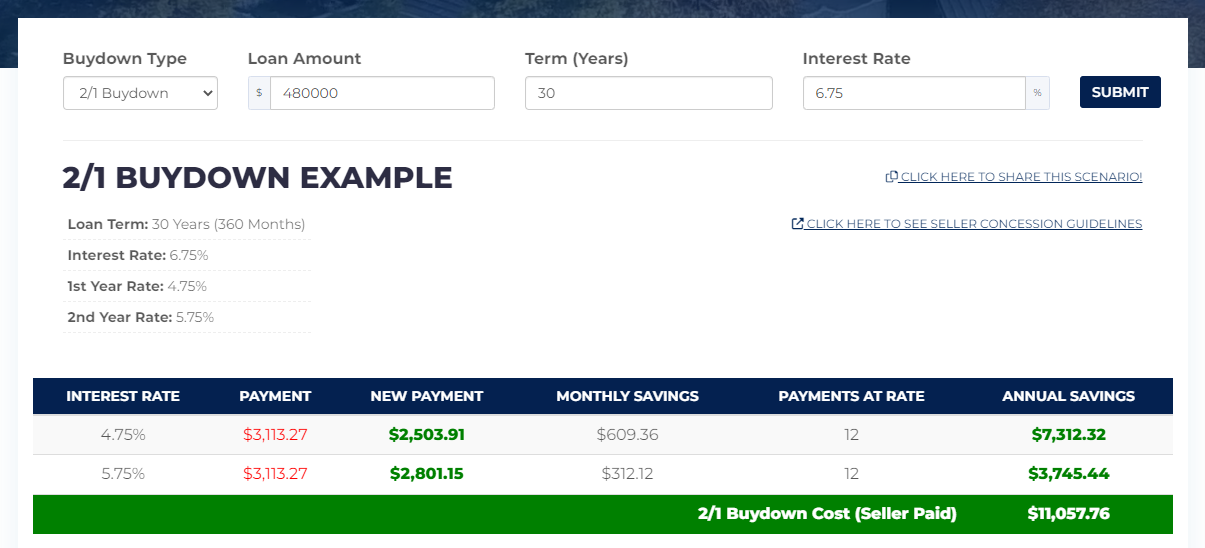
Let’s say you are looking at a home for $600,000.  You plan on making a 20% down payment, leaving $480,000 that needs to be financed.  Observe the chart below:

$609 dollars/month savings for the borrower during the first year!!!


Okay let’s break it down. If a borrower was financing their $480K loan at today’s rate of about 6.75% their monthly payment would be $3,113.27/month. When using this 2/1 buydown program their rate drops to 4.75% for the first year, and 5.75% for the second year. This lowers the monthly payments during that time to $2,503.91 and $2,801.15 respectively. After that point your loan goes back to what the original rate would have been if you were not taking advantage of this program. AND, should the interest rates fall during the course of the first two years, you can always refinance to the new lower rate after the buydown period ends.

One additional thing to note is that the borrower would still need to qualify for the loan at the current interest rate, not the buydown rate.

The best part about this is that everybody wins!  The seller gets more potential buyers interested in their home (this can be a lot more enticing and more cost effective than a price reduction), and the buyer gets two years of reduced monthly payments.  If both parties agree, the seller would then pay for the buydown through escrow when the home sale closes. In the example above the seller would pay around $10K depending on a variety of factors. Presto chango!


This is just another tool to put in your tool kit and another reason to work with a professional who has a full set of tools!

Article contributed by:

Real Estate Top 10 Predictions for 2023 - Matthew Gardner


This video shows Windermere Chief Economist Matthew Gardner’s Top 10 Predictions for 2023. Each month, he analyzes the most up-to-date U.S. housing data to keep you well-informed about what’s going on in the real estate market.


Real Estate Top 10 Predictions for 2023 - Matthew Gardner

1. There Is No Housing Bubble

Mortgage rates rose steeply in 2022 which, when coupled with the massive run-up in home prices, has some suggesting that we are recreating the housing bubble of 2007. But that could not be further from the truth.

Over the past couple of years, home prices got ahead of themselves due to a perfect storm of massive pandemic-induced demand and historically low mortgage rates. While I expect year-over-year price declines in 2023, I don’t believe there will be a systemic drop in home values. Furthermore, as financing costs start to pull back in 2023, I expect that will allow prices to resume their long-term average pace of growth.

2. Mortgage Rates Will Drop

Mortgage rates started to skyrocket at the start of 2022 as the Federal Reserve announced their intent to address inflation. While the Fed doesn’t control mortgage rates, they can influence them, which we saw with the 30-year rate rising from 3.2% in early 2022 to over 7% by October.

Their efforts so far have yet to significantly reduce inflation, but they have increased the likelihood of a recession in 2023. Therefore, early in the year I expect the Fed to start pulling back from their aggressive policy stance, and this will allow rates to begin slowly stabilizing. Rates will remain above 6% until the fall of 2023 when they should dip into the high 5% range. While this is higher than we have become used to, it’s still more than 2% lower than the historic average.

3. Don’t Expect Inventory to Grow Significantly

Although inventory levels rose in 2022, they are still well below their long-term average. In 2023 I don’t expect a significant increase in the number of homes for sale, as many homeowners do not want to lose their low mortgage rate. In fact, I estimate that 25-30 million homeowners have mortgage rates around 3% or lower. Of course, homes will be listed for sale for the usual reasons of career changes, death, and divorce, but the 2023 market will not have the normal turnover in housing that we have seen in recent years.

4. No Buyer’s Market But a More Balanced One

With supply levels expected to remain well below normal, it’s unlikely that we will see a buyer’s market in 2023. A buyer’s market is usually defined as having more than six months of available inventory, and the last time we reached that level was in 2012 when we were recovering from the housing bubble. To get to six months of inventory, we would have to reach two million listings, which hasn’t happened since 2015. In addition, monthly sales would have to drop below 325,000, a number we haven’t seen in over a decade. While a buyer’s market in 2023 is unlikely, I do expect a return to a far more balanced one.

5. Sellers Will Have to Become More Realistic

We all know that home sellers have had the upper hand for several years, but those days are behind us. That said, while the market has slowed, there are still buyers out there. The difference now is that higher mortgage rates and lower affordability are limiting how much buyers can pay for a home. Because of this, I expect listing prices to pull back further in the coming year, which will make accurate pricing more important than ever when selling a home.

6. Workers Return to Work (Sort of)

The pandemic’s impact on where many people could work was profound, as it allowed buyers to look further away from their workplaces and into more affordable markets. Many businesses are still determining their long-term work-from-home policies, but in the coming year I expect there will be more clarity for workers. This could be the catalyst for those who have been waiting to buy until they know how often they’re expected to work at the office.

7. New Construction Activity Is Unlikely to Increase

Permits for new home construction are down by over 17% year over year, as are new home starts. I predict that builders will pull back further in 2023, with new starts coming in at a level we haven’t seen since before the pandemic.

Builders will start seeing some easing in the supply chain issues that hit them hard over the past two years, but development costs will still be high. Trying to balance homebuilding costs with what a consumer can pay (given higher mortgage rates) will likely lead builders to slow activity. This will actually support the resale market, as fewer new homes will increase the demand for existing homes.

8. Not All Markets Are Created Equal

Markets where home price growth rose the fastest in recent years are expected to experience a disproportionate swing to the downside. For example, markets in areas that had an influx of remote workers, who flocked to cheaper housing during the pandemic, will likely see prices fall by a greater percentage than other parts of the country. That said, even those markets will start to see prices stabilize by the end of 2023 and resume a more reasonable pace of price growth.

9. Affordability Will Continue to Be a Major Issue

In most markets, home prices will not increase in 2023, but any price drop will not be enough to make housing more affordable. And with mortgage rates remaining higher than they’ve been in over a decade, affordability will continue to be a problem in the coming year, which is a concerning outlook for first-time buyers.

Over the past two years, many renters have had aspirations of buying but the timing wasn’t quite right for them. With both prices and mortgage rates spiraling upward in 2022, it’s likely that many renters are now in a situation where the dream of homeownership has gone. That’s not to say they will never be able to buy a home, just that they may have to wait a lot longer than they had hoped.

10. Government Needs to Take Housing More Seriously

Over the past two years, the market has risen to such an extent that it has priced out millions of potential home buyers. With a wave of demand coming from Millennials and Gen Z, the pace of housing production must increase significantly, but many markets simply don’t have enough land to build on. This is why I expect more cities, counties, and states to start adjusting their land use policies to free up more land for housing.

But it’s not just land supply that can help. Elected officials can assist housing developers by utilizing Tax Increment Financing tools, whereby the government reimburses a private developer as incremental taxes are generated from housing development. There are many tools like this at the government’s disposal to help boost housing supply, and I sincerely hope that they start to take this critical issue more seriously.


About Matthew Gardner

As Chief Economist for Windermere Real Estate, Matthew Gardner is responsible for analyzing and interpreting economic data and its impact on the real estate market on both a local and national level. Matthew has over 30 years of professional experience both in the U.S. and U.K.

In addition to his day-to-day responsibilities, Matthew sits on the Washington State Governors Council of Economic Advisors; chairs the Board of Trustees at the Washington Center for Real Estate Research at the University of Washington; and is an Advisory Board Member at the Runstad Center for Real Estate Studies at the University of Washington where he also lectures in real estate economics.


10 Tips to Help Winterize Your Home on Whidbey Island

Contributed by Si Fisher

As winter approaches, it's important to take some steps to prepare your home for the colder weather. This can save you big bucks on the heating bill, and as a homeowner we all know how important it is to maintain the greatest investment we have and protect it from potential damage.


Here are 10 tips to help you winterize your home on Whidbey Island

(Tip #10 might be the most important when living on Whidbey Island, don't miss it!)

1.  Seal windows and doors to keep the cold air out, and replace weather-stripping.


Small leaks can reduce your home's energy efficiency by as much as 30% annually! This leakage can be significantly reduced with some straightforward and affordable caulking of windows and weather stripping on doors.  Below are a couple videos that will help you if you want to take on these projects yourself.


Work with a local Realtor® who has a rolladex of local vendors to help with home projects!

2. Add or Install insulation in the attic or crawlspace


The attic is where insulation is most useful.

Unfortunately, the attic insulation in the majority of homes is either nonexistent or inadequate. The U.S. Environmental Protection Agency recommends that attics have at least R-38 insulation, which is generally 10 to 14 inches deep.

The hot air in the rooms below won't be able to enter the attic if the attic floor is adequately insulated. Caulking any ceiling penetrations—holes around pipes, ducts, and wires—as well as installing an insulated cover over the attic hatchway or stairs are equally crucial.

You could also look into getting your crawl space insulation on lock as well!

Check out this article for tips on crawl space insulation:

Or this video for installation tips:

3. Cover windows with heavy curtains or use plastic sealing kits to keep heat in.


In the winter, even the greatest, tightest-sealing windows seem a little chilly. Cover windows with insulated shades, heavy or thermal insulated curtains, or you can also get easy to install plastic shrink kits to make spaces seem warmer.


Highly Rated BUDGET Thermal Curtains on Amazon

Insulated Honeycomb Blinds for Windows on Amazon

Indoor Shrink Window Kit on Amazon

4. Check Your Fireplace

Creosote accumulation or animal nests might be dangerous in your wood-burning fireplace. Before lighting the first fire of the season, have an annual inspection. In addition to creosote the chimney can accumulate soot and other waste that an inspection will help identify.

An inspection can tell you wether or not your chimney needs to be cleaned, and if it is needed, it's best to have a professional get the job done.  Additionally, clean out any ash that has accumulated in the firebox using a vacuum or broom.

Likewise, regular cleaning and maintenance are needed for an electrical or propane fireplace.  To maintain your model running smoothly and safely, follow the manufacturer's instructions.

Are you the DIY type?  Below are some links for chimney cleaning supplies, and a how to video:

Chimney Cleaning Supplies on Amazon

Electric Fireplace Insert on Amazon


5. Clean your gutters and downspouts

Gutter cleaning is a crucial aspect of getting ready for winter. As soon as the last of the autumn leaves have fallen, it's a good idea to get the gutters cleaned. Examine and clear the gutters of leaves and other debris to avoid clogs. Additionally, clear gutters will enable appropriate drainage of melting snow.

Gutter guards are an option to consider if you want to prevent gutter cleaning. They can be manufactured of polyvinyl chloride (PVC), aluminum, or stainless steel and help keep leaves, pine needles, grit from roofs, and other debris out of your gutter. To maintain the guards' full efficiency, they periodically need to be brushed off, but this is not as laborious as regular cleaning.


Aluminum Gutter Guard on Amazon

6. Disconnect hoses from outdoor faucets and drain them properly

Remember to disconnect and drain all exterior hoses and irrigation. You don’t want them damaged! In addition, it is wise to cover your outside faucets to prevent pipes from bursting. They are pretty easy to install.


Deluxe Faucet Protector on Amazon

Standard Faucet Protector on Amazon

Bag Type Protector on Amazon

Blowout Valve Adapter on Amazon

Male to Male Adapter on Amazon


7. Change the furnace filter every 3 months

A clean filter helps improve the efficiency of your furnace. The airflow is obstructed by a filthy filter that has dust, pollen, lint, and other debris trapped inside of it, which makes your furnace work harder to heat your house. Filters should be changed at least every three months.

Same goes for your HP-mini split, except most filters only need to be replaced once a year.  They can also be cleaned regularly (at least once a month), to improve efficiency.

Furnace Air Filter MERV 8 on Amazon

8. Check roof for missing or damaged shingles

Again I must reiterate how important it is to protect your most important investment. There are few things worse than a damaged roof that leads to water damage! So, get up there yourself to check for damaged shingles, or pay a professional to take a look.

Best Marshalltown Trowel on Amazon

Roofing Nails on Amazon

4-Pieces Pry Bar Set on Amazon

Roofing Shingles on Amazon

NP1 Gray Polyurethane Caulk on Amazon

Sealant Caulking Gun on Amazon

9. Add a layer of mulch to your garden beds to protect plants from frostbite

Protect your beautiful plants & landscaping!  Adding a layer of mulch can protect some plants from frostbite, but you may even have potted plants you want to bring indoors for the winter.

They also offer cheap hoop house kits on amazon that are great for a little winter gardening!

Greenhouse Hoops for 3ft or Wider Grow Tunnel on Amazon

You can also check out these cheap DIY hacks to protect your plants in Winter:

10. Consider investing in a generator or make sure your existing one is well maintained and ready to go

On Whidbey it is pretty much inevitable that we will see some winter power outages. If you rely on electric heating, your home's temperature will drop quickly throughout the winter, posing a serious threat to everyone's safety, especially when it drops below freezing. Even as the storm rages outside, a generator can keep your furnace running or at least a space heater or two, until the main power is restored, keeping you warm and cozy. Other benefits include charging your mobile devices, powering your internet router and wifi, and making sure your fridge/freezer continue running as needed.

2350-Watt Portable Inverter Generator on Amazon

1500W Ceramic Personal Heater on Amazon

7000-Watt Inverter Generator on Amazon

24kW Home Standby Generator on Amazon

One might think it goes without saying, but for safety reasons it is worth mentioning that if you are using a generator, it needs to be ran outside to avoid getting carbon monoxide poisoning which can be lethal.  You also might invest in getting a cover to protect your outside generator from the elements.

Waterproof Universal Generator Cover on Amazon

Article contributed by: