





What is a Sellers' market? - How to navigate the real estate market on Whidbey Island

Contributed by Si Fisher

In the beautiful locale of Whidbey Island, including Clinton, Langley, Freeland, Greenbank, Coupeville, and Oak Harbor, the real estate scene can fluctuate. Even though the market has slowed since 2021 & 2022, currently in 2023 we are seeing low inventory, moderately fewer days on market, and the pace is picking up.


What is a Sellers' Market?

In simple terms, a real estate sellers' market is where the demand for homes outweighs the supply. This condition tends to favor home sellers over buyers, creating a competitive environment that can result in bidding wars and homes selling above their listing price.


Are you wondering, "Is it a buyers' market or sellers' market?"

So far in 2023, Whidbey Island is still in a sellers' market. This makes it the ideal time for homeowners to consider selling their properties. Check out this weeks stats by clicking here for more details.

What does this mean for Homebuyers?

In a sellers' market, buying a home or buying an investment property can seem daunting. Homes are often sold swiftly, and buyers need to be prepared to make competitive offers. If you're a prospective homebuyer on Whidbey Island, understanding the dynamics of a sellers' market is crucial.


How do you navigate a sellers' market?

So, how can you navigate this sellers' housing market, whether you're looking to buy or sell? The key is partnering with a Whidbey Island Realtor® who is a specialist in the Whidbey Island real estate market. Someone who lives and works here. Within Windermere Whidbey we have a variety of brokers who have a deep understanding of the local market conditions and the expertise to guide you through the process.


In this sellers' market, working with a Whidbey Island Specialist can mean the difference between getting your dream home or selling your property at an optimal price. Their guidance can help you understand the market trends, whether it's a real estate buyers' market or sellers' market, ensuring you make informed decisions.


Remember, every housing market has its own unique trends and patterns, and the current sellers' market on Whidbey Island is no exception. So, whether you're looking to sell or buy a home in Freeland, Langley, or any other beautiful town on Whidbey Island, seeking professional advice from a local expert can make a world of difference.


Ready to take the leap and make your real estate goals a reality?

Contact your local Whidbey Island Realtor® today and let them help you navigate this sellers' market, ensuring your real estate goals are met. Don't miss the opportunity to take advantage of the current sellers market or to prepare for a potential buyers' market in the future. We're here to help!
Remember to bookmark this page and check back regularly for updates on the Whidbey Island housing market. We'll keep you informed, whether it's a buyers' or sellers' market, so you can make the best decision for your real estate needs.

Article contributed by:

Contact a local expert to get expert advice about selling your home

Check out other articles below

Would the FHFA Mortgage Fee Changes Have Favored Buyers with Low Credit Scores?

The Federal Housing Finance Authority recently put a hold on raising upfront mortgage fees given pushback that suggested home buyers with good credit were being penalized. Windermere Chief Economist Matthew Gardner looks at Loan Level Price Adjustments (LLPAs) to explain why some headlines were misleading.

This video on the proposed FHFA mortgage fee changes is the latest in our Monday with Matthew series with Windermere Chief Economist Matthew Gardner. Each month, he analyzes the most up-to-date U.S. housing data to keep you well-informed about what’s going on in the real estate market.


FHFA Mortgage Fee Changes

Hello there, I’m Windermere Real Estate’s Chief Economist Matthew Gardner, and welcome to this month’s episode of Monday with Matthew. As most of you are aware, the Federal Housing Finance Authority announced that they were going to raise the upfront fees for mortgages backed by Fannie Mae and Freddie Mac, and that led to significant backlash from some suggesting that borrowers with good credit would now be paying more than borrowers with bad credit.

And as these voices grew louder, Congress stepped in with House Financial Services Committee Chair Patrick McHenry and Housing and Insurance subcommittee Chair Warren Davidson announcing a plan to repeal these fee increases if they were introduced. Well, this did not go unnoticed, and the FHFA announced on May 10th that they were putting a hold on a new fee structure in order to engage industry stakeholders and better understand their concerns.

So, for now nothing has changed, but I still think it’s a subject worth discussing because we will see another proposal from the FHFA at some point in the future. So, what’s going on?

Well, periodically the FHFA raises the upfront fees that the Agencies charge borrowers for the purchase and refinance of mortgages that they guarantee, and these fees are called Loan Level Price Adjustments, or LLPAs.

In April of 2022, these fees went up for several types of loans including ones in expensive markets that have a higher conforming loan limit than seen nationally, and they also raised fees on second home mortgages. But to support affordable housing, the lower rates for certain programs including HomeReady, Home Possible, and HFA Advantage weren’t increased. And they didn’t raise fees for loans to first-time home buyers in high-cost areas if they earned at or below the area median income.

And the new round of fee increases that was scheduled to start in May of this year has many believing that it was just another subsidy given to households with lower credit that’s being paid for by households with better credit. But is that really an accurate statement? I don’t necessarily think so.

First off, the FHFA had to increase fees this year simply because they needed the money to cover higher capital requirements that went into effect last year, but that’s a topic for another day. For now, let’s take a look at the changes that would have been made.

Changes to LLPAs
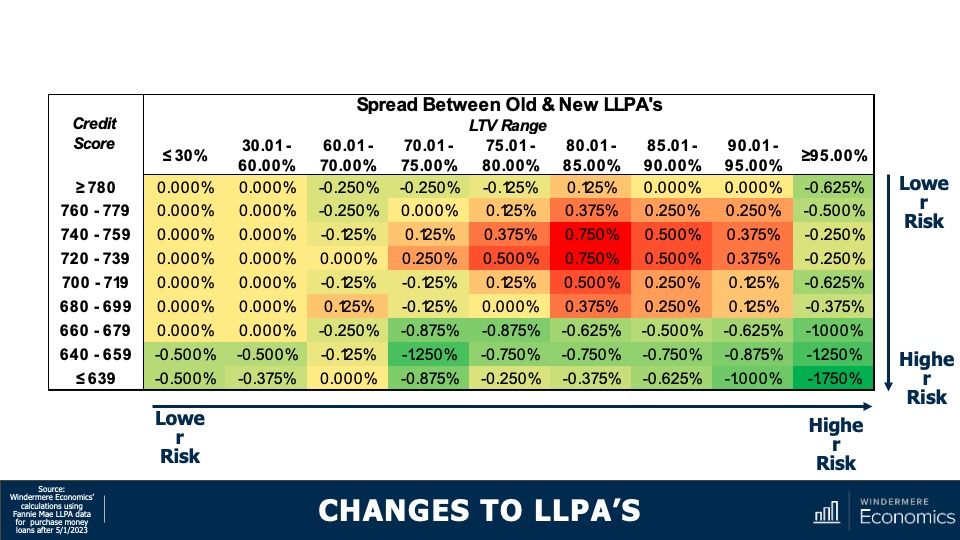
A matrix chart showing the differences between the mortgage fee loan level price adjustments that were in place and the FHFA's proposed mortgage fee increases for credit scores ranging from 639 and 780. The matrix chart shows that seemingly, the changes do benefit those with lower credit scores. However, that is misleading.


The matrix you see here shows you the difference between the fee that was in place and the one that was proposed. Remember, this is not the actual fee itself, but the spread between the old and new pricing. And, as you can see, on face value it really does look to benefit borrowers with lower credit scores and penalize households with better credit. For example…

Changes to LLPAs: Credit Score 640 – 659
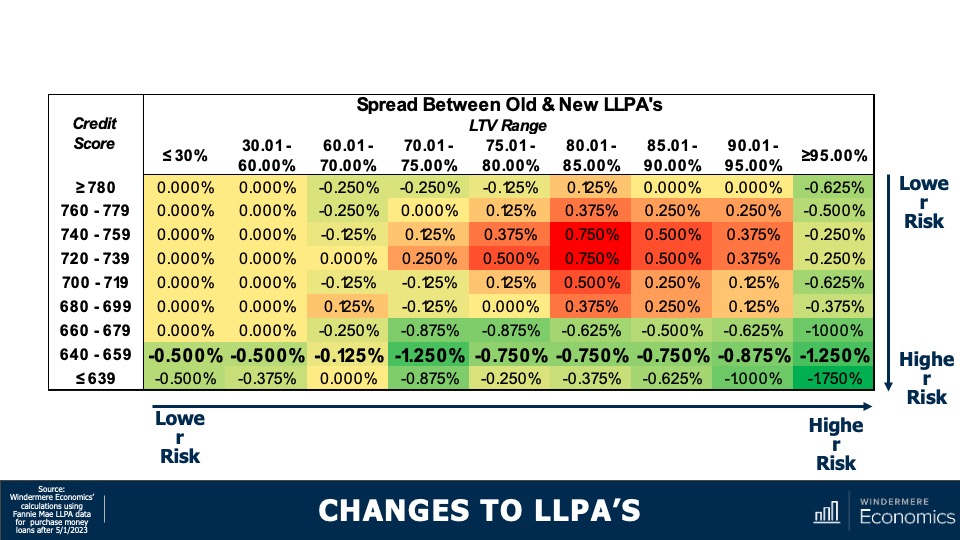
A matrix chart showing the differences between the mortgage fee loan level price adjustments that were in place and the FHFA's proposed mortgage fee increases for credit scores ranging from 639 and 780. The matrix chart shows that a household with a credit score of between 640 and 659 would see savings across all loan-to-value ranges.


A household with a credit score of between 640 and 659 would see savings across all loan-to-value ranges versus the following:

Changes to LLPAs: Credit Score 740 – 759
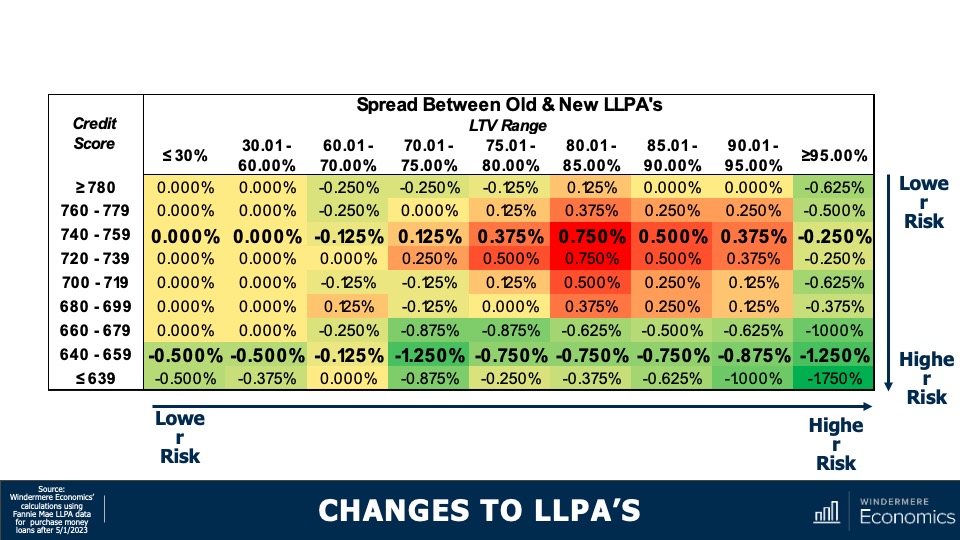
A matrix chart showing the differences between the mortgage fee loan level price adjustments that were in place and the FHFA's proposed mortgage fee increases for credit scores ranging from 639 and 780. The matrix chart shows that a household with a credit rating of 740 to 759 would be paying the same or more in most scenarios with fees increasing between 0.125% and three quarters of a percent.


A household with a credit rating of 740 to 759 who would be paying the same or more in all bar two scenarios with fees increasing between 0.125% and three quarters of a percent.

But is this really something to be worried about?

There are two things that stand out to me. The first is that a household putting down less than 20% has to buy private mortgage insurance. So, in reality, these households are actually less of a risk to the agencies than those who don’t, so isn’t it right that they should pay less in fees? Secondly, although I can’t disagree with anyone who states that families with lower credit will see fees go down and, generally speaking, they will go up for those with better credit, but people are confusing the CHANGE in the fee with the ACTUAL fee itself.

What I am saying is that low credit borrowers aren’t paying less than high credit borrowers. It’s just the spread in the rates between households with lower credit and those with higher credit has simply gotten smaller.

There is absolutely no scenario where someone with lower credit gets a lower fee. Let me show you.

Loan Level Pricing as of March 1, 2023
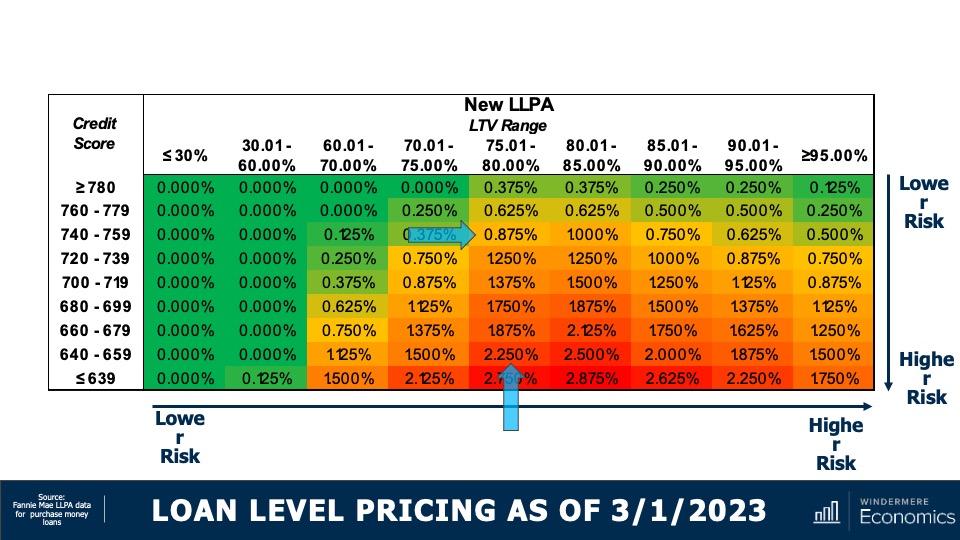
A matrix chart showing the differences between the mortgage fee loan level price adjustments that were in place and the FHFA's proposed mortgage fee increases for credit scores ranging from 639 and 780. The matrix chart shows the following scenario: There are two households wanting to buy houses and they are both looking to borrow 80% of the purchase price. One buyer has a credit score of 640, so their LLPA would be 2.25% of the loan amount or $9,000. The other buyer had a credit score of 740 so their fee would be 0.875%. That means the household with higher credit would be paying $5,500 less than the household with lower credit on a $400k loan.


This was the new pricing schedule had it actually come into effect. Now let’s say there are two households wanting to buy houses for $500,000 and both looking to borrow 80% of the purchase price.

One buyer has a credit score of 640, so their LLPA would be 2.25% of the loan amount, or $9,000. The other buyer had a credit score of 740 so their fee would be 0.875%. That means the household with higher credit would be paying $5,500 less than the household with lower credit on a $400k loan.

No one is arguing that households with lower credit scores would have paid less in upfront fees, but I actually don’t see a problem with that. Remember, Fannie and Freddie’s mission is, in part, to facilitate access to affordable housing. Moreover, these fees don’t even apply to non-conforming or jumbo loans and they don’t impact FHA or VA loans either.

Although I certainly don’t know where the FHFA will end up regarding fee changes, they will have to do something at some point. I just hope that any modified plan is presented in a way that fully describes the situation and isn’t one that’s able to be interpreted in a manner which allows for headlines that don’t describe the full picture.

As always, I’d love to hear your thoughts on this subject but, in the meantime, stay safe out there and I’ll see you all next month. Bye now.

To see the latest housing data for your area, visit our quarterly Market Updates page.


About Matthew Gardner

As Chief Economist for Windermere Real Estate, Matthew Gardner is responsible for analyzing and interpreting economic data and its impact on the real estate market on both a local and national level. Matthew has over 30 years of professional experience both in the U.S. and U.K.

In addition to his day-to-day responsibilities, Matthew sits on the Washington State Governors Council of Economic Advisors; chairs the Board of Trustees at the Washington Center for Real Estate Research at the University of Washington; and is an Advisory Board Member at the Runstad Center for Real Estate Studies at the University of Washington where he also lectures in real estate economics.


Article originally appears on windermere.com

10 Costs Associated with Selling Your Home on Whidbey Island

Contributed by Si Fisher

Are you considering selling your home or property on Whidbey Island? It's essential to understand the costs associated with selling your home before you list it. Here at Windermere Whidbey, we are experts in helping people sell their homes in the Whidbey Island area, including Langley, Clinton, Freeland, Greenbank, Coupeville, and Oak Harbor. In this article, we will go over the costs associated with selling a home on Whidbey Island and provide you with valuable information to help you make informed decisions.


1. Brokerage Fees

Business Agreement Whidbey Island Real Estate

One of the costs when selling a home is the compensation paid to your real estate agent. The compensation rate is most commonly a percentage of the sale price of the home, but this rate may vary depending on the real estate agent you work with. At Windermere Whidbey, we offer the highest quality in professional services, and our experienced agents will guide you through the entire process of selling your home.


2. Closing Costs

Whidbey Island Selling a Home Closing Costs

Closing costs are fees associated with the closing of your home sale. These fees may include title insurance, escrow fees, appraisal fees, and attorney fees. Closing costs can add up to 2-3% of the sale price of your home.


3. Home Repairs and Maintenance

Whidbey Island Home Repairs Costs

Before listing your home, it's essential to make necessary repairs and do some maintenance to increase the value of your home. Some repairs may include fixing plumbing or electrical issues, updating appliances, or painting. These repairs can cost anywhere from a few hundred dollars to several thousand dollars, depending on the extent of the repairs needed.  Find an experienced real estate agent in your market who can advise you on the repairs that are going to net you the best return on investment and that will help get your home sold in your preferred timeline.


4. Home Staging and Cleaning

Whidbey Island Home Staging and Cleaning Costs

A well-staged and clean home can significantly increase the chances of selling your home quickly and at a higher price. Professional home staging services can cost anywhere from $500 to $5,000. Professional cleaning services can cost between $100 to $500, depending on the size of your home.  A local Windermere Whidbey broker can easily setup a consultation with their preferred stagers on the island.


5. Home Inspection

Whidbey Island Home Inspection Costs

A pre-inspection of your home is something you may want to consider having done before listing your home to identify any issues that need to be fixed before the sale. Having this done can prevent any major surprises during a transaction that may cause it to fail or put you at a disadvantage in negotiations.  If you have a sale fail, it can be damaging to the value of your home and effect your preferred sale timelines.   A home inspection can cost anywhere from $400 to $1,000, depending on the size of your home, and any ancillary services that potentially need to be added.  Typically the standard "Full Home Inspection" packages are sufficient as a prelisting inspection and range from $400-500 for most homes.


6. Property Taxes

Whidbey Island Property Taxes

Property taxes are typically paid through the end of the year, and you may be required to pay a prorated amount for the time you owned the home during the year. Property taxes can be up to 1% of the sale price of your home.


7. Capital Gains Tax

Whidbey Island Capital Gains

If your home has increased in value since you purchased it, you may be required to pay capital gains tax. However, if you have lived in the home for at least two of the past five years, you may be exempt from paying capital gains tax up to $250,000 if you are single and $500,000 if you are married.


8. Moving Costs

Whidbey Island Moving Costs

Moving costs can add up quickly, especially if you are moving to a new city or state. The cost of moving depends on several factors, including the distance, the size of your home, and the amount of belongings you need to move.


9. Homeowner Association Fees
home owners association fees whidbey island

If you live in a community with a homeowner association, you may be required to pay fees associated with selling your home, such as transfer fees or disclosure fees.   Depending on the transaction negotiations you may be on the hook for paying off any levied assessment fees, and in rare cases contributing to pending assessments projected costs as well.  It's important to work with a local broker who will not only help you navigate these concerns prior to listing, but also negotiate on your behalf once your property is under contract.


10. Miscellaneous Fees

Whidbey Island Miscellaneous Fees

In addition to the fees mentioned above, you may also encounter other fees associated with selling your home on Whidbey Island, such as home warranty fees or home inspection repair costs. It's important to budget for these additional fees to avoid any unexpected expenses during the home selling process.

Septic and well inspections are two other things that often are important to look at especially on Whidbey Island.  These can be conducted prior to listing giving you an opportunity to make any corrections needed, paving the way for a smooth transaction and allowing you to attract the largest buyer pool.  If you opt not to have these done prior to listing it may cause bumps in the road leading to a sale fail, or a disadvantaged position during negotiations.  An experienced local broker is going to be your best advisor on these matters when making an informed decision on how to proceed.

Another aspect that shouldn't be overlooked is the importance of curb appeal. The first impression that your home makes on potential buyers is crucial, and the exterior of your home plays a significant role in that impression. A well-maintained and aesthetically pleasing landscape can significantly increase the value of your home and attract potential buyers.

However, landscaping costs can vary widely depending on the size of your yard and the amount of work required. Some landscaping costs may include lawn care, tree trimming, mulching, and planting flowers. It's important to budget for these costs to ensure that your home looks its best and stands out from the competition.

At Windermere Whidbey, we understand the importance of presenting your home in the best possible light. Our experienced agents can provide you with valuable advice on how to improve your home's curb appeal and maximize its value. Contact us today to schedule a consultation with a Whidbey Island specialist and start the process of selling your home with confidence.


Contact a Windermere Whidbey Real Estate Agent Today

Windermere Whidbey is a full-service real estate company with over 50 years of experience in the Washington real estate market. We have a team of experienced real estate agents who can help you sell your home for the best possible price. Contact us today to learn more about our services and how we can help you sell your home.

Article contributed by:

Contact a local expert to get expert advice about selling your home

Q1 2023 Western Washington Real Estate Market Update

Download the printable PDF by clicking this link!

The following analysis of select counties of the Western Washington real estate market is provided by Windermere Real Estate Chief Economist Matthew Gardner. We hope that this information may assist you with making better-informed real estate decisions. For further information about the housing market in your area, please don’t hesitate to contact your Windermere Real Estate agent.


Regional Economic Overview

The pace of employment growth in Western Washington continues to slow. The region added only 90,340 new jobs over the past 12 months. That said, the annual pace of employment growth was a respectable 3.6%. Three counties have not recovered completely from their pandemic job losses: Whatcom, Skagit, and Snohomish. However they are short by just under 10,000 jobs, which should be recovered by this fall. Regionally, the unemployment rate in February was 4.1%, which was marginally above the 3.8% level of a year ago. The employment outlook has improved modestly, with the likelihood of a recession in 2023 down to about 50%. That said, I expect the pace of job growth to continue to slow as businesses remain concerned about a contraction in consumer spending, as well as facing tighter credit conditions following recent bank failures.

Western Washington Home Sales

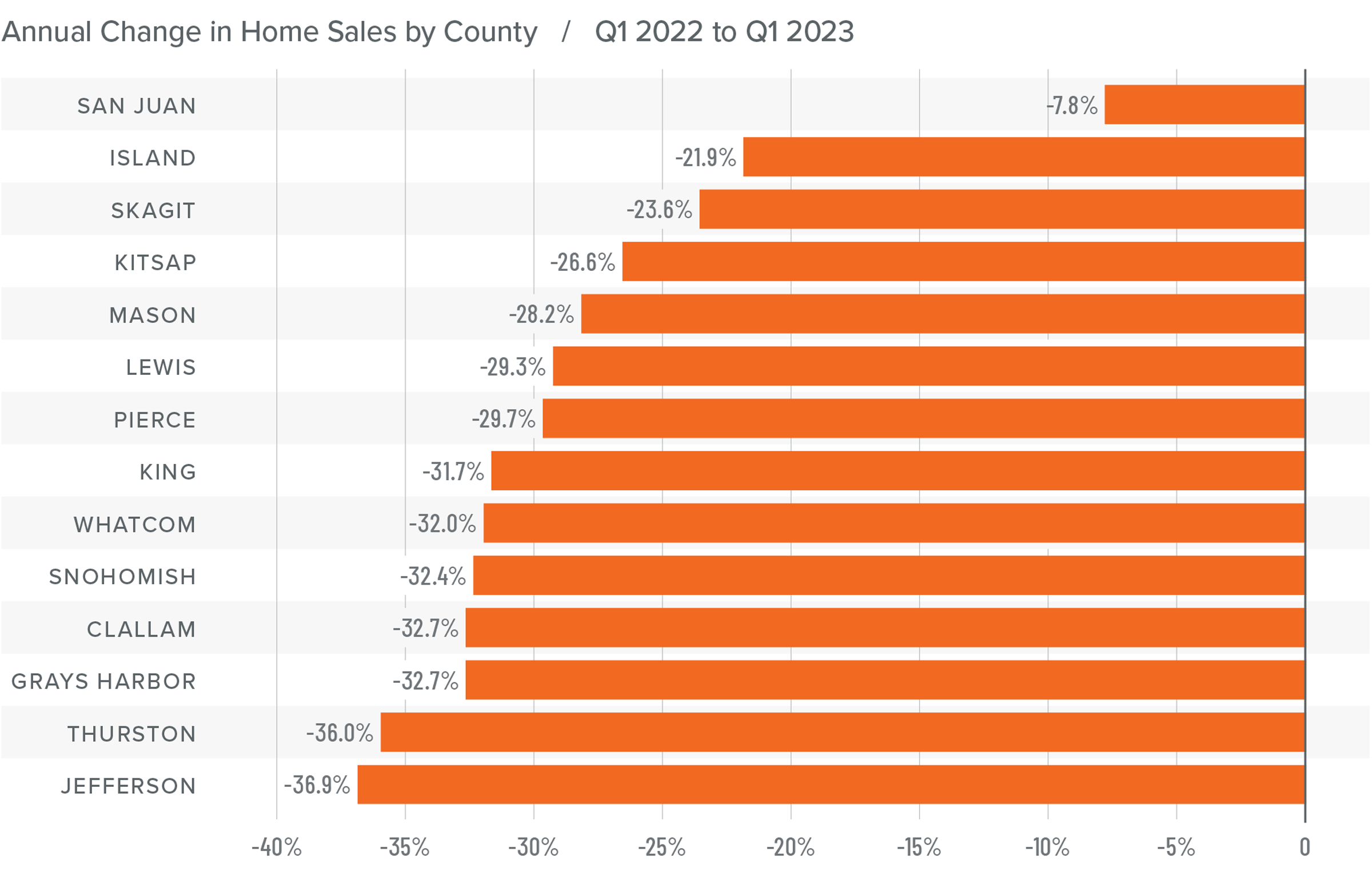
❱ In the first quarter of the year, 10,335 homes sold. This was down 30.9% from the same period in 2022 and 18.9% lower than in the fourth quarter of 2022.

❱ Lower sales activity was more a function of the limited number of homes for sale than anything else. Listing activity in the first quarter of 2023 was down 43% from the final quarter of 2022.

❱ Home sales fell across the board compared to the same quarter of last year and were lower in every county compared to the final quarter of 2022.

❱ Pending sales rose in all but three counties compared to the fourth quarter of 2022. This suggests that sales in the second quarter of the year may tick higher. That said, the region is in dire need of more inventory.

A bar graph showing the annual change in home sales for various counties in Western Washington from Q1 2022 to Q1 2023. All counties have a negative percentage year-over-year change. Here are the totals: San Juan at -7.8%, Island at -21.9%, Skagit -23.6%, Kitsap -26.6%, Mason -28.2%, Lewis -29.3%, Pierce -29.7%, King -31.7%, Whatcom -32%, Snohomish -32.4%, Clallam and Grays Harbor -32.7%, Thurston -36%, and Jefferson -36.9%.

Western Washington Home Prices

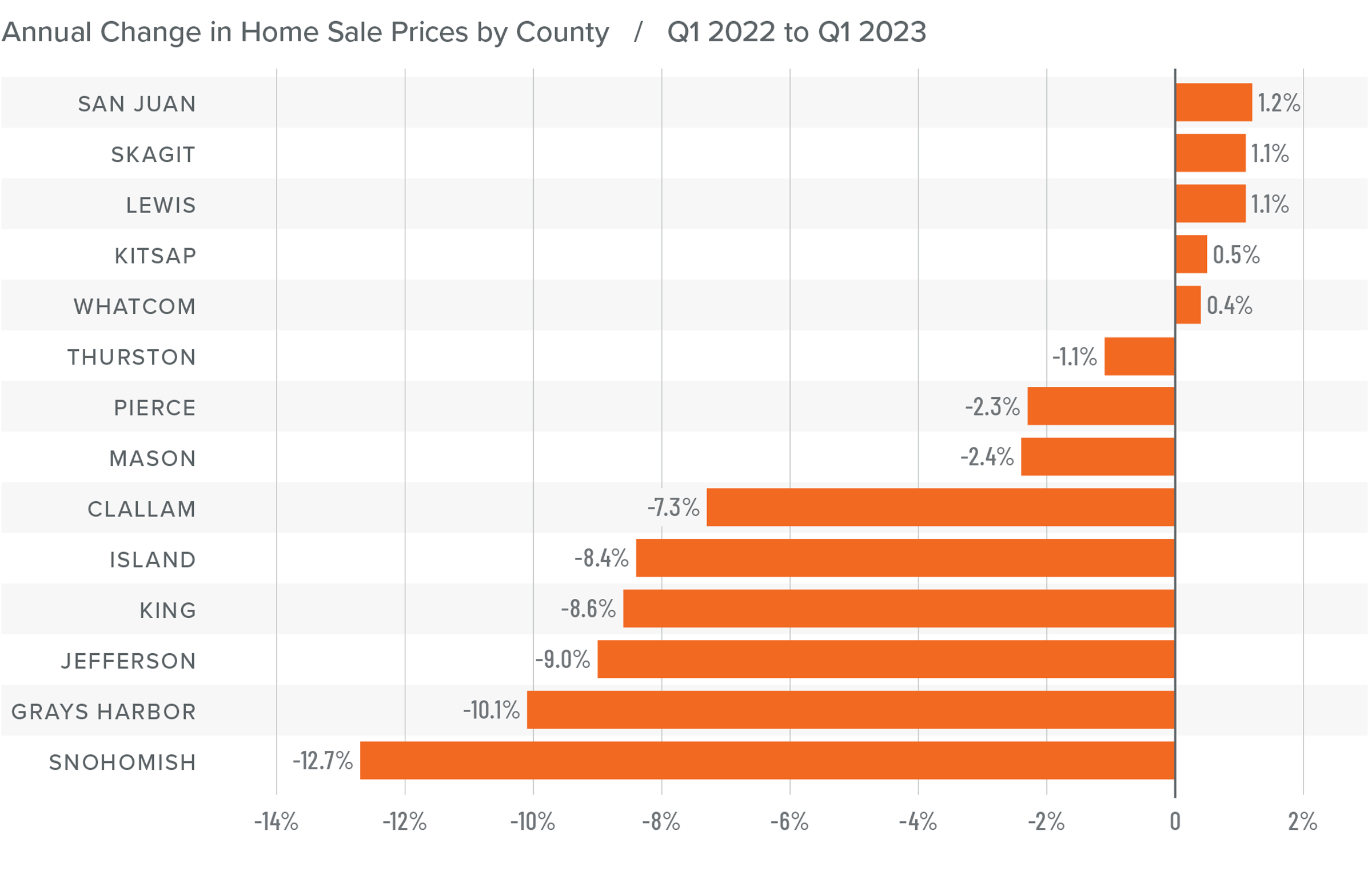
❱ Home prices fell an average of 6.9% compared to the first quarter of 2022 and were 1.3% lower than in the fourth quarter of 2022. The average home sale price in the first quarter of 2023 was $692,866.

❱ Compared to the fourth quarter of 2022, prices were higher in Kitsap, Skagit, Lewis, San Juan, and Whatcom counties.

❱ Even though prices fell in the region, five counties saw sale prices rise very modestly from the first quarter of 2023.

❱ It’s worth noting that median listing prices rose in all but two markets compared to the previous quarter. This suggests that sellers are getting a little more comfortable with the market. If listing prices continue to rise, one can surmise that home prices will follow suit.

A map showing the real estate home prices percentage changes for various counties in Western Washington. Different colors correspond to different tiers of percentage change. Grays Harbor and Snohomish Counties have a percentage change in the -12.7% to -9.5% range, Clallam, Jefferson, Island, and King counties are in the -9.4% to -6.2% change range, Whatcom, Mason, Thurston, and Pierce are in the -2.8% to 0.4% change range, and Lewis, San Juan, and Skagit counties are in the 0.5%+ change range.

A bar graph showing the annual change in home sale prices for various counties in Western Washington from Q1 2022 to Q1 2023. San Juan County tops the list at 1.2%, followed by Skagit and Lewis at 1.1%, Kitsap at 0.5%, Whatcom at 0.4%, Thurston at 1.1%, Pierce at -2.3%, Mason at -2.4%, Clallam at -7.3%, Island at -8.4%, King at -8.6%, Jefferson at -9%, Grays Harbor at -10.1%, and finally Snohomish at -12.7%.

Mortgage Rates

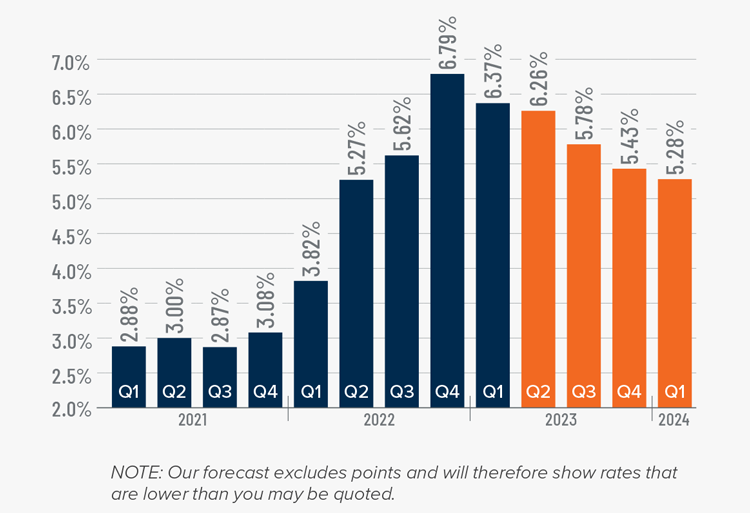
Rates in the first quarter of 2023 were far less volatile than last year, even with the brief but significant impact of early March’s banking crisis. It appears that buyers are jumping in when rates dip, which was the case in mid-January and again in early February.

Even with the March Consumer Price Index report showing inflation slowing, I still expect the Federal Reserve to raise short-term rates one more time following their May meeting before pausing rate increases. This should be the catalyst that allows mortgage rates to start trending lower at a more consistent pace than we have seen so far this year. My current forecast is that rates will continue to move lower with occasional spikes, and that they will hold below 6% in the second half of this year.

A bar graph showing the mortgage rates from Q1 2021 to the present, as well as Matthew Gardner's forecasted mortgage rates through Q1 2024. After the 6.79% figure in Q4 2022 and 6.37% in Q1 2023, he forecasts mortgage rates dipping to 6.26% in Q2 2023, 5.78% in Q3 2023, 5.43% in Q4 2023, and 5.28% in Q1 2024.

Western Washington Days on Market

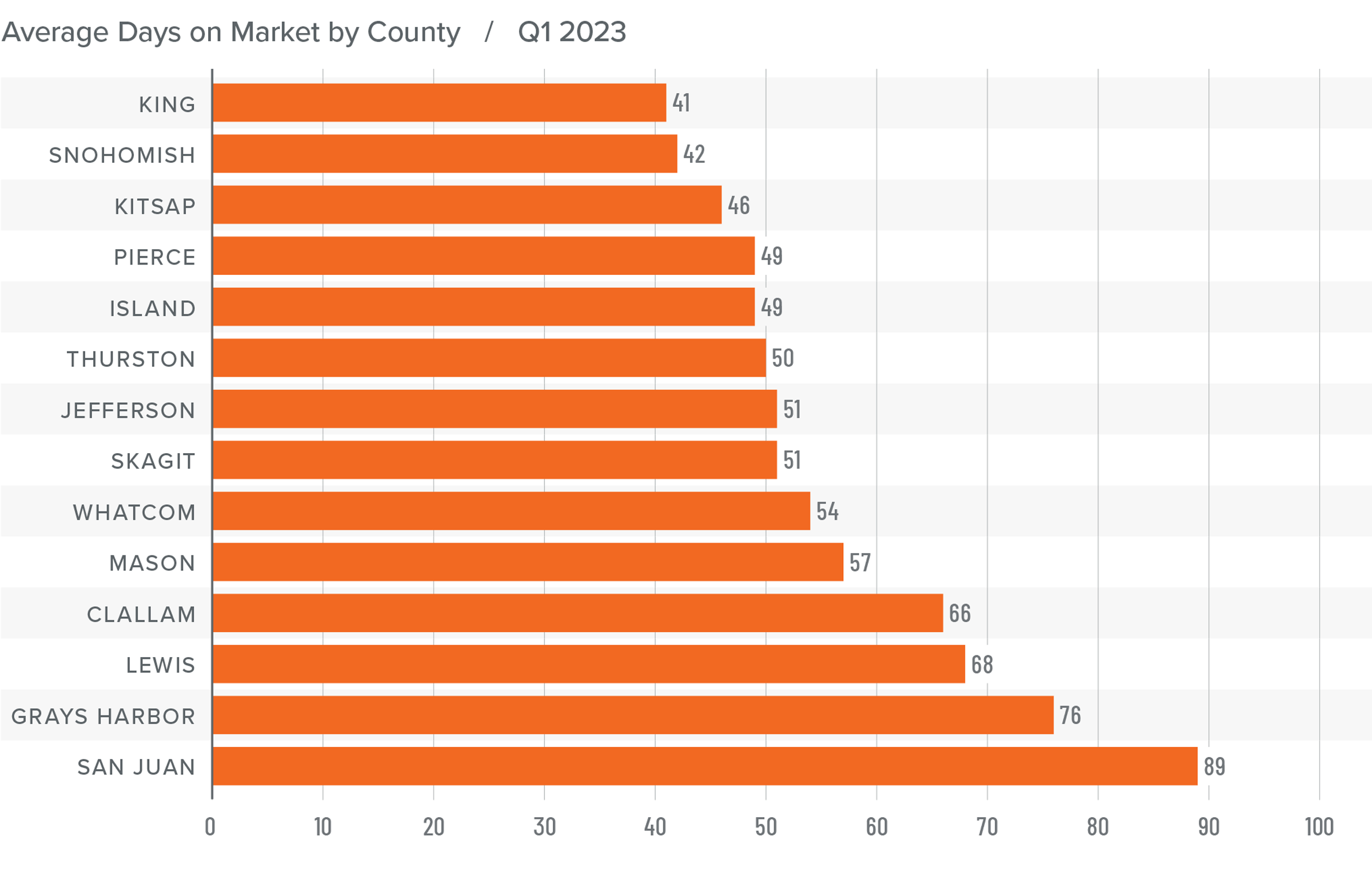
❱ It took an average of 56 days for a home to sell in the first quarter of this year. This was 32 more days than in the same quarter of 2022 and 16 days more than in the fourth quarter of last year.

❱ King County remains the tightest market in Western Washington, with homes taking an average of 41 days to sell. Homes in San Juan County took the longest time to sell.

❱ Market time rose in all counties contained in this report compared to the same period in 2022 and compared to the fourth quarter.

❱ The greatest increase in market time compared to a year ago was in Grays Harbor County, where it took an average of 41 more days for homes to sell. Grays Harbor County also saw the greatest increase in market time compared to the final quarter of 2022 (from 46 to 76 days).

A bar graph showing the average days on market for homes in various counties in Western Washington for Q1 2023. King County has the lowest DOM at 41, followed by Snohomish at 42, Kitsap at 46, Pierce and Island at 49, Thurston at 50, Jefferson and Skagit at 51, Whatcom at 54, Mason at 57, Clallam at 66, Lewis at 68, Grays Harbor at 76, and San Juan at 89.

Conclusions

This speedometer reflects the state of the region’s real estate market using housing inventory, price gains, home sales, interest rates, and larger economic factors.

Although the regional economy is still expanding, it continues to show signs of slowing. With the probability of a national recession this year now fifty-fifty, I do not see any reason for buyers to lose confidence in their housing decisions based purely on economic factors. Sellers appear to be a little more confident in the market as demonstrated by rising listing prices. Periods of lower mortgage rates and the lack of homes for sale are both likely contributors to this. Whatever the case may be, I am not seeing any signs of panic in the market.

A speedometer graph indicating a balanced market, leaning toward a seller's market in Western Washington in Q1 2023.

Even in the face of higher financing costs, low inventory levels support home values, and the data suggests that the worst of the price declines are now behind us. The region had fewer sales, modestly lower prices, and higher average days on market, all of which favor home buyers. However, lower inventory levels, higher pending sales, higher listing prices, and a higher absorption rate of homes that are for sale favor sellers. As such, I am moving the needle towards a balanced market, but one that ever so slightly favors sellers.

About Matthew Gardner

Matthew Gardner - Chief Economist for Windermere Real Estate

As Chief Economist for Windermere Real Estate, Matthew Gardner is responsible for analyzing and interpreting economic data and its impact on the real estate market on both a local and national level. Matthew has over 30 years of professional experience both in the U.S. and U.K.

In addition to his day-to-day responsibilities, Matthew sits on the Washington State Governors Council of Economic Advisors; chairs the Board of Trustees at the Washington Center for Real Estate Research at the University of Washington; and is an Advisory Board Member at the Runstad Center for Real Estate Studies at the University of Washington where he also lectures in real estate economics.