The Continued Decline of the Housing Market Index

This video is the latest in our Monday with Matthew series with Windermere Chief Economist Matthew Gardner. Each month, he analyzes the most up-to-date U.S. housing data to keep you well-informed about what’s going on in the real estate market.


Hello there, I’m Windermere’s Chief Economist Matthew Gardner and welcome to this month’s episode of Monday with Matthew. Today we are going to take a look at the new home market where headwinds are certainly growing. And the reason this particular subject piqued my interest was that the National Association of Home Builders just released their Housing Market Index for August, and the numbers were certainly eye-opening.

Now, for those of you who may not be particularly familiar with this index, it is based on a survey of home builders which asks them to give their opinions on the single-family home market and asks them to rate current market conditions for the sale of homes today as well as in six months’ time. It also asks their opinion regarding foot traffic of prospective buyers to their new home communities.

NAHB Housing Market Index
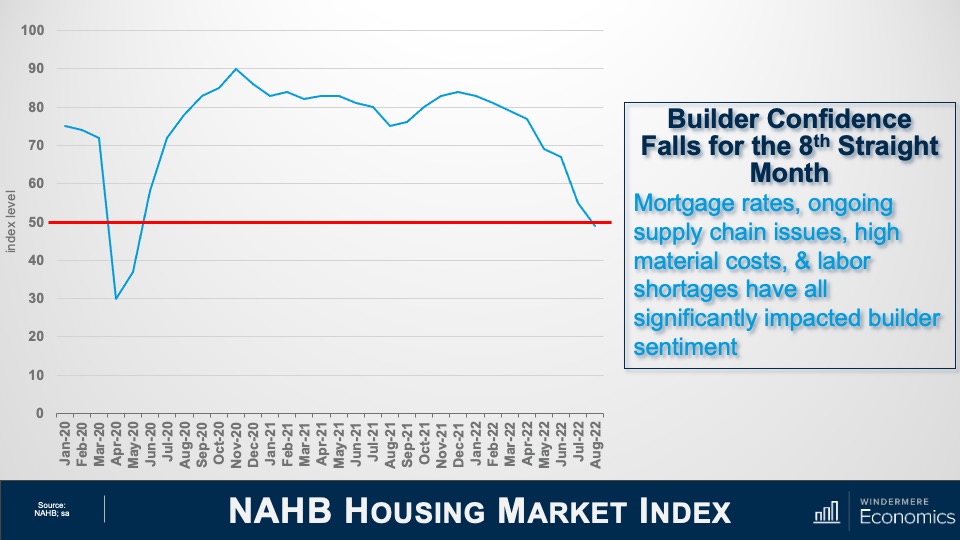
A line graph titled "NAHB Housing Market Index." It shows the falling confidence of U.S. home builder in the Housing Market Index, which measures their perspective of current market conditions for the sale of new homes. The x-axis spans from January 2020 to August 2022. August's figure of 49 represents the eight consecutive drop in the index, and is the first time we've seen a number below 50 since May of 2020.


And as you can see, the headline index level fell six points to 49. The drop in August marked the eighth consecutive monthly decline for the Housing Market Index. It was also notable because it was the first time since May of 2020 that the index has dropped below the key 50 breakeven level. This is significant, as it tells us that today more home builders currently rate sales conditions as poor than good.

Now, while the August number was certainly lower than some economists had forecast, I was actually not too surprised as builders have been reporting a spike in cancelled contracts recently. In fact, a report I just read that was put out by John Burns Consulting suggested that the cancellations have more than doubled since April with 17.6% of buyers pulling out of their purchases in July. That compares to 8% in April and 7 ½% a year ago.

Housing Market Index Components
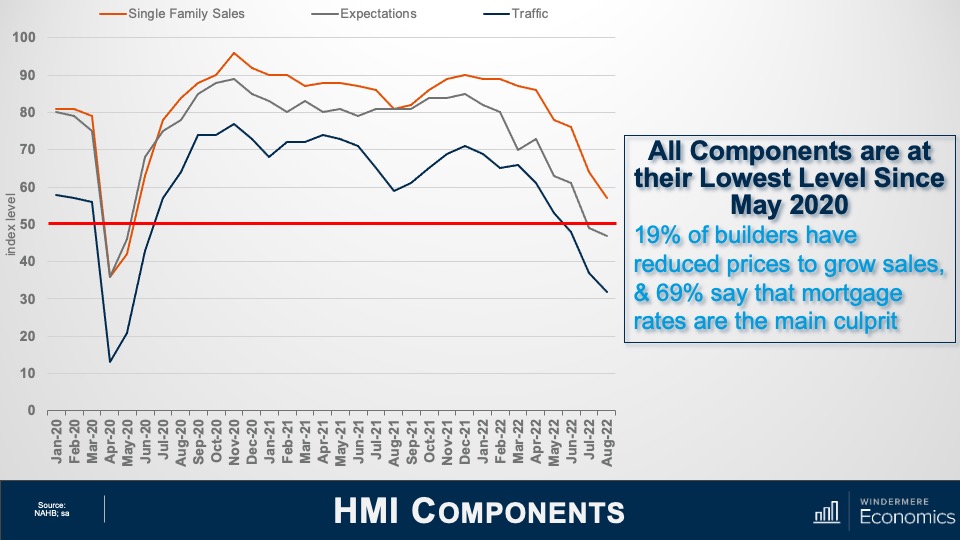
A multi-line graph titled "HMI Components." This chart shows the components behind home builder's falling confidence in the current market, displayed in the Housing Market Index. The three components displayed here are present single-family home sales, expectations (future sales), and traffic. All three are at their lowest levels since May 2020. Of the chart, Matthew Gardner says, "the present sales index fell seven points to 57 but is still above the breakeven point. The future sales series fell two points to 47, while prospective buyer traffic fell five points to 32 which, if we exclude the pandemic, represents the lowest index level since April of 2014."


This chart shows a breakdown of three components of the Housing Market Index which are all at their lowest levels since May of 2020, which was just before housing activity rebounded following the lockdown due to COVID-19.

  • The present sales index fell seven points to 57 but is still above the breakeven point
  • The future sales series fell two points to 47
  • Prospective buyer traffic fell five points to 32 which, if we exclude the pandemic, represents the lowest index level since April of 2014

I find this index has a very strong correlation with new home sales, but I also use it as a pretty reliable leading indicator when it comes to single-family housing starts. I’ll get to that shortly. The survey also stated that one in five builders had reduced prices in August. That might help to explain the 10-point spread between builders’ perception of current versus future sales. But there are limits on home builders’ ability to keep cutting prices in order to support sales. This has become a significant issue because many of them are currently holding a large stock of inventory.

New Homes for Sale
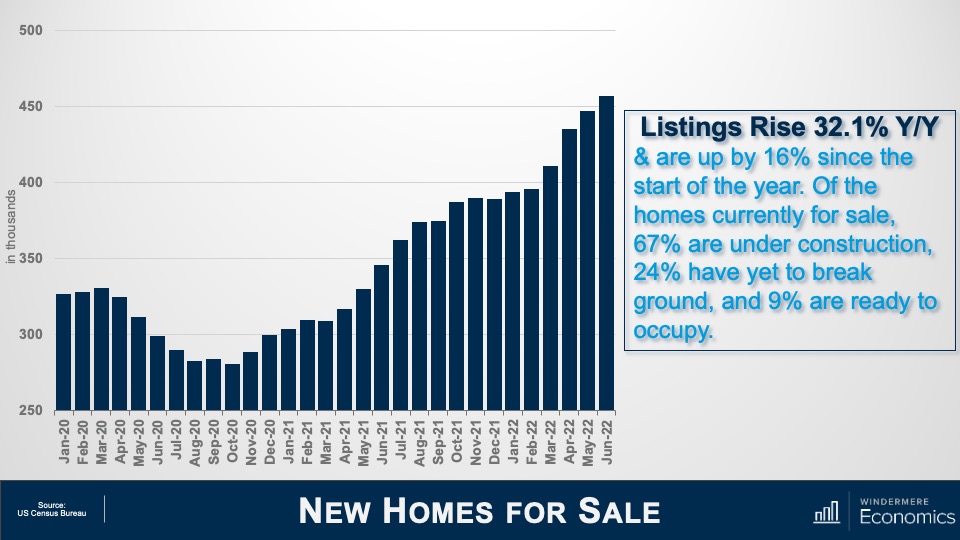
A bar graph titled "New Homes for Sale." It shows inventory levels for the period January 2020 through June 2022. Listings have risen 32.1% year over year, and are up 16% since the start of the year. Of the homes currently for sale, 67% are under construction, 24% have yet to break ground, and 95 are ready to occupy. The y-axis displays the number of new homes for sale in the thousands. June 2022 has the highest value on the chart, with an inventory level just above 450,000.


Here is what current inventory levels look like. Although you might think that it’s not that bad given that only 9% of available homes are finished are ready to move into, I would tell you that builders incur costs every day that a home is not sold, even if that home has yet to be built. And with inventory at a level not seen since 2008, I’m sure there are a lot of builders not sleeping too well right now.

I would add that by the time the above video is released, the July new home sales report will have been published. I can almost guarantee that the number of homes for sale will have grown further.

New Home Sales
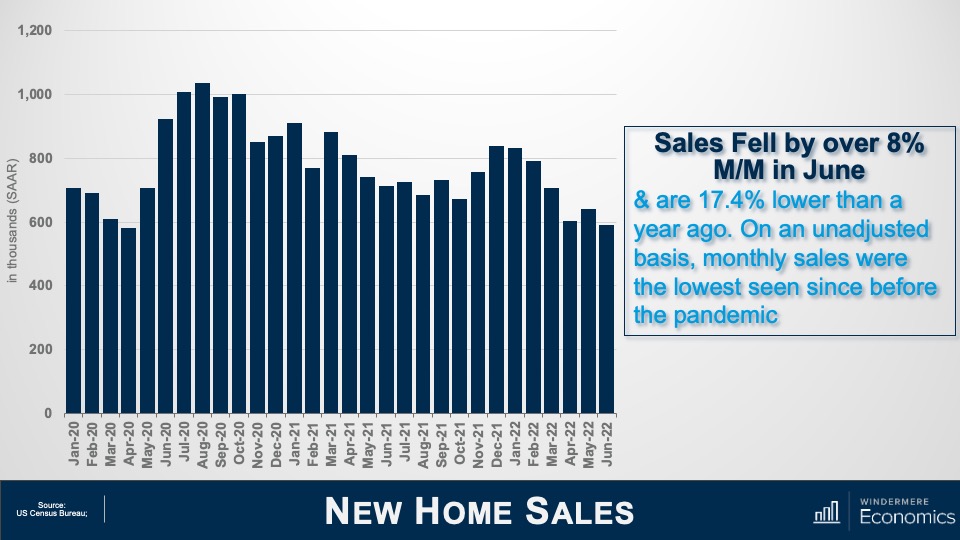
A bar graph titled "New Home Sales." When taken in context of the "New Homes for Sale" chart mentioned earlier in this month's episode, Matthew Gardner is showing a decline in the pace of sales activity. Sales fell by over 8% month over month in June 2022, and are 17.4% lower than a year ago. On an adjusted basis, monthly sales were the lowest seen since before the pandemic.


Higher inventory levels are due to slower sales activity, which is continuing to decline. Sales are 17% lower than a year ago. With more homes for sale and lower transactions, it would now take more than nine months to absorb all available homes using the current sales pace. I would also tell you that the last time months of supply broke above nine was all the way back in 2010.

  • It’s my forecast that sales in July will have dropped from the annualized rate of 590,000 shown in the chart above to somewhere between 570,000 and 580,000.

U.S. Single-Family Housing Starts
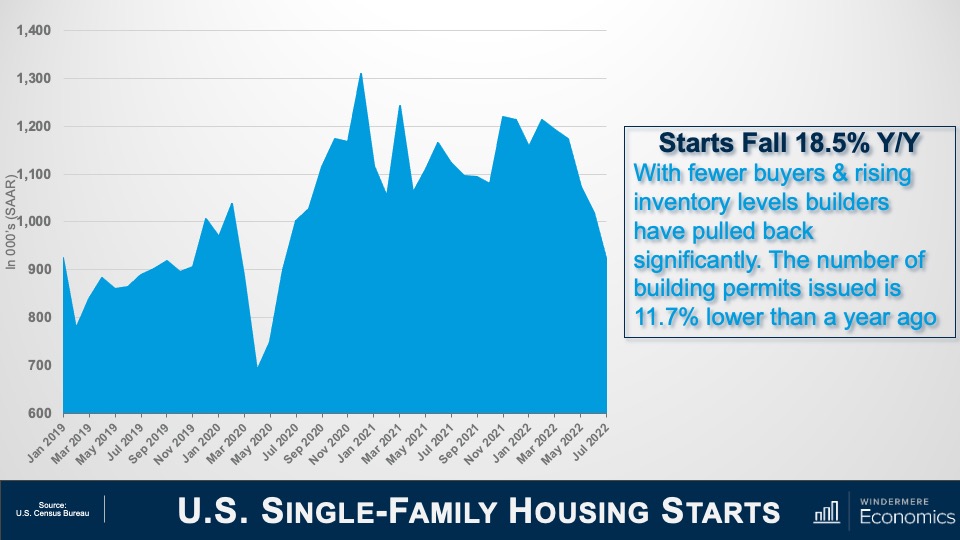
A chart titled "U.S. Single Family Housing Starts." It shows the number of new home starts from January 2019 to July 2022. The most recent figures show starts have fallen 18.5% year over year. As Matthew Gardner explains, "With fewer buyers and rising inventory levels, builders have pulled back significantly. The number of building permits issues is 11.7% lower than a year ago."


With high supply levels and lower sales, it’s not at all surprising to see builders hitting the brakes, with new home starts falling by 10.1% between June and July of this year. Starts are down by 18 ½% from a year ago. Starts have dropped on a sequential basis for five consecutive months now, and I am afraid that they will drop further before finding a bottom.

So, what’s the bottom line here? Well, there are several issues I see, the first of which is affordability. Home prices have been spiraling upward since the start of the pandemic not only because mortgage rates dropped, but construction costs started jumping and builders had to charge more for a home.

Builders saw prices rise by almost 18% last year. This had already taken a significant toll on affordability even before the mortgage rates spike we saw earlier this year. The upshot, as I see it, is that tighter monetary policy from the Fed, in concert with construction costs that remain well above normal levels, has hit builders and hit them hard. Of course, they are doing their best to address the situation by slowing construction activity significantly, but I think that they are going to have a pretty rough time for the next several months.

Ultimately, I see little option for home builders other than lowering prices further, especially now that they are competing with rising inventories in the resale market. I also believe that there are buyers out there waiting patiently on the sidelines for prices to drop in the coming months as they know that builders at some point have to solve the current supply demand imbalance and lowering prices is the easiest way of doing this. Last month the average price drop was 5%, but this is very likely to increase as we move toward the fall.

Will builders get through the situation they find themselves in? I believe that they will. And there are some glimmers of light out there with inflation appearing to be peaking, interest rates are, if not dropping, then certainly stabilizing, and this will help.

Builders also understand that the country has a significant housing shortage. In fact, a recent report published by “Up For Growth” suggested that we have a housing shortage today of around 3.8 million homes. Although this includes rental and ownership housing, some basic math tells me that there is a need today for around 2.5 million new owner-occupied homes. So, light is definitely at the end of the tunnel, but there is a way to go before they get out of it.

And there you have it. I hope that you’ve found my thoughts on this topic of interest. As always, if you have any questions or comments about the current new home environment, please do reach out to me. In the meantime, stay safe out there and I look forward to visiting with you all again next month.

Bye now.


About Matthew Gardner

As Chief Economist for Windermere Real Estate, Matthew Gardner is responsible for analyzing and interpreting economic data and its impact on the real estate market on both a local and national level. Matthew has over 30 years of professional experience both in the U.S. and U.K.

In addition to his day-to-day responsibilities, Matthew sits on the Washington State Governors Council of Economic Advisors; chairs the Board of Trustees at the Washington Center for Real Estate Research at the University of Washington; and is an Advisory Board Member at the Runstad Center for Real Estate Studies at the University of Washington where he also lectures in real estate economics.
2022 Western Washington Real Estate Market Update | Q2


The following analysis of select counties of the Western Washington real estate market is provided by Windermere Real Estate Chief Economist Matthew Gardner. We hope that this information may assist you with making better-informed real estate decisions. For further information about the housing market in your area, please don’t hesitate to contact your Windermere Real Estate agent.

Click here to get the Printable PDF version of the report!

Regional Economic Overview

The most recent employment data (from May) showed that all but 2,800 of the jobs lost during the pandemic have been recovered. More than eight of the counties contained in this report show employment levels higher than they were before COVID-19 hit. The regional unemployment rate fell to 4.5% from 5.2% in March, with total unemployment back to pre-pandemic levels. For the time being, the local economy appears to be in pretty good shape. Though some are suggesting we are about to enter a recession, I am not seeing it in the numbers given rising employment and solid income growth.

Western Washington Home Sales

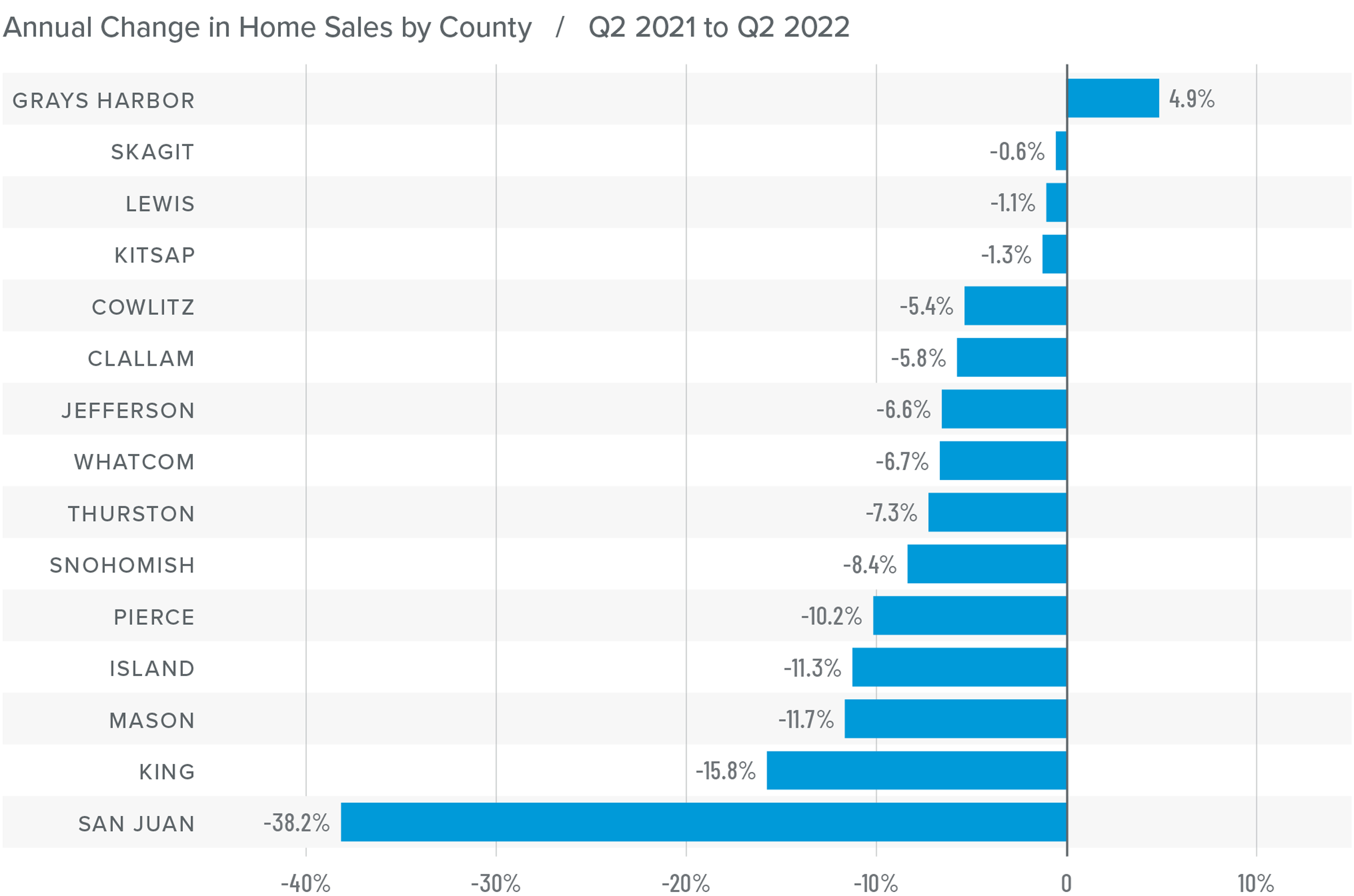
❱ In the second quarter of 2022, 23,005 homes sold, representing a drop of 11% from the same period a year ago, but up by a significant 52% from the first quarter of this year.

❱ Sales rose in Grays Harbor County compared to a year ago but fell across the balance of the region. The spring market, however, was very robust, likely due to growing inventory levels and buyers trying to get ahead of rising mortgage rates.

❱ Second quarter growth in listing activity was palpable: 175% more homes were listed than during the first quarter and 61.98% more than a year ago.

❱ Pending sales outpaced listings by a factor of 3:1. This is down from the prior year but only because of the additional supply that came to market.

A bar graph showing the annual change in home sales for various counties in Western Washington from Q2 2021 to Q2 2022. The only county with a positive percentage year-over-year change is Gray Harbor County at 4.9%. All other counties show a negative year-over-year change Here are the totals: Skagit -0.6%, Lewis -1.1%, Kitsap -1.3%, Cowlitz -5.4%, Clallam -5.8%, Jefferson -6.6%, Whatcom -6.7%, Thurston -7.3%, Snohomish -8.4%, Pierce -10.2%, Island -11.3%, Mason -11.7%, King -15.8%, and San Juan -38.2%.

Western Washington Home Prices

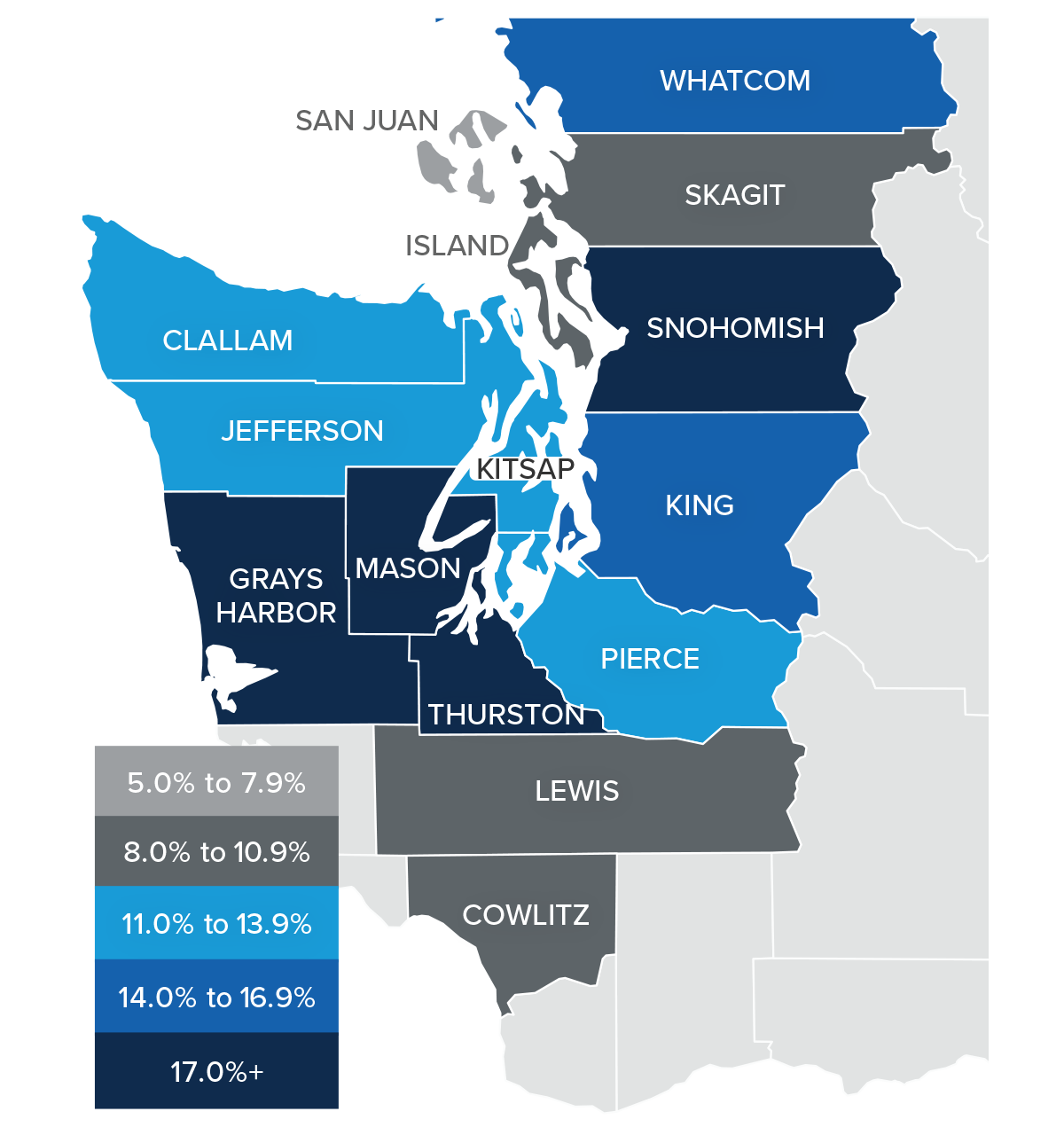
❱ Even in the face of rising mortgage rates, home prices continue to rise at a well-above-average pace, with average prices up 13.3% year over year to $830,941.

❱ I have been watching list prices as they are a leading indicator of the health of the housing market. Thus far, despite rising mortgage rates and inventory levels, sellers remain confident. This is reflected in rising median list prices in all but three counties compared to the previous quarter. They were lower in San Juan, Island, and Jefferson counties.

❱ Prices rose by double digits in all but four counties. Snohomish, Grays Harbor, Mason, and Thurston counties saw significant growth.

❱ List prices and supply are both trending higher, but this has yet to slow price growth significantly. I believe we will see the pace of appreciation start to slow, but not yet.

A map showing the real estate home prices percentage changes for various counties in Western Washington. Different colors correspond to different tiers of percentage change. San Juan County is the only county with a percentage change in the 5% to 7.9% range, Skagit, Lewis, and Cowlitz counties are in the 8% to 10.9% change range, Clallam, Jefferson, Kitsap, and Pierce are in the 11% to 13.9 % change range, King and Whatcom counties are in the 14% to 16.9% change range, and Grays Harbor, Mason, Thurston, and Snohomish counties are in the 17% + range.

A bar graph showing the annual change in home sale prices for various counties in Western Washington from Q2 2021 to Q2 2022. Snohomish county tops the list at 20.6%, followed by Grays Harbor at 18.9%, Mason at 18.4%, Thurston at 17.4%, Whatcom at 16.3%, King at 14.3%, Kitsap at 13.8%, Jefferson at 13.6%, Pierce at 13%, Clallam at 12.7%, Skagit at 10.8%, Lewis at 9.1%, Cowlitz at 8.9%, Island at 8.6%, and finally San Juan at 5.6%.

Mortgage Rates

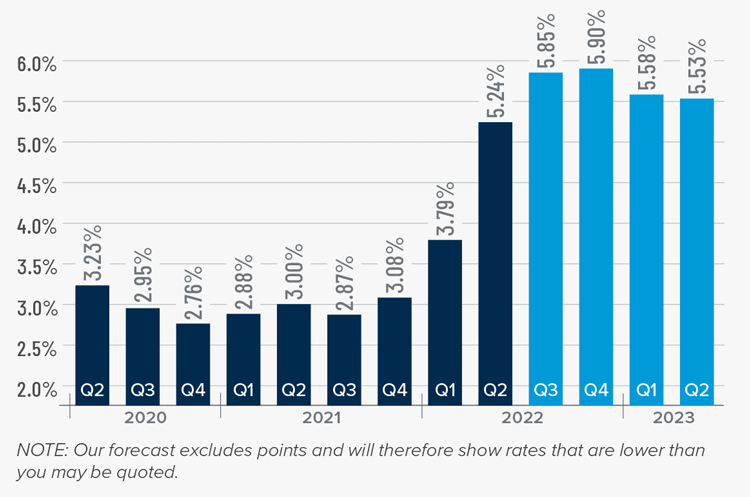
Although mortgage rates did drop in June, the quarterly trend was still moving higher. Inflation—the bane of bonds and, therefore, mortgage rates—has yet to slow, which is putting upward pressure on financing costs.

That said, there are some signs that inflation is starting to soften and if this starts to show in upcoming Consumer Price Index numbers then rates will likely find a ceiling. I am hopeful this will be the case at some point in the third quarter, which is reflected in my forecast.

A bar graph showing the mortgage rates from 2020 to the present, as well as Matthew Gardner's forecasted mortgage rates through Q2 2023. He forecasts mortgage rates continuing to climb to 5.9% in Q4 2022, then tapering off to 5.58% in Q1 2023 and 5.53% in Q2 2023.

Western Washington Days on Market

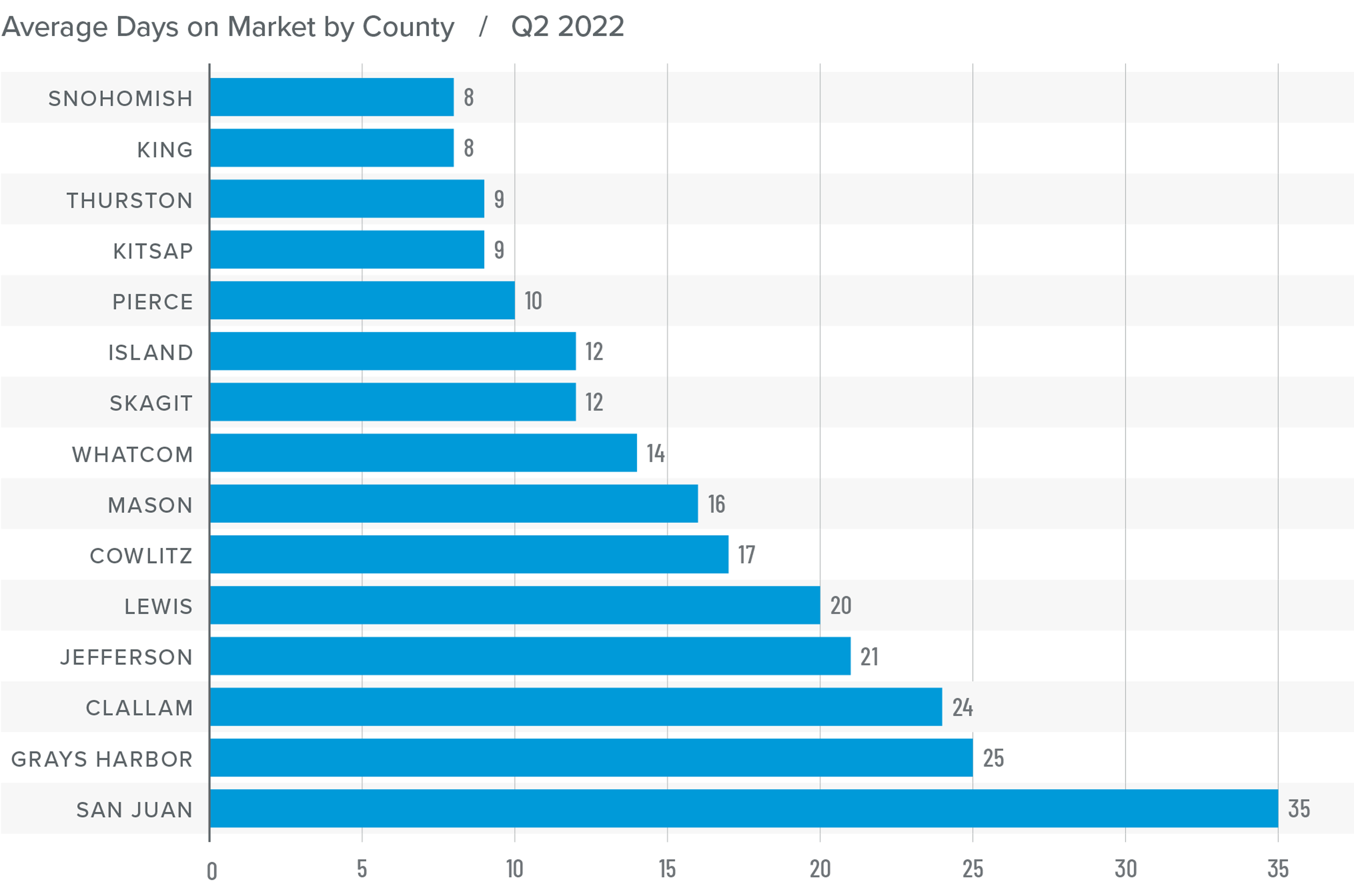
❱ It took an average of 16 days for a home to go pending in the second quarter of the year. This was 2 fewer days than in the same quarter of 2021, and 9 fewer days than in the first quarter.

❱ Snohomish, King, and Pierce counties were, again, the tightest markets in Western Washington, with homes taking an average of between 8 and 10 days to sell. Compared to a year ago, average market time dropped the most in San Juan County, where it took 26 fewer days for a seller to find a buyer.

❱ All but six counties saw average time on market drop from the same period a year ago. The markets where it took longer to sell a home saw the length of time increase only marginally.

❱ Compared to the first quarter of this year, average market time fell across the board. Demand remains very strong.

A bar graph showing the average days on market for homes in various counties in Western Washington for Q2 2022. Snohomish and King counties have the lowest DOM at 8, followed by Thurston and Kitsap at 9, Pierce at 10, Island and Skagit at 12, Whatcom at 14, Mason at 16, Cowlitz at 17, Lewis at 20, Jefferson at 21, Clallam at 24, Grays Harbor at 25, and San Juan at 35.

Conclusions

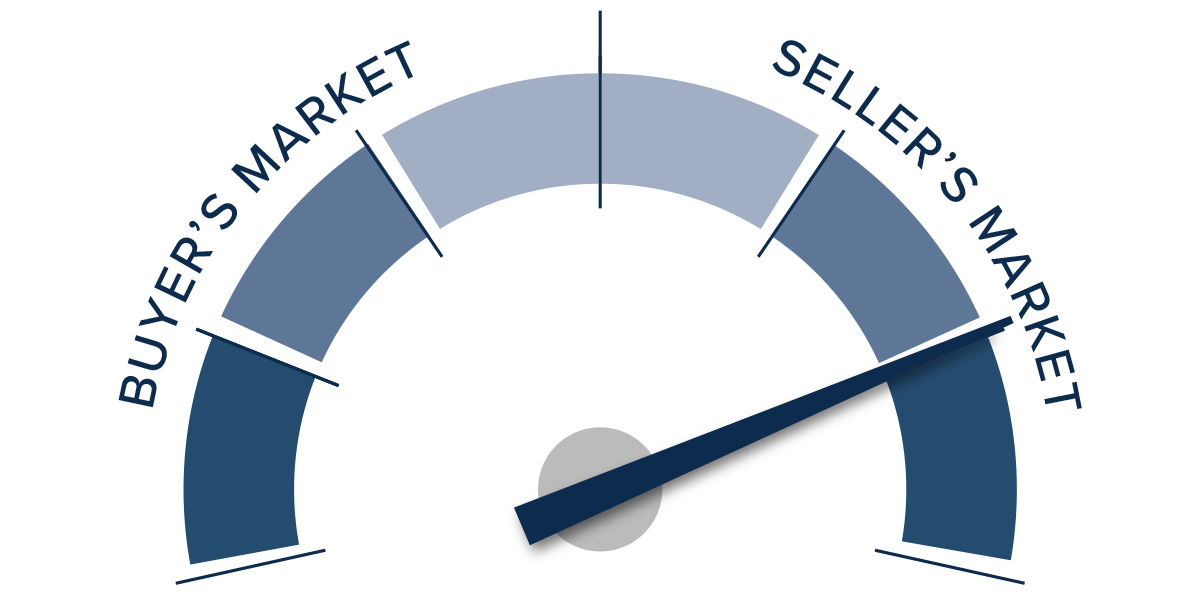
This speedometer reflects the state of the region’s real estate market using housing inventory, price gains, home sales, interest rates, and larger economic factors.

The economy remains buoyant, which is an important factor when it comes to the regional housing market, particularly as it affects buyers. Even though the number of homes that came to market has jumped significantly, which should favor those looking for a new home, demand is still robust, and the market remains competitive.

A speedometer graph indicating a strong seller's market in Western Washington for Q2 2022.

Much to the disappointment of buyers, rising listing prices suggest that sellers are clearly still confident even as financing costs continue to increase. While the pace of price growth is slowing, sellers are still generally in control. As such, I have moved the needle a little more in the direction of sellers. Until we see list-price growth and home sales slow significantly, we will not reach a balanced market.

About Matthew Gardner

Matthew Gardner - Chief Economist for Windermere Real Estate

As Chief Economist for Windermere Real Estate, Matthew Gardner is responsible for analyzing and interpreting economic data and its impact on the real estate market on both a local and national level. Matthew has over 30 years of professional experience both in the U.S. and U.K.

In addition to his day-to-day responsibilities, Matthew sits on the Washington State Governors Council of Economic Advisors; chairs the Board of Trustees at the Washington Center for Real Estate Research at the University of Washington; and is an Advisory Board Member at the Runstad Center for Real Estate Studies at the University of Washington where he also lectures in real estate economics.
The Landscape for Mortgage Rates and Inflation in 2022


This video is the latest in our Monday with Matthew series with Windermere Chief Economist Matthew Gardner. Each month, he analyzes the most up-to-date U.S. housing data to keep you well-informed about what’s going on in the real estate market. 


Hello there, I’m Windermere’s Chief Economist Matthew Gardner and welcome to this month’s episode of Monday with Matthew. You know, one of the many things I love about being an economist is that it is a remarkably humbling profession. You see, just when we start to believe that our models are close to perfection, something comes along to remind us that forecasting isn’t an exact science.

And if you’re wondering what I am talking about, I recently took a look at the 2022 mortgage rate forecast I put out at the start of the year and…well, let’s say that rates rose at a far faster pace than I had anticipated. I thought that now would be a good time to take another look at rates and share my thoughts on the direction that they will likely take during the rest of the year and my reasoning behind it. And that means we need to talk about inflation.

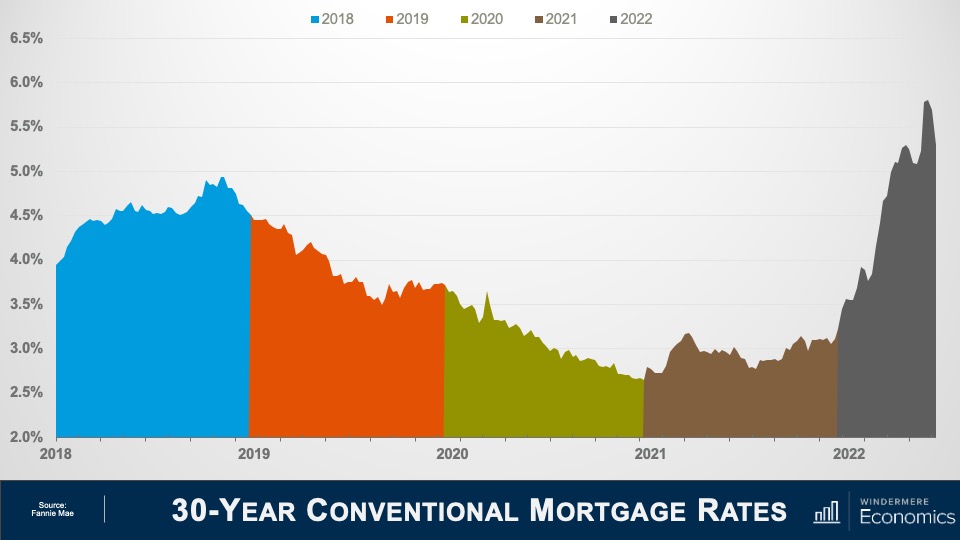
30-Year Conventional Mortgage Rates: 2018 – 2022

A graph showing the 30-year conventional mortgage rates for the years 2018-2022. The curve of the graph creates a sine wave, increasing from roughly 4% to 5% in 2018, dropping to roughly 3.5% by the end of 2019, decreasing further to roughly 2.5% by the end of 2020, coming back up to roughly 3.0% by the end of 2021, and spiking up to over 5.8% in 2022 before dipping slightly.


So, a quick look back. As you can see, there wasn’t much to celebrate in 2018, with rates rising from 3.95% to 4.94% before pulling back and ending the year at around 4.5%. In 2019, rates fell following the Feds’ announcement that they were likely done with raising the Fed Funds Rate, and the mortgage market also reacted positively to the announcement from the White House that they were going to impose tariffs on select Chinese imported goods. We saw an uptick in late summer, but that was mainly due to news related to BREXIT.

In 2020, rates were dropping but spiked very briefly when COVID-19 shut the country down and bond markets panicked. But with the Fed jumping in with an emergency rate cut and announcing that they would start buying a significant number of treasuries and mortgage-backed securities, rates tumbled to an all-time low of just 2.66%. In 2021, rates rose as new COVID infections plummeted, but then dropped again as the Delta variant took hold, but ultimately trended modestly higher in the second half of the year.

And then we get to 2022. Rates started the year at just over 3.1% but have since skyrocketed to over 5.8% before a small pullback that started a few weeks ago. In as much as economists expected rates to rise this year, nobody anticipated how fast they would rise. So, what went wrong? Well, there’s actually a rather simple answer.

Even though we expected rates to trend higher in 2022, there were two things we hadn’t built into our forecast models.

  1. Russia’s invasion of the Ukraine
  2. Inflation continued to climb for far longer than we expected

So, how do things look for the rest of the year? To explain my thinking, it’s important to remember that the bond market and, by implication, mortgage rates hate nothing more than high inflation because when inflation is running hot, it limits demand for bonds which, in turn, forces the interest rate payable on bonds to rise and this pushes mortgage rates higher.

But what’s been fascinating to watch is that over the past couple of weeks, rates have actually been dropping which is certainly counterintuitive given where inflation is today. And the only reason I can see for this is that bond traders were thinking that inflation might be topping out.

But then we got the June CPI numbers, and it certainly didn’t suggest that inflation was slowing, in fact it showed the opposite. But even though the total inflation rate hasn’t yet peaked, I believe that a shift has actually started and that we are closer to a peak in inflation than you may think.

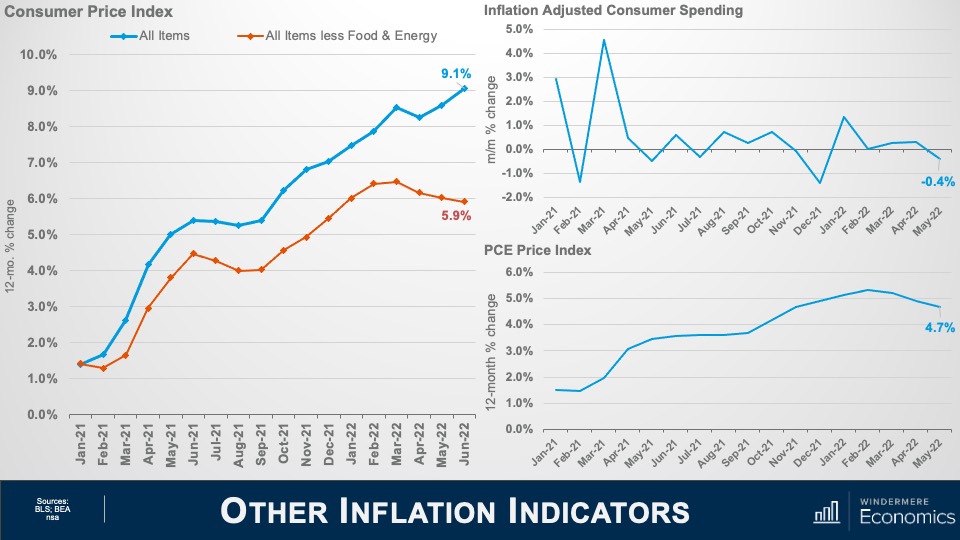
Indicators of Inflation: Consumer Spending

Three line graphs titled "Consumer Price Index," "Inflation Adjusted Consumer Spending," and PCE Price Index. The Consumer Price Index shows year-over-year percentage changes from present day back to January 2021, with two lines showing all items and all items less food and energy. The all items line starts around 1.5% in January 2021, gradually increasing to 9.1% in June 2022, while the all items less food and energy line also starts around 1.5% in January 2021 and undulates to 5.9% in June 2022. The "Inflation Adjusted Consumer Spending" chart shows month-over-month percentage changes from January 2021 to May 2022. The line spikes up and down throughout the first half of 2021, going as high as roughly 4.5% around March 2021 and as low as roughly negative 1.5% in February 2021. The line stabilizes for the remainder of the x-axis, ending at 0.4% in May 2022. The "PCE Price Index" graph shows year-over-year percentage changes from January 2021 to May 2022. The line starts around 1.5% in January 2021, gradually increasing through February 2022 around 5% before tapering to 4.7% in May 2022.


The June CPI report showed the headline inflation rate still trending higher but look at the core rate which excludes the volatile food & energy sectors. That has actually been pulling back for the past three months. And consumer spending when adjusted for inflation fell 0.4% in May. That’s the first monthly drop since last December, and I expect the June number when it comes out at the end of the month to show spending dropping even further.

This is a very important dataset that often gets overlooked but it is starting to tell me that the economy is slowing because of inflation and slower spending acts as a headwind to further price increases.

The core PCE price index is up 4.7% year-over-year, but this was the smallest annual increase since last November and you can see that it is also starting to roll over. This index is actually the Fed’s favored measure of inflation as it’s more comprehensive that the CPI number as it measures the change in spending for all consumers, not just urban households.

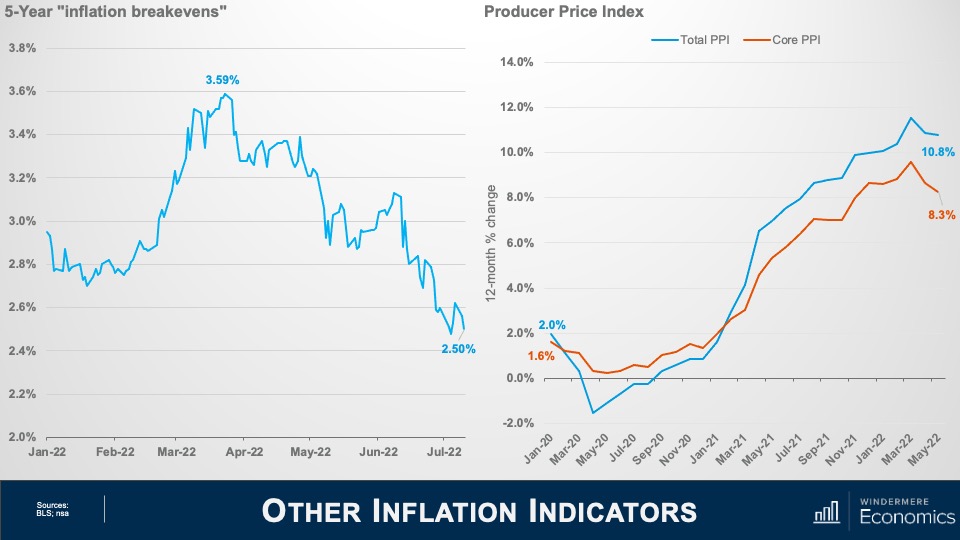
Indicators of Inflation: 5-Year Breakevens and Producer Price Index

Two line graphs titled "5-Year Inflation Breakevens" and "Producer Price Index." The breakevens graph shows percentage changes from January 2022 to July 2022, starting at 3.0% in January 2022, increasing to 3.59% in March 2022, before gradually decreasing to 2.50% in July 2022. The "Producer Price Index" graph shows year-over-year percentage changes from January 2020 to May 2022, with two lines showing Total PPI and Core PPI. Both lines gradually increase along the x-axis, peaking around March 2022. Total PPI increases from 2.0% from 10.8 in May 2022, while core PPI increases from 1.6% to 8.3% over the same time period.


The five-year “inflation breakeven” has plunged more than a full percentage point since peaking at just under 3.6% in late March. And this number is important as it lets us know where bond traders expect the average inflation rate to be over the next five years.

The Producer Price Index measures inflation at the wholesale, not retail, level and even though the total rate rose as energy costs continue to impact the manufacturing sector, the core rate has been pulling back for the past three months. Now let’s look at some commodity prices and see what’s going on there.

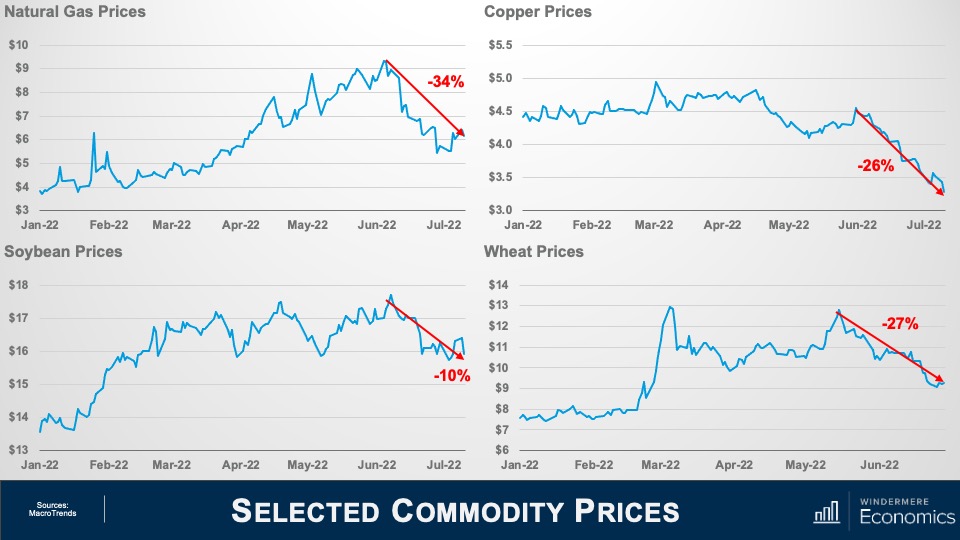
Selected Commodity Prices: Natural Gas, Copper, Soybeans, Wheat

Four line graphs titled "Natural Gas Prices," "Copper Prices," "Soybean Prices," and "Wheat Prices." Natural Gas, Soybean, and Wheat prices all share a similar trend in that they gradually increase from January 2022 to June 2022 before dropping from June to July 2022. Natural gas prices fell by 34% from June to July 2022, while soybean prices fell 10% and wheat prices fell 27% over that same time period. Copper prices are steady from January 2022 to April 2022, before gradually dropping through April and May, then drastically falling 26% from June to July 2022. In summary, prices of all commodities are falling a significant amount over the past month (June to July 2022).


  • The price for natural gas is down over 34% from its recent high
  • Copper prices are down 26% from the recent June peak and down substantially from March
  • Soybean prices are down 10%
  • Despite the war in Ukraine, wheat prices are down 27% from June

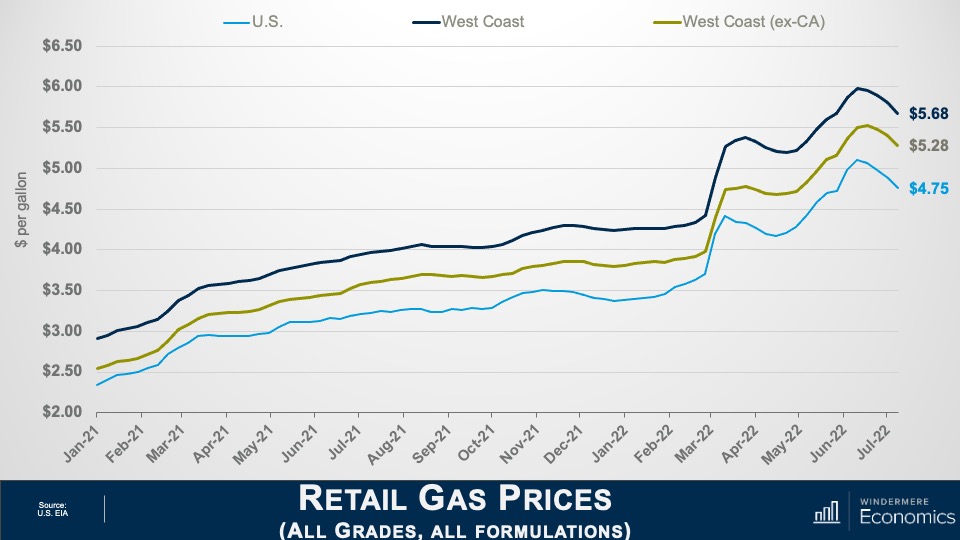
Retail Gas Prices: West Coast, West Coast Excluding CA, U.S.

A line graph titled "Retail Gas Prices" with three lines: U.S., West Coast, and West Coast excluding California. All three lines show increases in price per gallon from January 2021 to July 2022. All three lines peak in June 2022. The West Coast gas prices went from roughly three dollars per gallon to $5.68 per gallon in July 2022, the West Coast excluding California line goes from roughly $2.50 per gallon in January 2021 to $5.28 in July 2022, and the U.S. line goes from just below $2.50 per gallon in January 2021 to $4.75 per gallon in July 2022.


It appears as if gas prices have also rolled over. Of course, here on the West Coast it’s more expensive than the nation even when you take California out of the equation.

U.S. Treasury Yields: 10-Year and 2-Year Constant

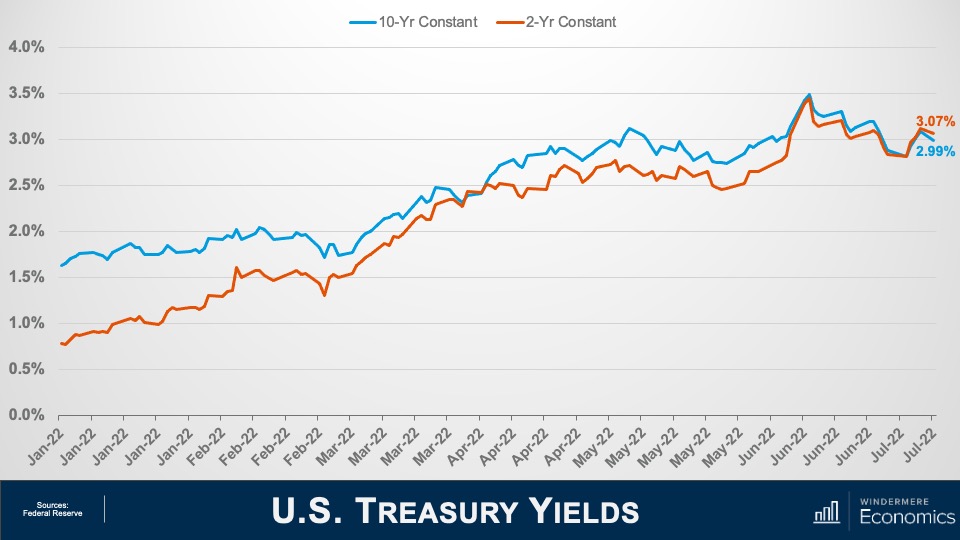
A line graph with two lines showing the U.S. Treasury Yields 10-year constant and 2-year constant from January 2022 to July 2022. The 10-year constant gradually increases over this period of time from 1.5% in January 2022 to 2.99% in July 2022. The 2-year constant gradually increases as well, from roughly 0.75% in January 2022 to 3.07% in July 2022.


And finally, to cap things off, traders must also be pondering the same numbers as I am because bond yields themselves have been tumbling at both the long and short ends of the yield curve with the 10-year note still yielding less than 3% even after the CPI report and two-year yields, while still elevated, are still down from 2.42% just two weeks ago.

So, given all the charts we have looked at, I hope that you too are seeing some light at the end of the tunnel when it comes to the likelihood that inflation is about to start easing.

No doubt, the headline inflation number for June wasn’t one that anyone wanted to see but, if the trends we have looked at continue, I still expect inflation to start slowly creeping lower, which will push bond prices higher, yields will start to pause—if not drop—and that will allow mortgage rates to hold at or close to their current levels for the time being. Although we could see rates coming down, though they will still start with a five for the foreseeable future. I hope that you have found my thoughts of interest.

As always, if you have any questions or comments about this particular topic, please do reach out to me but, in the meantime, stay safe out there. I look forward to visiting with you all again next month.

Bye now.


About Matthew Gardner

As Chief Economist for Windermere Real Estate, Matthew Gardner is responsible for analyzing and interpreting economic data and its impact on the real estate market on both a local and national level. Matthew has over 30 years of professional experience both in the U.S. and U.K.

In addition to his day-to-day responsibilities, Matthew sits on the Washington State Governors Council of Economic Advisors; chairs the Board of Trustees at the Washington Center for Real Estate Research at the University of Washington; and is an Advisory Board Member at the Runstad Center for Real Estate Studies at the University of Washington where he also lectures in real estate economics.