A Whidbey Island Look: Making Sense of the Shifting Western Washington Real Estate Market

Hi, I'm your friendly Whidbey Island real estate specialist. In the world of real estate, having a savvy local expert by your side is like having a lighthouse in a storm—especially now. While economists paint broad strokes about the Western Washington housing market, what's truly happening on our beautiful island? Let's dive into the latest data and translate what it means for you.

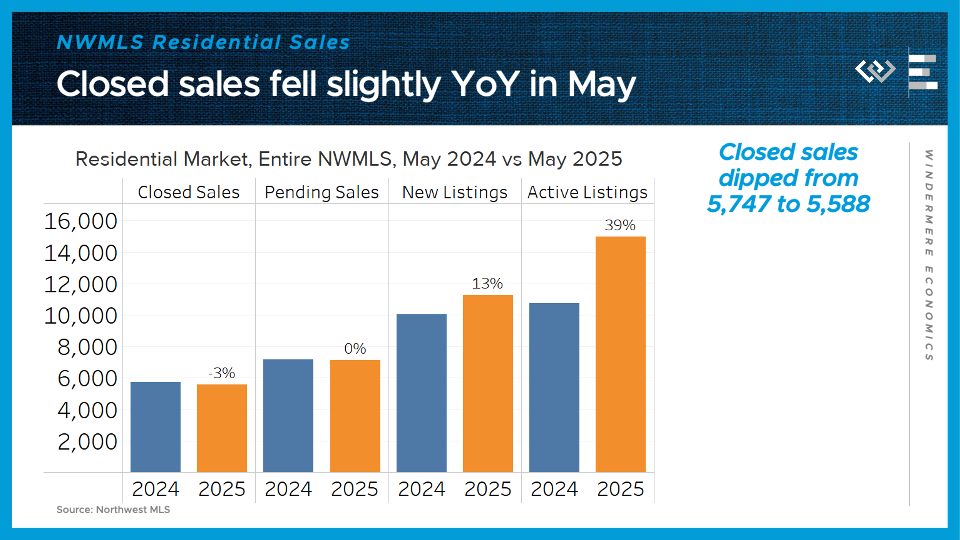
The recent chatter across the real estate world, sparked by Windermere's Chief Economist Jeff Tucker's latest analysis, has been about a market in flux. A pullback in April's pending sales, influenced by stock market jitters and political announcements, led to fewer closed sales in May across the Northwest MLS. But as the stock market found its footing, the housing market is also showing signs of a comeback.

But the big question is: How does the wider regional story translate to the unique Whidbey Island real estate market? Let's look at the key metrics for our local communities.

Windermere Economics Local Look with Jeff Tucker

1. Closed and Pending Sales: A Tale of Two Markets

Across the entire Northwest MLS, closed single-family home sales saw a 3% dip in May compared to last year, a direct echo of April's uncertainty. Pending sales, a more current indicator of buyer demand, flattened out year-over-year after a 4% drop in April, suggesting a rebound.

Here on Whidbey, however, we're marching to the beat of our own drum. While the region is seeing a slight cooling, the island's market is showing resilience. Thinking of buying or selling on the island? Understanding these nuances is key. Partnering with a Whidbey Island Specialist ensures you're not just getting general data, but actionable, hyper-local insights.

Chart showing NWMLS closed sales fell slightly year over year in May

2. Listings & Inventory: More Choices for Whidbey Buyers

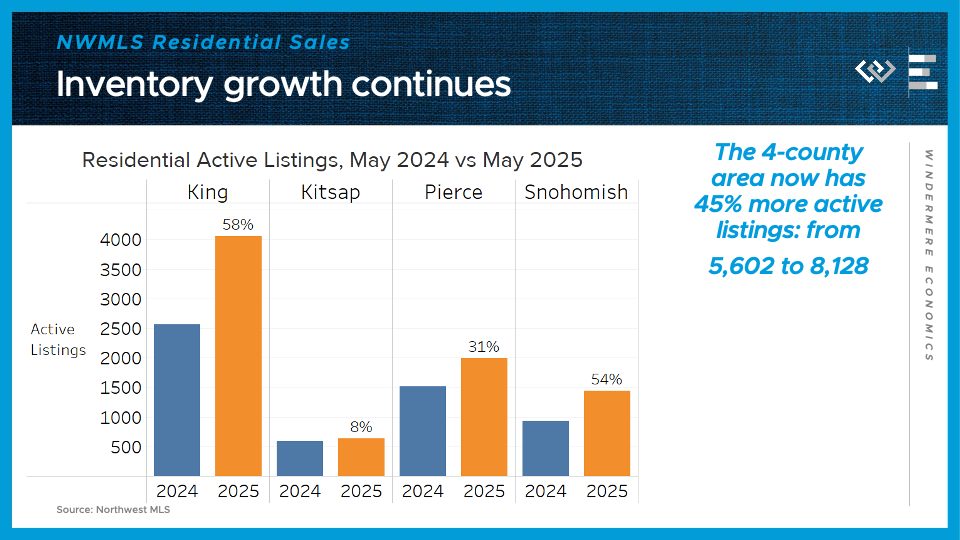
On the supply side, the story for Western Washington is one of significant growth. New listings jumped by 13% across the NWMLS, and active listings ended May a whopping 39% higher than in 2024. This is great news for buyers, who now have the most options they've seen in years.

This trend holds true for the Whidbey Island real estate market. This expanding inventory offers a golden opportunity for buyers to find their perfect island retreat without the intense competition of recent years. For sellers, it means that strategic pricing and presentation, guided by a local expert, are more important than ever.

Chart showing NWMLS inventory growth continues

3. Median Sale Prices: The Whidbey Island Distinction

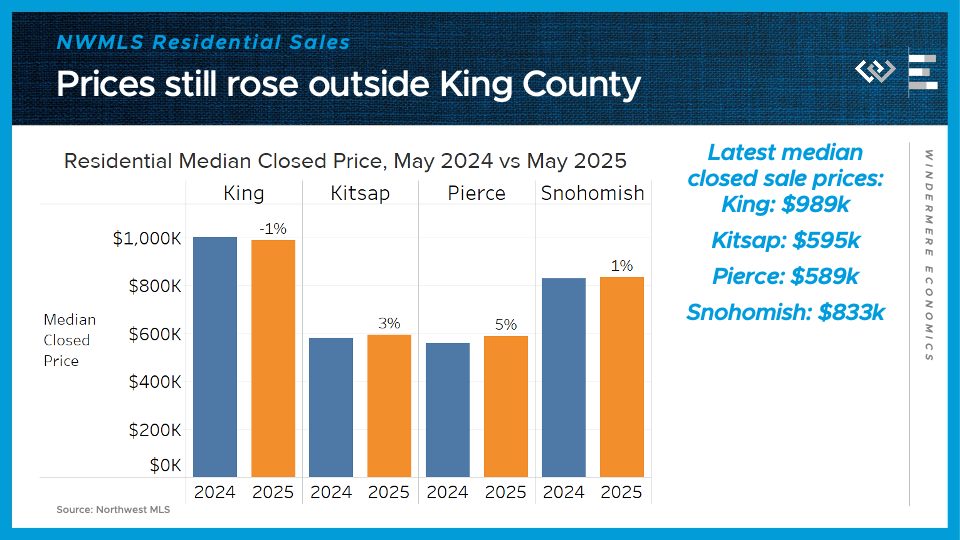
Regionally, the median price for a single-family home slipped by 1% to $677,500, a pause in price appreciation caused by more inventory and cautious buyers. The greater Seattle area saw prices dip slightly, heavily influenced by a 1.2% drop in King County.

But here's where hiring a Whidbey Island Realtor truly pays off. Our local market tells a different, more positive story. Far from declining, our property values are holding strong, demonstrating a continued, robust demand for the island lifestyle.

Chart showing real estate prices still rose outside King County

Putting It All Together for Whidbey Island

While regional reports provide a good map, you need a local guide to navigate the terrain. The Whidbey Island real estate market is proving to be robust and distinct from the broader Western Washington trends. We have growing inventory, which is a significant win for buyers, coupled with strong property values, which is excellent news for sellers.

Economic uncertainty and mortgage rates around 7% are still factors, of course. But the data shows that the dream of island living is alive and well. Buyers have more choices, and sellers can be confident in the enduring value of their investment.

Whether you're looking to sell your property or find your forever home in Langley, Oak Harbor, Coupeville, or anywhere in between, the market holds promise. Let's connect and discuss how these trends create opportunity for you. With a dedicated Whidbey Island Realtor, you'll have the expert partnership you need to achieve your real estate goals with confidence.

2022 Western Washington Real Estate Market Update | Q2


The following analysis of select counties of the Western Washington real estate market is provided by Windermere Real Estate Chief Economist Matthew Gardner. We hope that this information may assist you with making better-informed real estate decisions. For further information about the housing market in your area, please don’t hesitate to contact your Windermere Real Estate agent.

Click here to get the Printable PDF version of the report!

Regional Economic Overview

The most recent employment data (from May) showed that all but 2,800 of the jobs lost during the pandemic have been recovered. More than eight of the counties contained in this report show employment levels higher than they were before COVID-19 hit. The regional unemployment rate fell to 4.5% from 5.2% in March, with total unemployment back to pre-pandemic levels. For the time being, the local economy appears to be in pretty good shape. Though some are suggesting we are about to enter a recession, I am not seeing it in the numbers given rising employment and solid income growth.

Western Washington Home Sales

❱ In the second quarter of 2022, 23,005 homes sold, representing a drop of 11% from the same period a year ago, but up by a significant 52% from the first quarter of this year.

❱ Sales rose in Grays Harbor County compared to a year ago but fell across the balance of the region. The spring market, however, was very robust, likely due to growing inventory levels and buyers trying to get ahead of rising mortgage rates.

❱ Second quarter growth in listing activity was palpable: 175% more homes were listed than during the first quarter and 61.98% more than a year ago.

❱ Pending sales outpaced listings by a factor of 3:1. This is down from the prior year but only because of the additional supply that came to market.
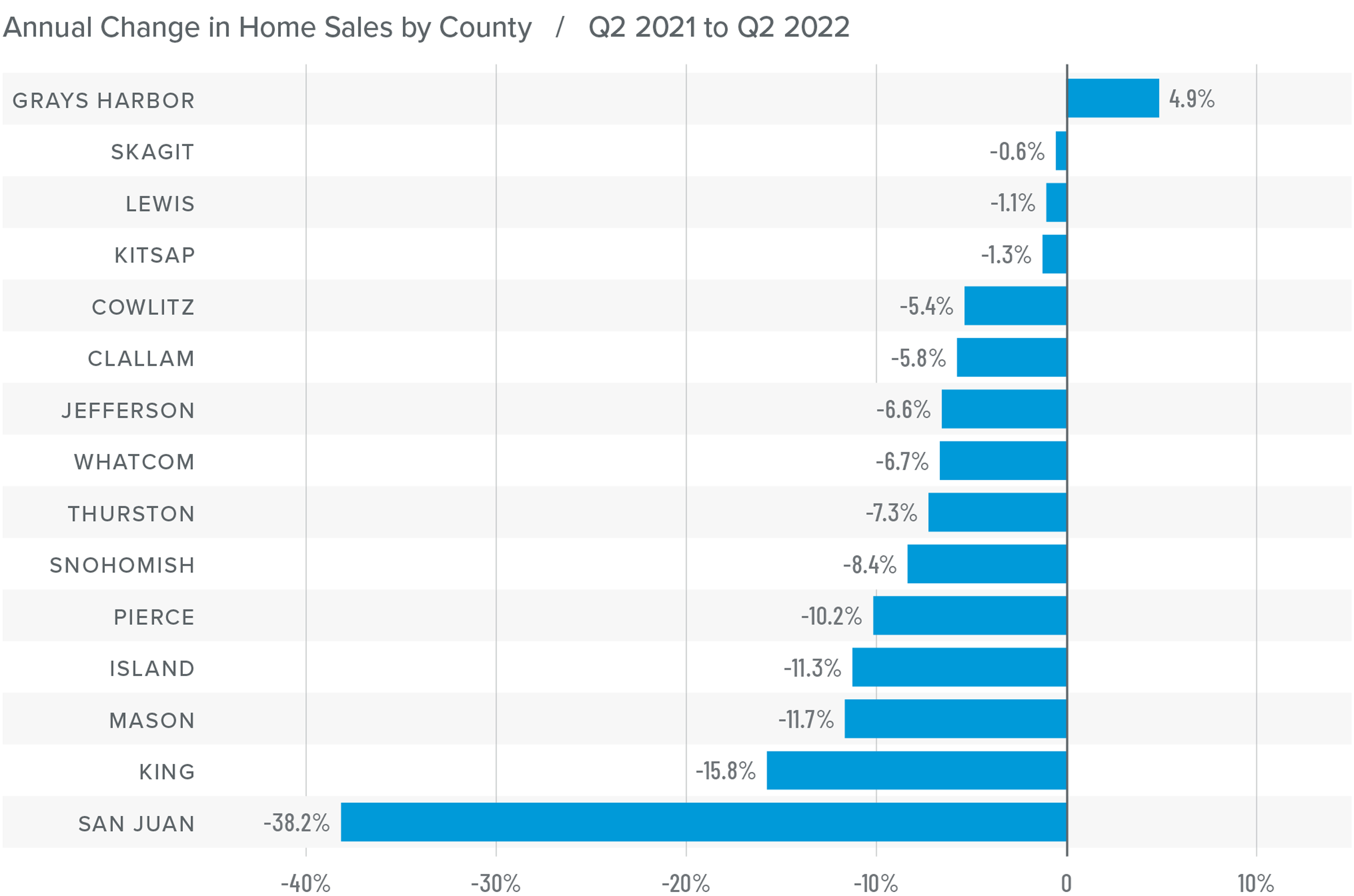
A bar graph showing the annual change in home sales for various counties in Western Washington from Q2 2021 to Q2 2022. The only county with a positive percentage year-over-year change is Gray Harbor County at 4.9%. All other counties show a negative year-over-year change Here are the totals: Skagit -0.6%, Lewis -1.1%, Kitsap -1.3%, Cowlitz -5.4%, Clallam -5.8%, Jefferson -6.6%, Whatcom -6.7%, Thurston -7.3%, Snohomish -8.4%, Pierce -10.2%, Island -11.3%, Mason -11.7%, King -15.8%, and San Juan -38.2%.

Western Washington Home Prices

❱ Even in the face of rising mortgage rates, home prices continue to rise at a well-above-average pace, with average prices up 13.3% year over year to $830,941.

❱ I have been watching list prices as they are a leading indicator of the health of the housing market. Thus far, despite rising mortgage rates and inventory levels, sellers remain confident. This is reflected in rising median list prices in all but three counties compared to the previous quarter. They were lower in San Juan, Island, and Jefferson counties.

❱ Prices rose by double digits in all but four counties. Snohomish, Grays Harbor, Mason, and Thurston counties saw significant growth.

❱ List prices and supply are both trending higher, but this has yet to slow price growth significantly. I believe we will see the pace of appreciation start to slow, but not yet.
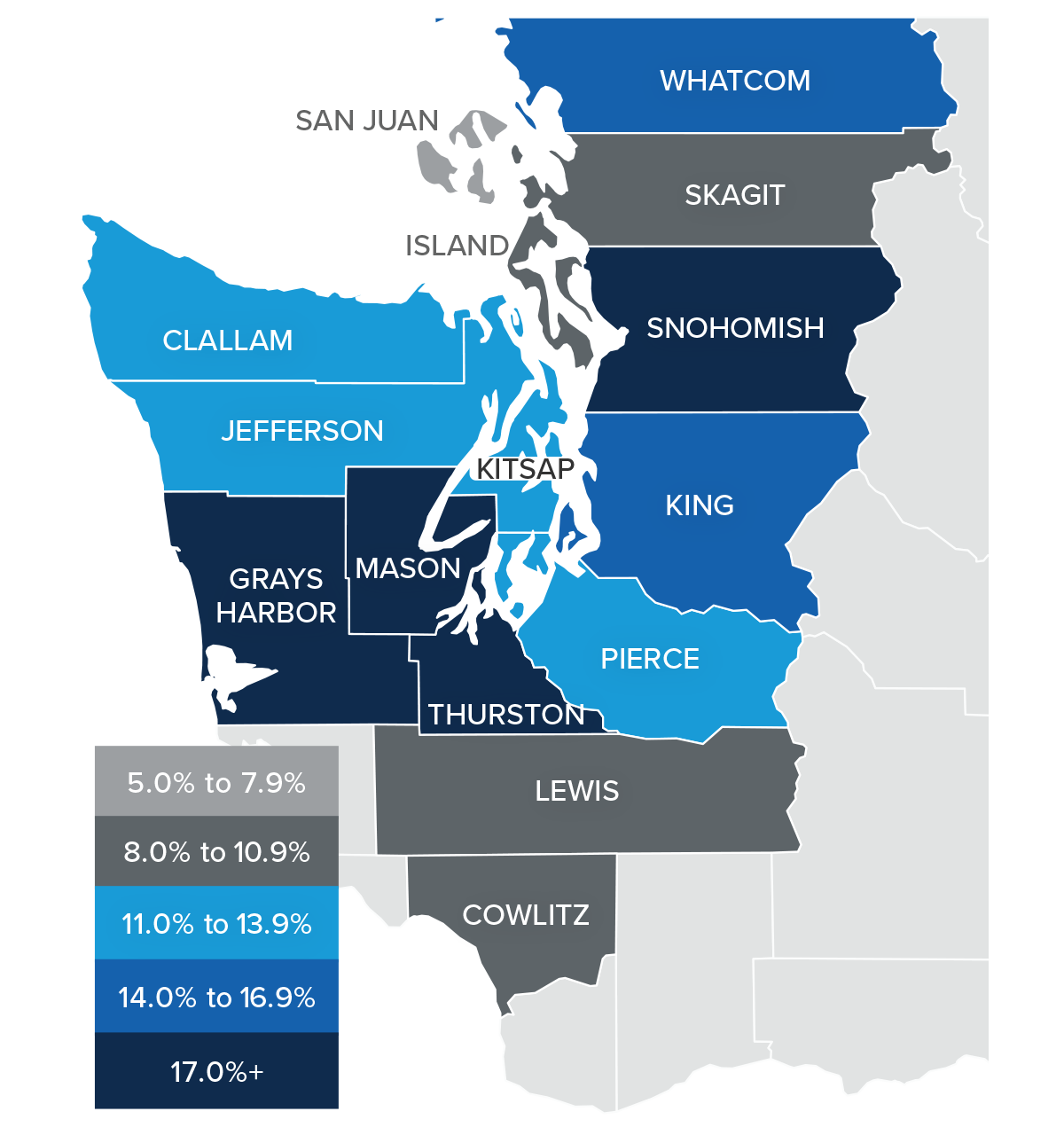
A map showing the real estate home prices percentage changes for various counties in Western Washington. Different colors correspond to different tiers of percentage change. San Juan County is the only county with a percentage change in the 5% to 7.9% range, Skagit, Lewis, and Cowlitz counties are in the 8% to 10.9% change range, Clallam, Jefferson, Kitsap, and Pierce are in the 11% to 13.9 % change range, King and Whatcom counties are in the 14% to 16.9% change range, and Grays Harbor, Mason, Thurston, and Snohomish counties are in the 17% + range.

A bar graph showing the annual change in home sale prices for various counties in Western Washington from Q2 2021 to Q2 2022. Snohomish county tops the list at 20.6%, followed by Grays Harbor at 18.9%, Mason at 18.4%, Thurston at 17.4%, Whatcom at 16.3%, King at 14.3%, Kitsap at 13.8%, Jefferson at 13.6%, Pierce at 13%, Clallam at 12.7%, Skagit at 10.8%, Lewis at 9.1%, Cowlitz at 8.9%, Island at 8.6%, and finally San Juan at 5.6%.

Mortgage Rates

Although mortgage rates did drop in June, the quarterly trend was still moving higher. Inflation—the bane of bonds and, therefore, mortgage rates—has yet to slow, which is putting upward pressure on financing costs.

That said, there are some signs that inflation is starting to soften and if this starts to show in upcoming Consumer Price Index numbers then rates will likely find a ceiling. I am hopeful this will be the case at some point in the third quarter, which is reflected in my forecast.
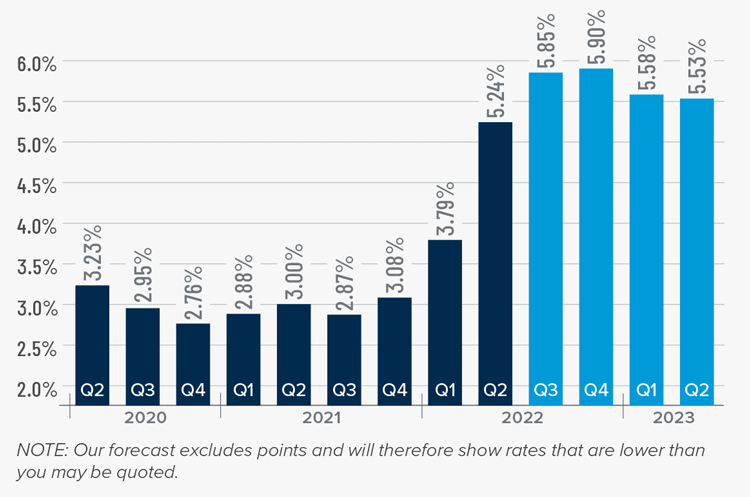
A bar graph showing the mortgage rates from 2020 to the present, as well as Matthew Gardner's forecasted mortgage rates through Q2 2023. He forecasts mortgage rates continuing to climb to 5.9% in Q4 2022, then tapering off to 5.58% in Q1 2023 and 5.53% in Q2 2023.

Western Washington Days on Market

❱ It took an average of 16 days for a home to go pending in the second quarter of the year. This was 2 fewer days than in the same quarter of 2021, and 9 fewer days than in the first quarter.

❱ Snohomish, King, and Pierce counties were, again, the tightest markets in Western Washington, with homes taking an average of between 8 and 10 days to sell. Compared to a year ago, average market time dropped the most in San Juan County, where it took 26 fewer days for a seller to find a buyer.

❱ All but six counties saw average time on market drop from the same period a year ago. The markets where it took longer to sell a home saw the length of time increase only marginally.

❱ Compared to the first quarter of this year, average market time fell across the board. Demand remains very strong.
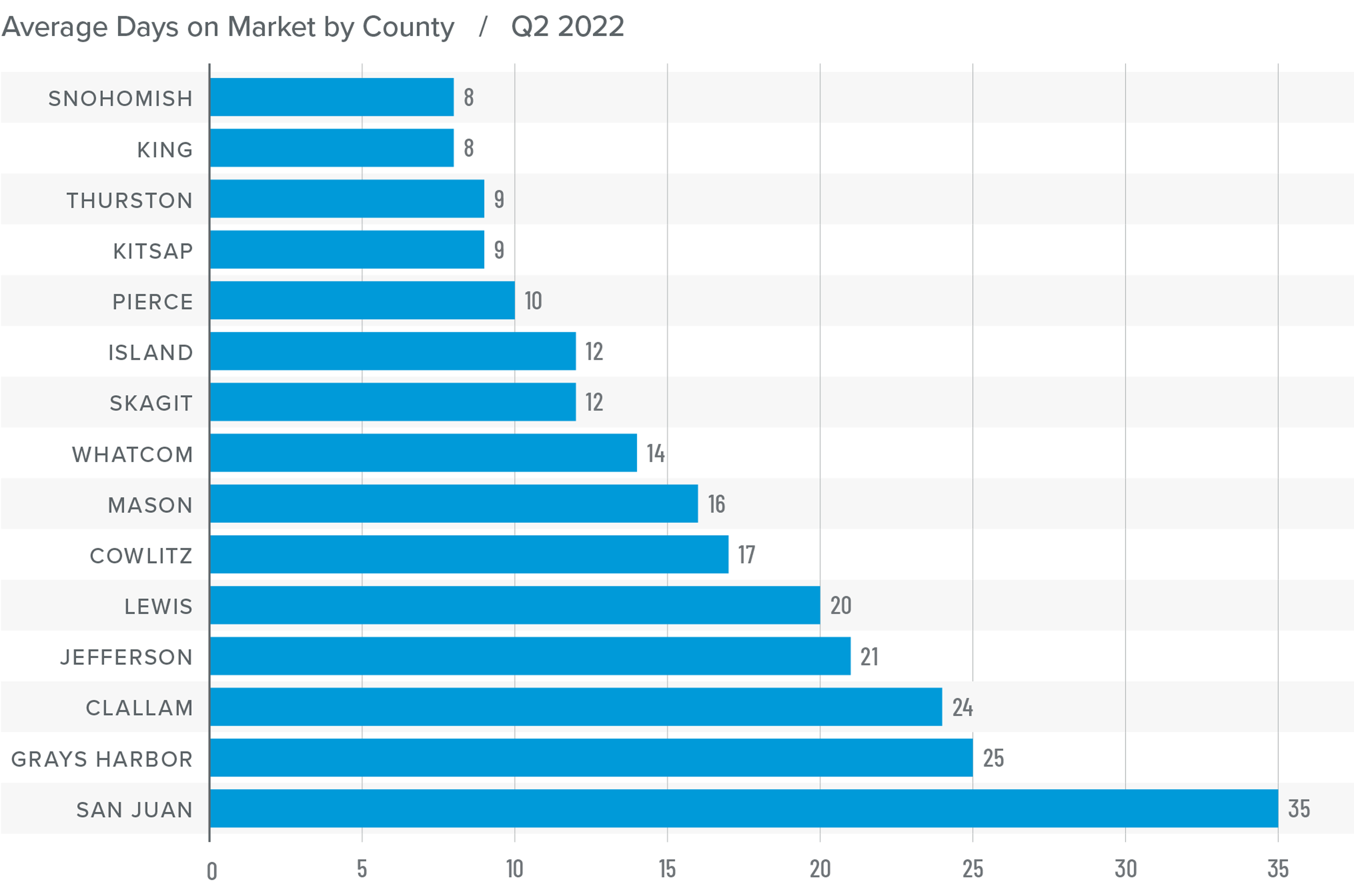
A bar graph showing the average days on market for homes in various counties in Western Washington for Q2 2022. Snohomish and King counties have the lowest DOM at 8, followed by Thurston and Kitsap at 9, Pierce at 10, Island and Skagit at 12, Whatcom at 14, Mason at 16, Cowlitz at 17, Lewis at 20, Jefferson at 21, Clallam at 24, Grays Harbor at 25, and San Juan at 35.

Conclusions

This speedometer reflects the state of the region’s real estate market using housing inventory, price gains, home sales, interest rates, and larger economic factors.

The economy remains buoyant, which is an important factor when it comes to the regional housing market, particularly as it affects buyers. Even though the number of homes that came to market has jumped significantly, which should favor those looking for a new home, demand is still robust, and the market remains competitive.
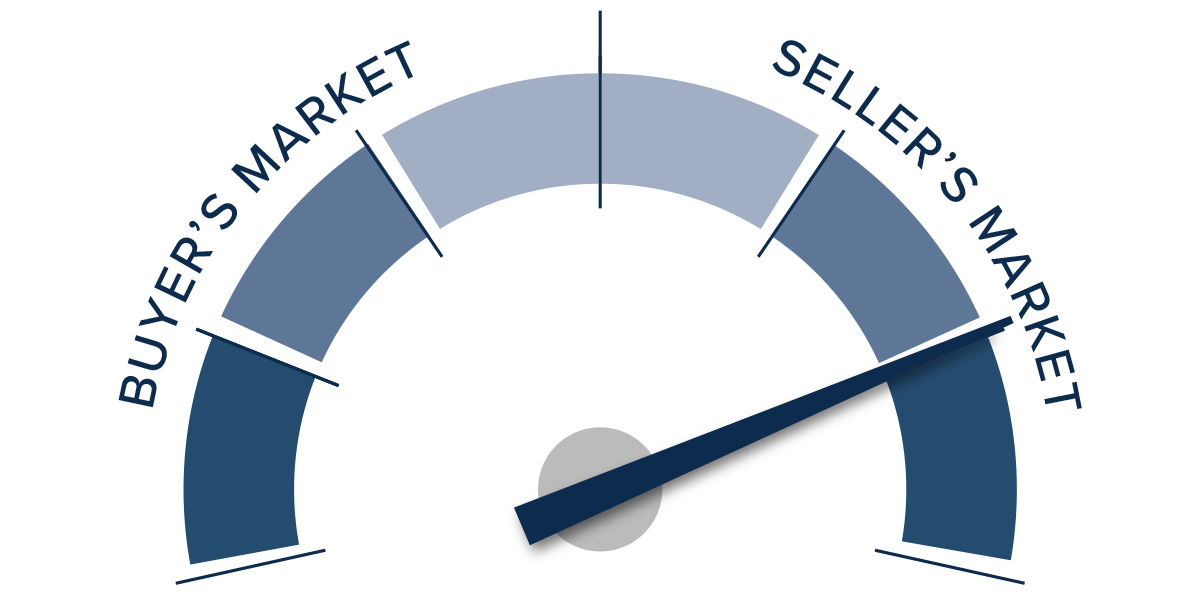
A speedometer graph indicating a strong seller's market in Western Washington for Q2 2022.

Much to the disappointment of buyers, rising listing prices suggest that sellers are clearly still confident even as financing costs continue to increase. While the pace of price growth is slowing, sellers are still generally in control. As such, I have moved the needle a little more in the direction of sellers. Until we see list-price growth and home sales slow significantly, we will not reach a balanced market.

About Matthew Gardner

Matthew Gardner - Chief Economist for Windermere Real Estate

As Chief Economist for Windermere Real Estate, Matthew Gardner is responsible for analyzing and interpreting economic data and its impact on the real estate market on both a local and national level. Matthew has over 30 years of professional experience both in the U.S. and U.K.

In addition to his day-to-day responsibilities, Matthew sits on the Washington State Governors Council of Economic Advisors; chairs the Board of Trustees at the Washington Center for Real Estate Research at the University of Washington; and is an Advisory Board Member at the Runstad Center for Real Estate Studies at the University of Washington where he also lectures in real estate economics.