Facebook
 X
X
 Pinterest
 Copy Link
Whidbey Island Whale Watching from Shore: How to Follow Sightings and Read the Water

Image note: The visuals in this article are editorial guide images created to explain shore-based whale watching on Whidbey Island. They are not documentary photos from a specific place, event, business, property, or moment.
Whale watching from Whidbey Island’s shore is less about memorizing one “best” beach and more about learning how to use a moving sighting. Whales travel through Saratoga Passage, Admiralty Inlet, Possession Sound, Penn Cove, and nearby waterways on their own schedule. A report that was useful 20 minutes ago may point to a different viewing area now—or the whale may have changed direction or disappeared beneath the surface.
This guide explains how to follow current reports, read the water, choose a verified public viewpoint, use Langley’s Whale Bell, and share a useful sighting without promising that wildlife will appear on demand.
The quick answer
- Check the Orca Network Whale Sighting Network.
- Note the report’s time, location, direction, and side of the channel.
- Choose a safe, verified public viewpoint that fits the reported movement.
- Scan slowly with your eyes first, then use binoculars.
- Expect uncertainty. A sighting report is a clue, not a reservation.
Start with the sighting, not the viewpoint
Orca Network’s community-based Whale Sighting Network gathers reports from the public, partner organizations, volunteers, and scientists. Reports are reviewed and cross-checked, creating records that support research, conservation work, and alerts to vessels in busy waterways.
Before leaving for the shoreline, check the latest sighting resources and Orca Network’s Public Viewpoints Map. Check the timestamp before anything else. Whales can cover considerable water, reverse direction, pause to feed, or remain submerged long enough to frustrate even experienced observers.
How to read a Whidbey whale report
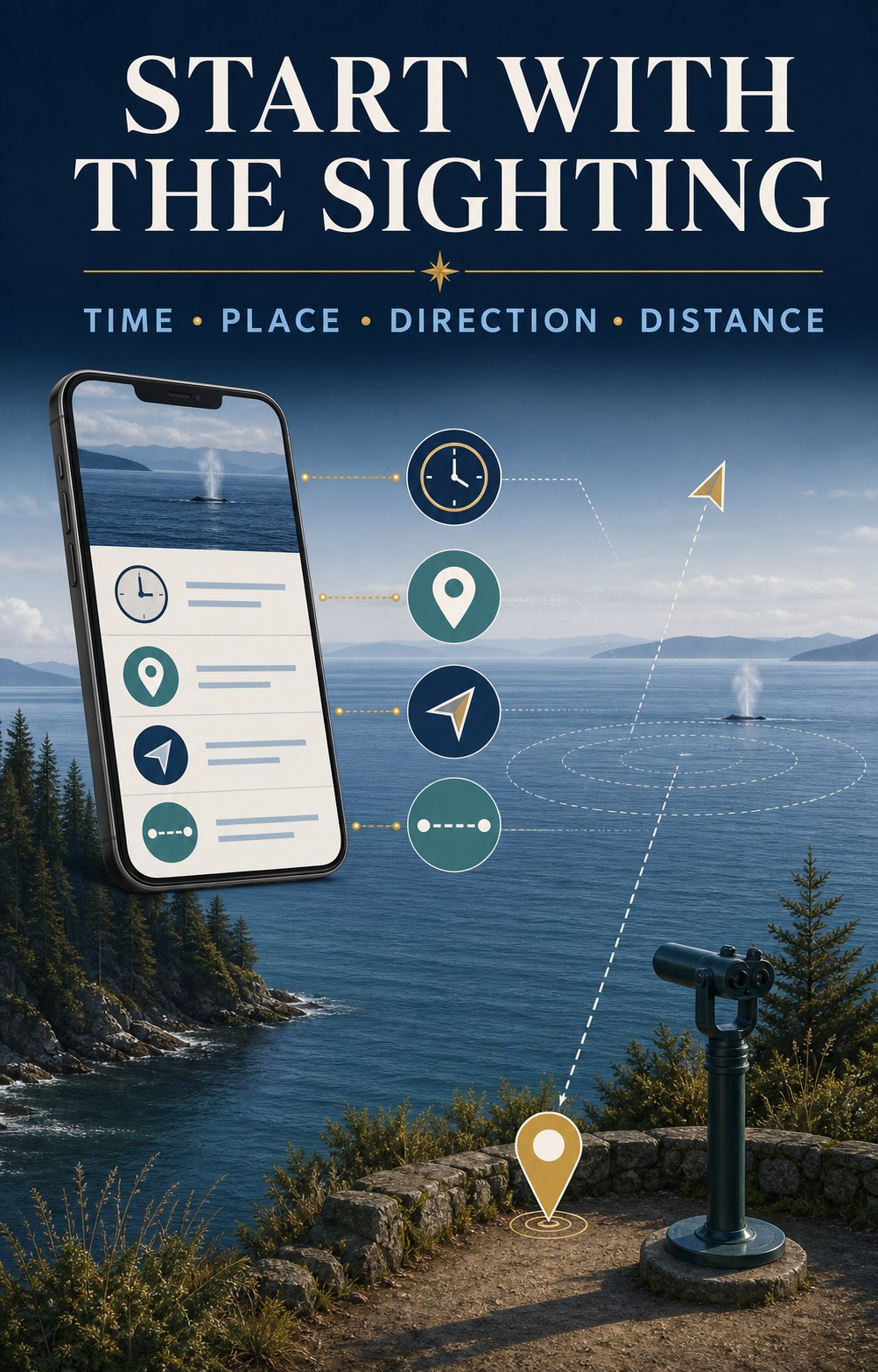
| Report detail | What it helps you decide |
|---|---|
| Time | Whether the report may still be actionable. |
| Place | Which waterway and public viewpoints make sense. |
| Direction | Where the whale may travel next if it maintains course. |
| Whidbey side, opposite shore, or mid-channel | Whether a shore view is realistic and which side offers the better angle. |
| Traveling, milling, or feeding | Whether movement may be steady or the whale may remain in one area. |
| Species or “unconfirmed” | What clues to watch for without forcing an identification. |
Illustrative example—not a live sighting:
“10:20 a.m.—two whales southbound past Sandy Point, Whidbey side of mid-channel, traveling steadily.”
The useful clues are the exact time, southbound direction, and position nearer Whidbey. A reader might consider a legal public viewpoint farther south, but only after checking travel time and current access. Do not race through neighborhoods or stop where parking is prohibited.
Four useful public-viewing zones
These are not ranked and none guarantees a whale. Match the waterway to the latest report, then confirm hours, parking, closures, and access on the official page before driving. For broader shoreline planning, use the Whidbey Island Beach Access Guide.
1. Langley waterfront: Saratoga Passage
Langley is the island’s most complete shore-watching starting point because it combines a waterfront sightline, the Whale Bell, and a staffed educational resource nearby. The Langley Whale Center at 105 Anthes Avenue shares current sighting information, local tips, and exhibits about Salish Sea marine mammals. At the final July 2026 verification, its posted hours were Wednesday through Sunday, 11 a.m.–4 p.m.; hours vary seasonally, so check before visiting. You can also open the Langley Whale Center in Google Maps.
Nearby Whale Bell Park and Seawall Park overlook Saratoga Passage. Visit the Whale Bell Park page, view Whale Bell Park in Google Maps, or explore more of Langley.
2. Bush Point: west-side Admiralty Inlet
When a current report places whales along South Whidbey’s west side or Admiralty Inlet, Bush Point can provide a useful public shoreline angle. Check the Port of South Whidbey facility page for current hours and access information, then use Google Maps for Bush Point. Remember that this is an active boat-ramp and fishing area; keep launch access clear.
3. Fort Casey: broad Admiralty Inlet views
Fort Casey offers broad shoreline and elevated sightlines across Admiralty Inlet. That can be useful when a report is distant or moving through the inlet, but binoculars may still be essential. Confirm park information with Washington State Parks and open Fort Casey in Google Maps. If you are making a day of Central Whidbey, use the Coupeville guide for nearby planning.
4. Clinton and Possession: southern waterways
Reports from Possession Sound or the Clinton ferry approach may make Clinton Beach Park or Possession Beach Waterfront Park relevant. Both facilities can carry changing notices, so use the official pages immediately before visiting. For directions, open Clinton Beach Park or Possession Beach Waterfront Park in Google Maps.
The Langley Whale Bell: look first, then ask which way
Whale Bell Park sits near First Street and Anthes Avenue in downtown Langley. Its memorable instruction is simple: see a whale, ring the bell. The sound invites everyone nearby to turn toward Saratoga Passage and start looking.
The bell is a local signal, not a guarantee that the whale will remain visible. If you hear it, scan the water first and then ask the most useful questions: Where was the whale? Which direction was it moving? How long ago was it seen? Was it close to the Whidbey side, near the opposite shore, or mid-channel?
If you are the person ringing the bell, share the time, approximate position, direction, and number of animals. Name the species only when you are confident or when a qualified observer has confirmed it. “Unconfirmed whale” is more useful than a confident but incorrect identification.
What you may see from shore
Gray whales
A returning group of gray whales known as the North Puget Sound “Sounders” has historically detoured into the region to feed, especially during spring. Gray whales are baleen whales that often feed on small prey in bottom sediments. Their surfacing can show a low, mottled back, a heart-shaped or bushy blow in suitable conditions, and sometimes a tail before a deeper dive.
Recent patterns are less tidy than an old seasonal calendar suggests: some Sounders have arrived earlier, stayed longer, or appeared during winter. Orca Network also reports serious conservation concerns for eastern North Pacific gray whales. Give any whale plenty of space and use the current gray whale information rather than relying on a fixed month.
Killer whales
A tall dorsal fin can be striking even at a distance, but shore observers should be cautious about identification. Bigg’s killer whales and endangered Southern Resident killer whales are distinct populations with different diets and movement patterns. A distant fin alone may not tell you which population you are seeing. Look for a verified report before repeating an identification.
Humpbacks and other marine mammals
Humpback whales and other cetaceans can also move through the greater Salish Sea. Harbor porpoises, seals, and sea lions are more common supporting characters. Distance, glare, waves, and floating logs can fool the eye, so watch for repeated, coordinated movement before deciding that a dark shape is an animal.
How to scan the water
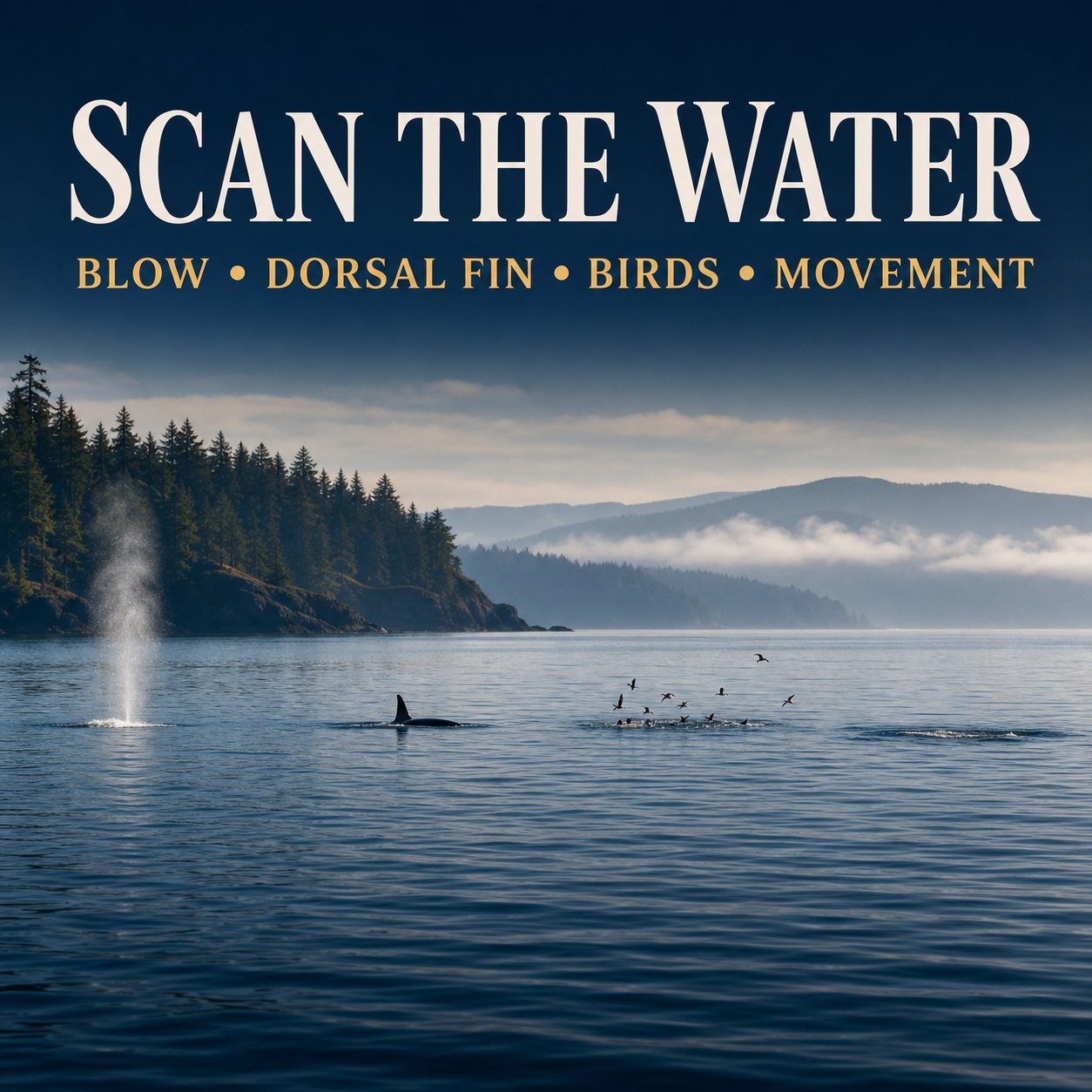
- Begin with your eyes. A wider field of view makes it easier to notice a blow or unusual surface movement.
- Divide the horizon into sections. Scan slowly from one reference point to the next rather than swinging binoculars randomly.
- Look for repetition. A blow, back, or fin followed by another surfacing along a consistent path is more useful than one unexplained splash.
- Watch the birds, but do not overread them. Concentrated bird activity can reveal feeding action or baitfish, but it does not automatically mean a whale is present.
- Use binoculars to confirm. An 8x or 10x pair is a practical shore-watching range for many people. Brace your elbows or use a railing where permitted.
- Stay with one area for several minutes. Whales spend much of their time below the surface and may reappear farther along their travel path.
Report what you saw
A useful report includes the date, exact time, location, direction of travel, estimated number of animals, observed behavior, and whether photographs are available. If you are unsure of the species, say so.
Submit your observation through Orca Network’s online whale-sighting report. These reports do more than help the next shore watcher: verified records support research and can help alert ferries and commercial vessels when whales are near busy waterways.
Watch responsibly from shore
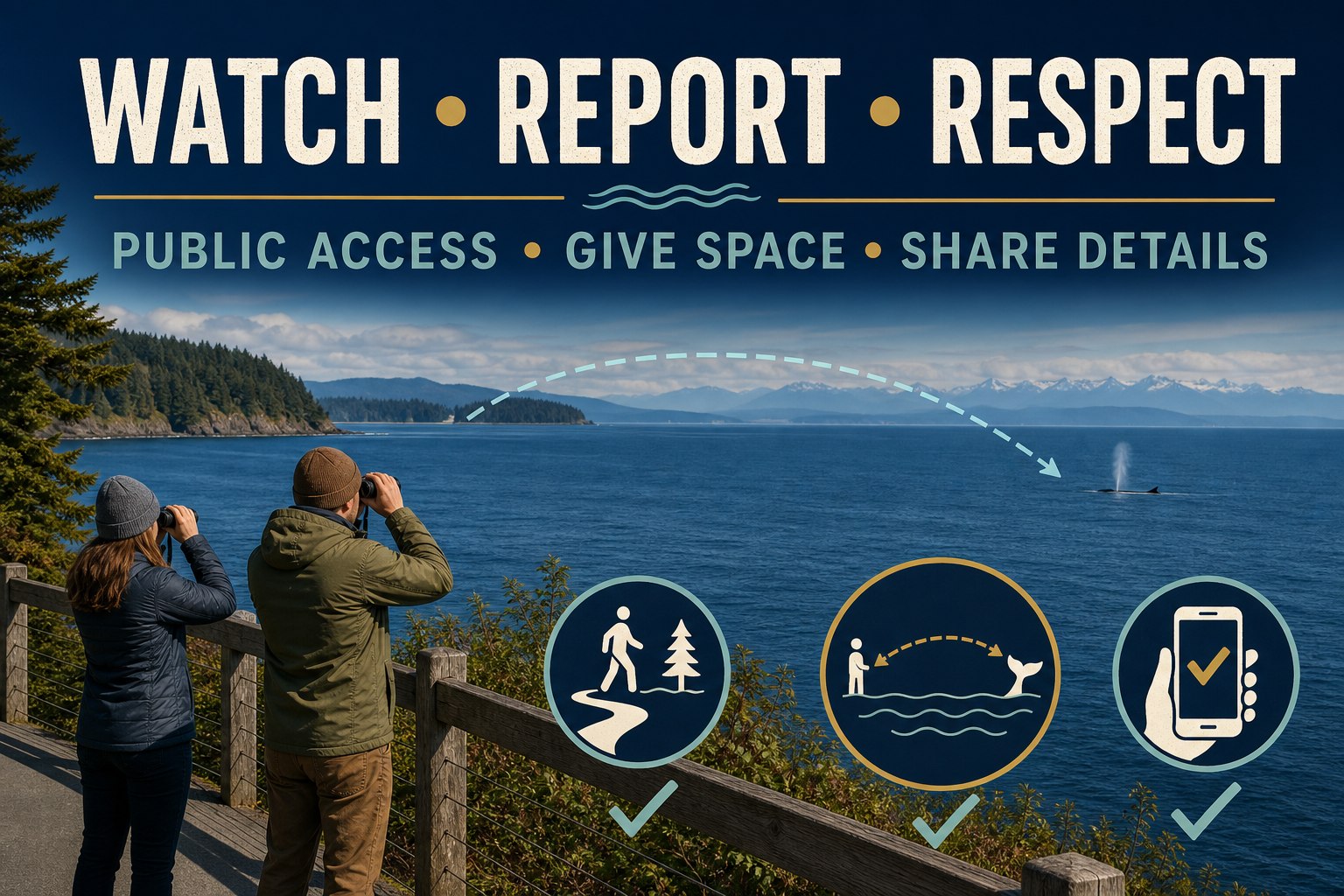
- Use established public access and legal parking; do not cut through private shoreline or residential property.
- Give seals, sea lions, nesting birds, and other wildlife ample room.
- Never feed, touch, call to, chase, or attempt to redirect wildlife.
- Do not launch a drone to get closer to marine mammals.
- If an animal appears distressed, stranded, entangled, injured, or dead, do not approach it. Use the NOAA West Coast Marine Mammal Stranding Network for current reporting guidance.
- If you switch from shore to a boat, kayak, or paddleboard, additional legal distances and operating rules apply. Review the current Be Whale Wise regulations and guidelines before getting on the water.
A realistic 60-minute shore-watching plan
- 5 minutes: Check the newest sighting and the official access page.
- 10 minutes: Travel only to a safe public viewpoint that fits the report. If the drive is longer, reconsider whether the sighting is still actionable.
- 35 minutes: Scan in sections, recheck likely zones, and enjoy the wider waterfront scene.
- 5 minutes: Record useful details if a whale appears.
- 5 minutes: Submit a report—and if no whale appears, leave with the satisfaction of having spent an attentive hour beside the Salish Sea.
Frequently asked questions
What is the best time of year to see whales from Whidbey Island?
Spring is historically associated with North Puget Sound gray whales known as the Sounders, but recent arrival and departure patterns vary. Killer whales and other cetaceans may appear at different times. Current sighting reports are more useful than relying on one guaranteed season.
Where is the Langley Whale Bell?
Whale Bell Park is near First Street and Anthes Avenue in downtown Langley, overlooking Saratoga Passage and close to Seawall Park and the Langley Whale Center.
What does it mean when the Langley Whale Bell rings?
Someone nearby has spotted a whale and is alerting others to look. Scan immediately, then ask where the whale was seen and which direction it was traveling. The bell does not guarantee the animal is still visible.
Where can I find current Whidbey whale sightings?
Start with Orca Network’s Whale Sighting Network, its recent reports, and its Public Viewpoints Map. The Langley Whale Center can also provide current sighting context and local tips during open hours.
Can I see whales from the Clinton–Mukilteo ferry?
It is possible to spot marine mammals from a ferry, but it is never dependable. Treat any sighting as a bonus, remain in authorized passenger areas, and do not let whale watching interfere with boarding, unloading, or crew instructions.
What binoculars are useful for whale watching from shore?
Many shore watchers find 8x or 10x binoculars practical. Start with your unaided eyes to locate movement, then use binoculars to confirm details. A stable stance matters as much as magnification.
Should I report a whale sighting?
Yes. Record the exact time, location, direction, estimated number of animals, behavior, and whether photos are available. Submit the details to Orca Network, and label the species unconfirmed when you are unsure.
What should I do if I see a stranded or distressed whale?
Keep people and pets away, do not touch or attempt to move the animal, and report it through the NOAA West Coast Marine Mammal Stranding Network. Follow instructions from authorized responders.
The best shore-watching habit is attention
Check the report, read the direction, use public access, and give the water time. Whether a whale surfaces or not, the process makes you more aware of the living waterways around Whidbey Island.
Continue planning with the Whidbey Island Beach Access Guide or Guide to Langley.

Information and public notices were last verified July 27, 2026. Wildlife activity, hours, access conditions, closures, and regulations can change. Check linked official sources before visiting.
Written by Si Fisher
The Ultimate Guide to Whidbey Island April Events (2026)

The Ultimate Guide to Whidbey Island April Events (2026)
If you are looking for the best things to do on Whidbey Island from April 7 through the end of the month, this is the stretch where spring really starts to feel alive. The island’s event calendar shifts into a more energetic rhythm with theater, whale-season traditions, Earth Day gatherings, live music, plant sales, workshops, and one of Oak Harbor’s signature spring weekends.
This guide is designed to be more useful than a random list of dates. Some events are better for a relaxed date night, some are ideal for families, some are stronger if you want live music or food-and-drink energy, and others are the kind of seasonal traditions that help you experience what Whidbey actually feels like in spring. If you are still getting to know the island, this is also a good month to notice how different places like Langley, Freeland, Greenbank, Coupeville, Clinton, and Oak Harbor each have their own rhythm. You can explore more of that local context through Windermere Whidbey’s Whidbey Island area guide, or take a closer look at communities like Langley and Freeland while you plan your outings.
Key Takeaways
- Late April has real range: this stretch includes festivals, live music, theater, workshops, Earth Day events, and major community weekends.
- Holland Happening is the biggest headline weekend: if you want one big all-in spring event, this is the easiest anchor pick.
- South Whidbey is especially strong this month: Welcome the Whales, WICA, Ott & Hunter, Bailey’s, and multiple Freeland/Clinton events give the south end real depth.
- You can build your month around your style of outing: arts, family events, spring markets, food-and-drink nights, and outdoor community events are all represented.

Best Bets for Seasonal Whidbey Spring Experiences
Welcome the Whales Parade & Festival
Date: April 10–12, 2026
Location: South Whidbey / Langley-area programming
This is one of the most distinctly Whidbey events on the April calendar. Orca Network’s annual Welcome the Whales celebration centers on the return of the “Sounders” gray whales and blends marine education, parade-and-festival energy, and family-friendly spring programming. If you want something that feels local, seasonal, and memorable rather than generic, this is one of the strongest picks of the month.
Whidbey Earth Day at Camp Casey
Date: April 18, 2026
Time: 10:00 a.m. to 2:00 p.m.
Location: Camp Casey – 1276 Engle Rd, Coupeville, WA 98239
This is one of the better community-minded spring events on the island. The event is geared toward hands-on Earth Day activities, nature experiences, and family participation, which makes it a good fit for anyone who wants something more active and purposeful than just browsing booths.
Little BIG Fest Earth Day
Date: April 25, 2026
Location: Royal Alvin Hall – 9372 WA-525, Freeland, WA 98249
Little BIG Fest’s Earth Day edition looks like one of the more playful late-April community events. It brings together music, food, and a spring community vibe that feels more celebratory than formal. If Camp Casey sounds a little more educational, Little BIG Fest sounds more social and music-forward.
Local Tip
If you only have bandwidth for one bigger spring weekend, pick the event that matches how you actually like to spend a day. Holland Happening is the obvious all-in festival choice, but if you prefer something more Whidbey-specific and less crowded, Welcome the Whales or Camp Casey Earth Day may be the better fit.
Best Arts, Theater, and Culture Picks

Sense & Sensibility at WICA
Date: April 9–25, 2026
Location: Whidbey Island Center for the Arts – 565 Camano Ave, Langley, WA 98260
WICA’s production of Sense & Sensibility looks like one of the strongest arts anchors on the island this month. The run spans much of mid-to-late April, which makes it useful for planning because you have multiple chances to catch it. If you want one event that can anchor a dinner-and-show kind of outing in Langley, this is probably the easiest recommendation in the whole guide.
Art Talks with Rebecca Albiani: Jane Austen
Date: April 15, 2026
Time: 11:00 a.m.
Location: WICA – 565 Camano Ave, Langley, WA 98260
This pairs naturally with the Sense & Sensibility run and gives the month a nice literary through-line. It is a good choice if you want something quieter, more thoughtful, and less crowded than the bigger community weekends.
Steps MAMMA MIA! Sing-Along
Date: April 16, 2026
Location: The Clyde Theatre – 217 1st St, Langley, WA 98260
This one is more about fun than refinement, which is exactly why it belongs here. If the goal is a lively night out with crowd energy, nostalgia, and a built-in social atmosphere, this is one of the clearer April picks.
Andre Feriante in Concert
Date: April 17, 2026
Time: 2:00–3:00 p.m.
Location: Freeland Library – 5495 Harbor Ave, Freeland, WA 98249
This is a nice lower-key music pick if you want something artistic without the structure of a bigger festival or evening show. It adds depth to the month’s cultural calendar and gives Freeland a stronger arts foothold in the roundup.
Salish Sea Early Music Festival: Telemann Paris Quartets II
Date: April 28, 2026
Time: 7:00 p.m.
Location: Coupeville United Methodist Church – 608 N Main St, Coupeville, WA 98239
If you want something more musically formal and less casual than the wineries or festival stages, this is one of the strongest high-culture picks in the back half of the month.
Best Live Music, Drinks, and Date-Night Events
Ott & Hunter Live Music Night: Deseo Carmin
Date: April 11, 2026
Time: 7:00 p.m.
Location: Ott & Hunter Winery Tasting Room – 204 1st St, Langley, WA 98260
This is a strong date-night pick if you want something intimate rather than large-scale. The published description points to a lively blend of Latin rhythms, jazz-funk, and flamenco energy, which gives it more identity than a generic tasting-room performance listing.
Ott & Hunter Live Music Night: Kareem Kandi World Orchestra
Date: April 18, 2026
Time: 7:00 p.m.
Location: Ott & Hunter Winery Tasting Room – 204 1st St, Langley, WA 98260
This is another strong Langley evening option, especially for readers who want something musical but still easy to fold into a polished evening out.
Ott & Hunter Live Music Night: Dmitri Matheny Group
Date: April 25, 2026
Time: 7:00 p.m.
Location: Ott & Hunter Winery Tasting Room – 204 1st St, Langley, WA 98260
If you are trying to build a polished late-April night around Langley, this is one of the cleaner picks on the calendar.
Lo-Fi and Zero-Proof Cocktails
Date: April 16, 2026
Time: 6:00–7:30 p.m.
Location: Hierophant Meadery – 5586 Harbor Ave, Freeland, WA 98249
This is one of the more lifestyle-friendly events in the month because it lands in that sweet spot between niche and broadly appealing. It works for readers who want a social outing that is lighter than a big festival and more specific than just grabbing drinks somewhere.
Oysters & Beer with Salinity & Thirsty Crab
Date: April 25, 2026
Time: 3:00–5:00 p.m.
Location: Thirsty Crab Brewery – 9000 State Route 525, Clinton, WA 98236
This is one of the better food-and-drink picks in the later-April run. If you want an event that feels local, springy, and easy to fold into a Whidbey afternoon, this stands out.
Bailey’s Corner Store Open Mic Comedy Night
Date: April 8, 2026
Location: Bailey’s Corner Store – 5590 Bayview Rd, Langley, WA 98260
Bailey’s belongs on the radar if you are trying to widen the event lens beyond the usual polished cultural anchors. This kind of smaller recurring venue energy helps round out what actually feels alive on South Whidbey in a given month.
Best Family and Community Weekends
Holland Happening
Date: April 24–26, 2026
Location: Downtown Oak Harbor
Holland Happening is one of the clearest headline events on Whidbey in late April. It returns as Oak Harbor’s major spring celebration, with Dutch-heritage roots but a broader community feel that includes a parade, street-festival energy, vendors, food, entertainment, and the well-known Klompen races. If you only pick one major festival-style weekend this month, this is the default choice.
Whidbey Island Marathon Weekend
Packet pickup / late registration: April 25, 2026
Race day: April 26, 2026
Location: Windjammer Park / Oak Harbor race weekend
The marathon weekend is a strong fit for readers who like activity-based events, destination energy, or race-day spectator atmosphere. Even if you are not running, events like this bring out waterfront energy, volunteers, and the kind of community momentum that makes a weekend feel elevated.
After Hours Game Night
Date: April 25, 2026
Time: 6:30–9:00 p.m.
Location: Freeland Library – 5495 Harbor Ave, Freeland, WA 98249
This is one of the better family-friendly late-month picks if you want something playful without having to commit to a giant festival. Mini golf through the library, games, trivia, and pizza give it a broader appeal than a simple library listing might suggest.
Best Picks for Garden, Home, and Spring-Reset Energy

Greenbank Garden Club Plant Sale
Date: April 25, 2026
Time: reportedly 10:00 a.m. to 2:00 p.m.
Location: Greenbank Farm Barn A – 765 Wonn Rd, Greenbank, WA 98253
For readers who immediately perk up at the phrase “plant sale,” this is one of the more practical and appealing events in the whole month. Published listings indicate a large annual sale with locally grown plants and a mix of vegetable starts, herbs, perennials, shrubs, and garden-related extras.
Fruit Tree Workshop: Soil Science 101
Date: April 25, 2026
Time: 10:00 a.m.
Location: Coupeville
This is a good inclusion for readers who want practical spring energy instead of pure entertainment. It adds a home-and-garden angle that helps the month feel more complete, and it fits naturally with broader spring-reset thinking around gardens, homes, and seasonal routines.
Smaller but Noteworthy April Picks
- Art Village Reception featuring Nick Toombs & Brat Leathers — April 11, Clinton. Main event page
- rePurpose Day — April 22, Langley. Main event page
- Jigsaw Puzzle Exchange — April 26, Freeland Library. Main event page / library events page
- Six Weeks to a First Draft with Suzanne Kelman — starts April 27, Freeland Library. Main event page / library events page
- Aging in Place — April 29, Freeland Library. Main event page / library events page
- The Codebreaker documentary screening — April 21, Coupeville Library. Main event page / library events page
How to Choose the Right April Event for You
If you want the most distinctly Whidbey spring event, start with Welcome the Whales. If you want the strongest arts-and-culture option, go with Sense & Sensibility at WICA. If you want the biggest all-around community weekend, Holland Happening is the headline pick. If you want something more family-friendly and outdoorsy, Camp Casey Earth Day and Little BIG Fest Earth Day are strong choices. And if you want a slower, more browseable spring outing, the Greenbank Garden Club Plant Sale is one of the most naturally satisfying picks in the whole month.
Why This Part of the Calendar Matters on Whidbey
Late April is one of those windows when Whidbey starts showing more of its full personality. You get some of the first bigger spring crowds, but the island still feels more breathable than peak summer. Community events are back in motion, outdoor spaces are waking up, and it becomes easier to picture the rhythm of actually living here instead of only visiting on a sunny July weekend.
For people who are still getting to know the island, event calendars like this are useful for more than entertainment. They show how community life actually works here, which is one reason these seasonal guides pair naturally with broader real estate questions. If you are thinking about making a move, comparing neighborhoods, or just figuring out which part of the island best matches your rhythm, Windermere Whidbey can help connect the lifestyle picture with the actual market.
Frequently Asked Questions
What are the biggest Whidbey Island events in late April 2026?
Some of the most prominent late-April events include Holland Happening in Oak Harbor, the Whidbey Island Marathon weekend, Little BIG Fest Earth Day, and WICA’s Sense & Sensibility run.
What is a good Whidbey April event for families?
Family-friendly options in this stretch include Welcome the Whales, Earth Day at Camp Casey, Little BIG Fest Earth Day, and Holland Happening.
Are there good arts events on Whidbey Island in April 2026?
Yes. Stronger arts picks include Sense & Sensibility at WICA, Art Talks with Rebecca Albiani: Jane Austen, the Steps MAMMA MIA! Sing-Along, and several live music nights like Deseo Carmin at Ott & Hunter.
What should I double-check before going?
Check the official event page for final times, ticketing requirements, venue details, parking information, and any weather-related updates.
Thinking About Life on Whidbey?
One of the best ways to understand Whidbey is to see what fills the calendar in different communities. If you are starting to imagine island life for yourself, those lifestyle cues matter just as much as square footage or list price. When you are ready to connect the event calendar with neighborhoods, homes, and what different parts of the island actually feel like, Windermere Whidbey can help.