Facebook
 X
X
 Pinterest
 Copy Link
The Current State of the U.S. Housing Market | April 2022

This video is the latest in our Monday with Matthew series with Windermere Chief Economist Matthew Gardner. Each month, he analyzes the most up-to-date U.S. housing data to keep you well-informed about what’s going on in the real estate market.
Hello there, I’m Windermere’s Chief Economist Matthew Gardner, and welcome to this month’s episode of Monday with Matthew. With home prices continuing to defy gravity, mortgage rates spiking, the Fed raising interest rates significantly, a yield curve that is just keeping its nose above water, and some becoming vocal about the possibility that we are going to enter a recession sooner rather than later, it’s not at all surprising that many of you have been asking me whether the housing market is going to pull back significantly, and a few of you have asked whether we aren’t in some sort of “bubble” again.
Because this topic appears to be giving many of you heartburn, I decided that it’s a good time to reflect on where the housing market is today and give you my thoughts on the impact of rising mortgage rates on what has been an historically hot market.
The Current State of the U.S. Housing Market
Home Sale Prices
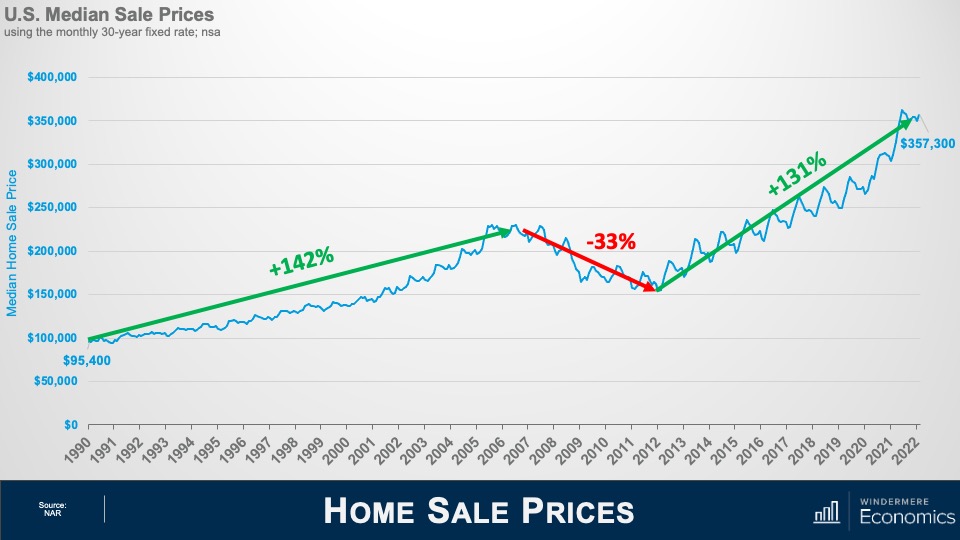
As usual, a little perspective. Between 1990 and the pre-bubble peak in 2006, home prices rose by 142%, which was a pretty impressive annual increase of 5.6% over a 16 1/2-year period. When the market crashed, prices dropped by 33%, but from the 2012 low to today, prices have risen by 131%, or at an even faster annual rate of 8.6% over a shorter period of time—10 years.
You may think that prices rising at an annual rate that exceeds the pace seen before the market crash is what has some brokers and home buyers concerned, but that really isn’t what has many people scared. It’s this.
Mortgage Rates in 2022
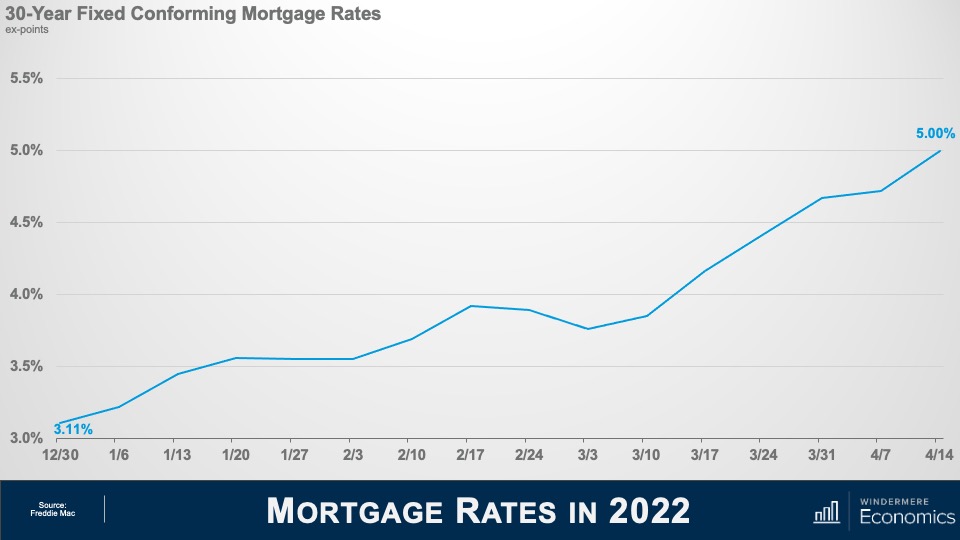
At the start of 2022, the average 30-year fixed mortgage rate was just a little above 3%. But, over a brief 15-week period, they have skyrocketed to 5%. This has led some to worry that the market is about to implode. Of course, nobody can say that the run-up in home prices hasn’t been phenomenal over the past few years, and it’s certainly human nature to think that “what goes up, must come down,” but is there really any reason to panic? I think not, and to explain my reasoning, let’s look back in time to periods when rates rose significantly and see how increasing mortgage rates impacted the marketplace.
Housing and Mortgage Markets During Times of Rising Rates
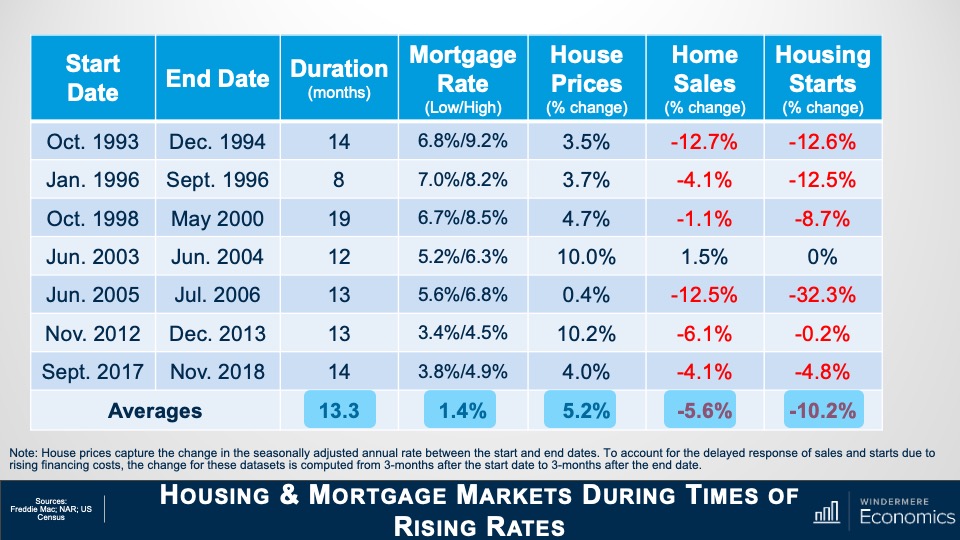
This table shows seven periods over the past 30 years when mortgage rates rose significantly. On average, rates trended higher for just over a year before pulling back, and the average increase was 1.4%. But now look at how it impacted home prices: it really didn’t. On average, during these periods of rising financing costs, home prices still rose by just over 5%. Clearly, not what some might have expected. But there were some negatives from mortgage rates trending higher, and these came in the form of lower sales in all but one period and new housing starts also pulled back.
So, if history is any indicator, the impact of the current jump in mortgage rates is likely to be seen in the form of lower transactions rather than lower prices. And this makes sense. Although rising financing costs puts additional pressure on housing affordability, what people don’t appear to think about is that mortgage rates actually tend to rise during periods of economic prosperity. And what does a flourishing economy bring? That’s right. Rising wages. Increasing incomes can certainly offset at least some of the impacts of rising mortgage rates.
Static Equilibrium Analysis – 1/3
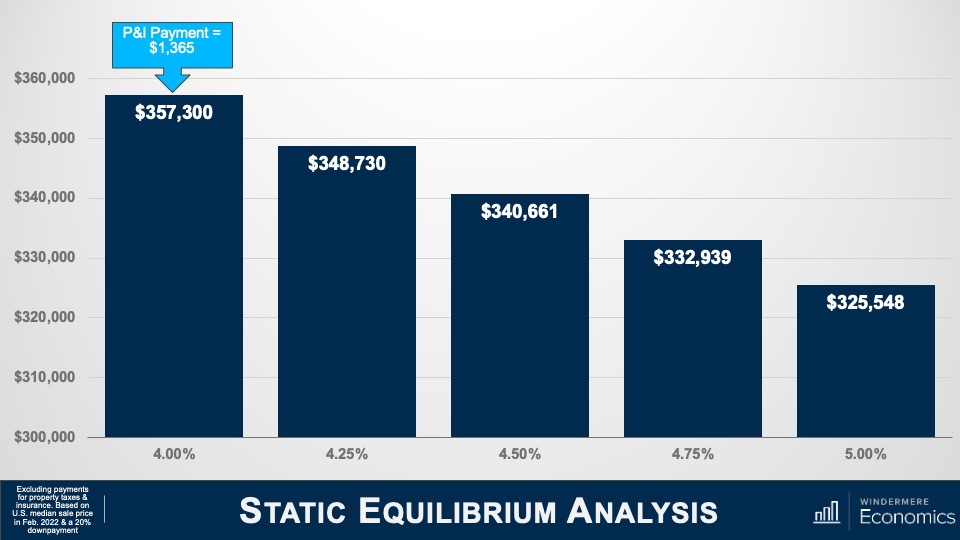
To try and explain this, I’m using the median US sale price in February of this year, assuming a 20% down payment and the mortgage rate of 4%. And you can see that the monthly P&I payment would be $1,365. But as mortgage rates rise, and if buyers wanted to keep the same monthly payment, then they would have to buy a cheaper home. Using a rate of 5%, a buyer could afford a home that was 9% cheaper if they wanted to keep the payment the same as it would have been if rates were still at 4%.
But, as I mentioned earlier, an expanding economy brings higher wages, and this is being felt today more than usual, given the worker shortage that exists and businesses having to raise compensation. Average weekly wages have risen by over five-and-a-half percent over the past year—well above the pre-pandemic average of two-and-a-half percent. Although increasing incomes would not totally offset rising mortgage rates, it does have an impact.
Static Equilibrium Analysis – 2/3
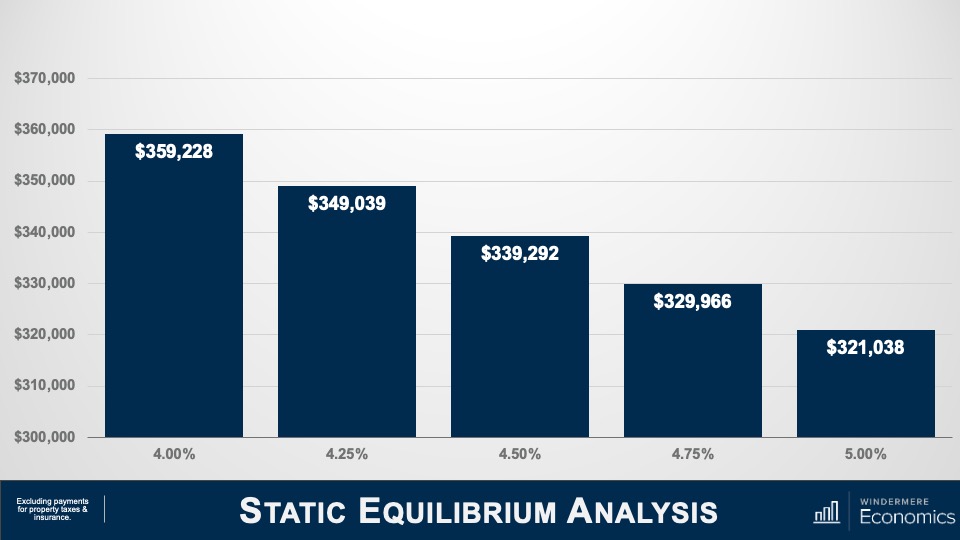
To demonstrate this, let’s use the U.S. average household income of $70,611. Assuming that they’ve put aside 20% of their gross income for a down payment, they could afford a home priced just under $360,000 if mortgage rates were at 4%. As rates rise—and assuming that their income doesn’t—their buying power is reduced by over 10%, or just over $38,000.
Static Equilibrium Analysis – 3/3
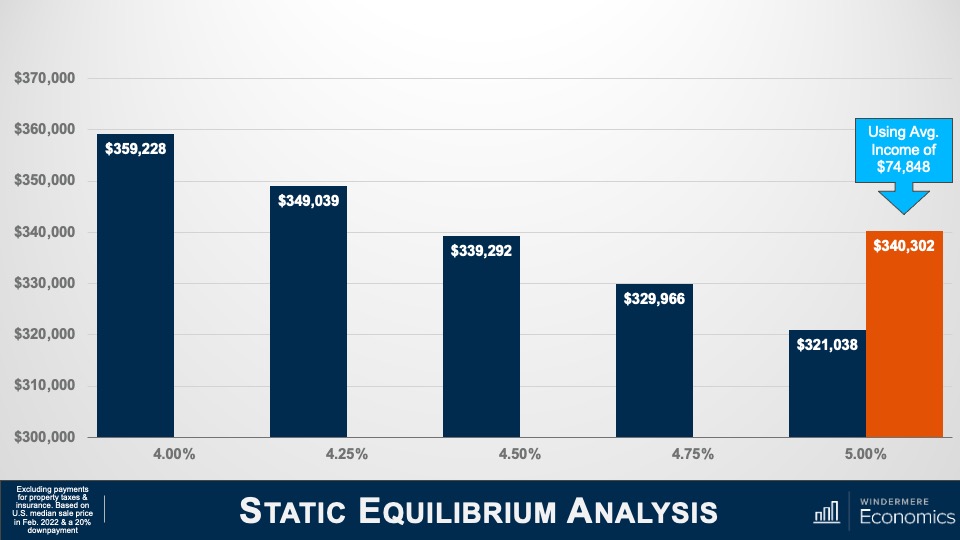
But if we believe that incomes will rise, then the picture looks very different. Assuming wages rise by 6%, their buying power drops by just 5% if rates rose from 4% to 5%, or a bit less than $19,000.
Although rates have risen dramatically in a short period, because they started from an historic low, the overall impacts are not yet very significant. If history is any indicator, mortgage rates increasing are likely to have a more significant impact on sales, but a far smaller impact on prices.
But there are other factors that come into play, too. Here I’m talking about demand. The only time since 1968 that home prices have dropped on an annualized basis was in 2007 through 2009 and in 2011, and this was due to a massive increase in the supply of homes for sale. When supply exceeds demand, prices drop.
So, how is it different this time around? Well, we know that the supply glut that we saw starting to build in mid-2006 was mainly not just because households were getting mortgages that, quite frankly, they should never have gotten in the first place, but a very large share held adjustable rate mortgages which, when the fixed interest rate floated, they found themselves faced with payments that they could not afford. Many homeowners either listed their homes for sale or simply walked away.
Although it’s true that over the past two or so months more buyers have started taking ARMs as rates rose, it’s not only a far smaller share than we saw before the bubble burst, but down payments and credit quality remained far higher than we saw back then.
So, if we aren’t faced with a surge of inventory, I simply don’t see any reason why the market will see prices pull back significantly. But even if we do see listing activity increase, I still anticipate that there will be more than enough demand from would-be buyers. I say this for several reasons, the first of which is inflation.
What a lot of people aren’t talking about is the proven fact that owning real estate is a significant hedge against rising inflation. You see, most buyers have a mortgage, and a vast majority use fixed-rate financing. This is the hedge because even as consumer prices are rising, a homeowner’s monthly payments aren’t. They remain static and, more than that, their monthly payments actually become lower over time as the value of the dollar diminishes. Simply put, the value of a dollar in—let’s say 2025—will be lower than the value of a dollar today.
But this isn’t the only reason that inflation can actually stimulate the housing market. Home prices historically have grown at a faster pace than inflation.
Hedge Against Inflation
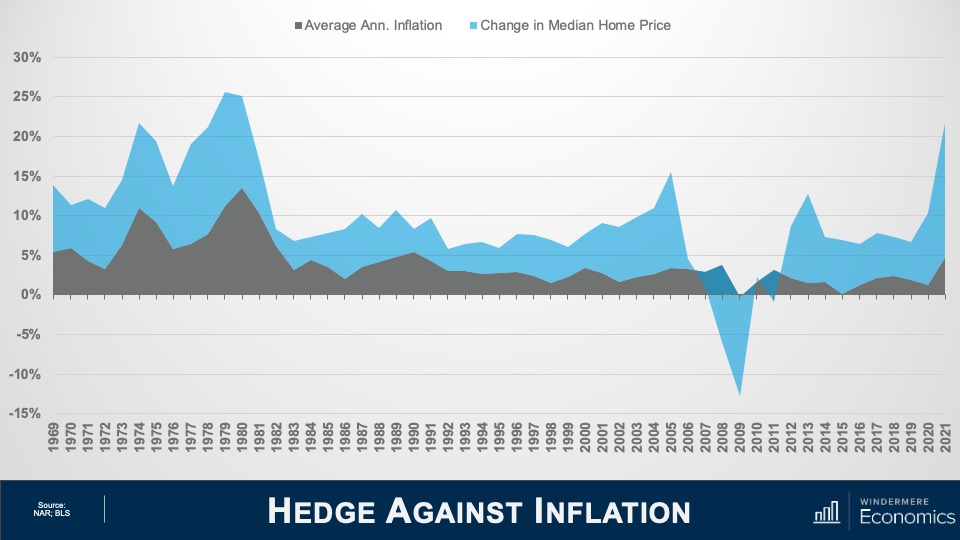
This chart looks at the annual change in total CPI going back to 1969. Now let’s overlay the annual change in median U.S. home prices over the same time period. Other than when home prices crashed with the bursting of the housing bubble, for more than fifty years home price growth has outpaced inflation. And this means we are offsetting high consumer prices because home values are increasing at an even faster rate.
But inflation has additional impacts on buyers. Now I’m talking about savings. As we all know, the interest paid on savings today is pretty abysmal. In fact, the best money market accounts I could find were offering interest rates between 0.5% and 0.7%. And given that this is significantly below the rate of inflation, it means that dollars saved continue to be worth less and less over time while inflation remains hot.
Now, rather than watching their money drop in value because of rising prices, it’s natural that households would look to put their cash to work by investing in assets where the return is above the rate of inflation—meaning that their money is no longer losing value—and where better place to put it than into a home.
Housing as a Hedge Against Inflation
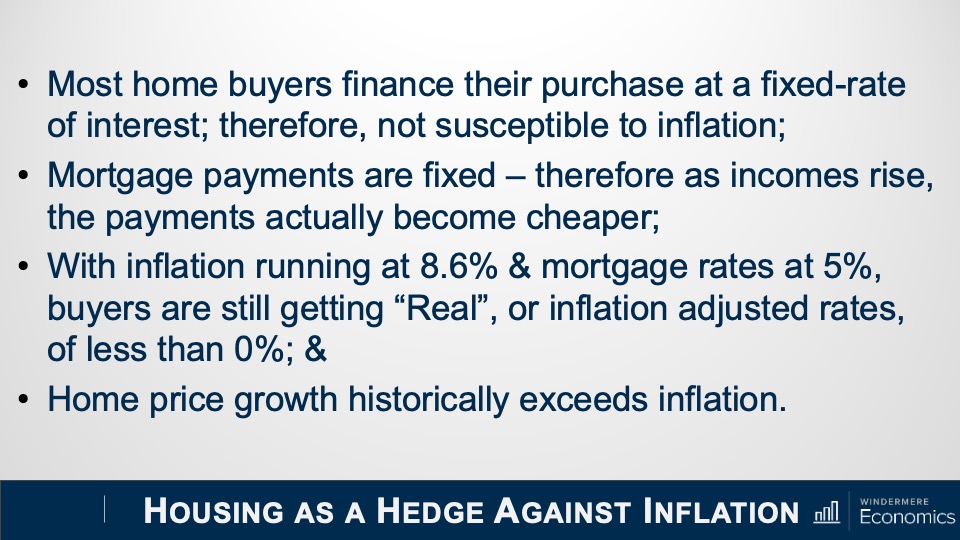
So, the bottom line here is that inflation supports demand from home buyers because:
- Most are borrowing at a fixed rate that will not be impacted by rising inflation
- Monthly payments are fixed, and these payments going forward become lower as incomes rise, unlike renters out there who continue to see their monthly housing costs increase
- With inflation at a level not seen since the early 1980s, borrowers facing 5% mortgage rates are still getting an amazing deal. In fact, by my calculations, mortgage rates would have to break above 7% to significantly slow demand, which I find highly unlikely, and
- If history holds true, home price appreciation will continue to outpace inflation
Demand appears to still be robust, and supply remains anemic. Although off the all-time low inventory levels we saw in January, the number of homes for sale in March was the lowest of any March since record keeping began in the early 1980’s.
But even though I’m not worried about the impact of rates rising on the market in general, I do worry about first-time buyers. These are households who have never seen mortgage rates above 5% and they just don’t know how to deal with it! Remember that the last time the 30-year fixed averaged more than 5% for a month was back in March of 2010!
And given the fact that these young would-be home buyers have not benefited from rising home prices as existing homeowners have, as well as the fact that they are faced with soaring rents, making it harder for them to save up for a down payment on their first home, many are in a rather tight spot and it’s likely that rising rates will lower their share of the market.
So, the bottom line as far as I am concerned is that mortgage rates normalizing should not lead you to feel any sort of panic, and that current rates are highly unlikely to be the cause of a market correction.
And I will leave you with this one thought. If you agree with me that a systemic drop in home prices has to be caused by a significant increase in supply, and that buyers who are currently taking out adjustable-rate mortgages are more qualified, and therefore able to manage to refinance their homes when rates do revert at some point in the future, then what will cause listings to rise to a point that can negatively impact prices?
It’s true that a significant increase in new home development might cause this, but that is unlikely. And as far as existing owners are concerned, I worry far more about a prolonged lack of inventory. I say this for one very simple reason and that is because a vast majority off homeowners either purchased when mortgage rates were at or near their historic lows, or they refinanced their current homes when rates dropped.
And this could be the biggest problem for the market. Even if rates don’t rise at all from current levels, I question how many owners would think about selling if they were to lose the historically low mortgage rates that they have locked into. It is quite possible that for this one reason, we may experience a tight housing market for several more years.
As always, if you have any questions or comments about this particular topic, please do reach out to me but, in the meantime, stay safe out there and I look forward to visiting with you all again next month.
Bye now.
This blog entry was originally posted on Windermere.com and can be viewed HERE
APRIL 2022 Whidbey Island Real Estate Market Update
🚨 Here it is folks! The April 2022 Whidbey Island Real Estate Market Update (rolling 12-month report). CLICK HERE TO GET THE PRINTABLE PDF!
🗺️ Stats are separated by area: South, Central, & North Whidbey, and incorporate data from the 12 months prior to our current month.
🏡All stats represent only the residential & condo sales, except for the ones specifically for vacant land. May not represent all market activity.
If you want help interpreting this data and what it means for you. Feel free to message us and setup a free buyers or sellers consultation.
🤗 Enjoy!
#wearewhidbey #windermereEconomics
Created by Si Fisher
.
.
.
Data supplied by the NWMLS. Neither the
Board or its MLS guarantees its accuracy. May
not reflect all real estate activity in the market.
March 2022 Whidbey Island Real Estate Market Update
🚨 Here it is folks! The March 2022 Whidbey Island Real Estate Market Update (rolling 12-month report). CLICK HERE TO GET THE PRINTABLE PDF!
🗺️ Stats are separated by area: South, Central, & North Whidbey, and incorporate data from the 12 months prior to our current month.
🏡All stats represent only the residential & condo sales, except for the ones specifically for vacant land. May not represent all market activity.
If you want help interpreting this data and what it means for you. Feel free to message us and setup a free buyers or sellers consultation.
🤗 Enjoy!
#wearewhidbey #windermereEconomics
Created by Si Fisher
.
.
.
Data supplied by the NWMLS. Neither the
Board or its MLS guarantees its accuracy. May
not reflect all real estate activity in the market.
December 2021 Whidbey Island Real Estate Market Update
🚨 Here it is folks! Your year-to-date Whidbey Island Real Estate Market Update. CLICK HERE TO GET THE PRINTABLE PDF!
🗺️ Stats are separated by area: South, Central, & North Whidbey.
🏡All stats represent only the residential & condo sales, except for the ones specifically for vacant land. May not represent all market activity.
If you want help interpreting this data and what it means for you. Feel free to message us and setup a free buyers or sellers consultation.
🤗 Enjoy!
#wearewhidbey #windermereEconomics
Created by Si Fisher
.
.
.
Data supplied by the NWMLS. Neither the
Board or its MLS guarantees its accuracy. May
not reflect all real estate activity in the market.
Now What? What to do after Christmas

Now What?
The gifts are all open, friends and family have returned to their respective homes, the ball has fallen, and the kids are back in school. The holiday season has officially come to a close, leaving us with the annual question of “Now what?”
Although this question can be an ominous one correlating to all that life may hold for us in the coming 12 months, for many it also applies to right here and right now. The sudden calm after Christmas can leave people dazed or even in a state of shock when they realize they have a bit of post-holiday cleanup to complete. It can be hard to know where to start or what to do when it comes to reorienting your home back to normal. We are here to help with 5 After Christmas Activities.
-
Donate Old Toys
If you’re like most families, the quantity of toys in your home this time of year probably spikes quite a bit. When new and exciting Christmas gifts join those that came before it can feel like you’re living on the Island of Misfit Toys. Sneaking unplayed-with toys out of their room in the dead of night may be the easiest option but encouraging your children to choose which toys they would like to donate can help teach generosity, the importance of cleaning up, and critical decision making skills. Once you and your kids have decided which toys they can bear to part with there are a few choices on where you can donate. Below are some of Whidbey’s second-hand shops and charities that accept lightly used toys.

-
Island Thrift | 600 SE Barrington Dr, Oak Harbor
-
Upscale Resale | 210 SE Pioneer Way, Oak Harbor
-
Habitat for Humanity | 280 SE Pioneer Way, Oak Harbor
-
The Garage of Blessings | 800 SE Barrington Drive, Oak Harbor
-
Recycle Your Tree
Now for that (maybe less than lush) tree currently gracing your living room with its presence. It’s always a little sad when the time comes around to take down the Christmas tree, but the end of its needle droppings is usually welcomed. What’s not welcomed is the question of what to do with it. If you live in a house with a wood burning fireplace it might be a little tempting to chop it up and throw it in, but this is a BAD IDEA. When pine needles catch on fire they don’t burn slowly like wood, but instead spark out in all directions which can be a huge fire hazard in a home. Instead, what you should do is deposit your tree at one of the island’s Solid Waste drop-off locations where they can be put with other yard waste and recycled properly:

-
North Whidbey Solid Waste | 3151 Oak Harbor Road, Oak Harbor
-
Coupeville Solid Waste Complex | 20018 State Highway 20, Coupeville
-
Bayview Solid Waste | 5790 S Kramer Road, Langley
-
What You Can and Can’t Recycle
“Did you know that household waste increases by more than 25% from Thanksgiving to New Year’s?” (King5) It’s little wonder why this increased waste occurs. However, it doesn’t make the statistic any less startling. To put that in perspective, since the average American produces about 4.5 lbs of waste a day (EPA); Whidbey Island theoretically produces an additional 3,500 TONS of waste every holiday season. If there was ever a stat to make you want to recycle, that should be it! However, in order to be an effective recycler you need to know what can and what can’t go in that little blue bin of yours. So here’s a quick rundown of what can and can’t go in your recycling bin.

CAN Recycle● Cardboard boxes● Plain paper boxes and bags● Plain wrapping paper● Holiday Cards (w/o embellishments)● Tissue paper |
CAN’T Recycle● Bubble wrap● Cellophane● Tinsel● Plastic Bags● Holiday Lights● Ribbons● Bows● Foam Packaging |
-
Give to the Food Bank
During the holidays it’s very easy to get caught up in the good cheer and generosity of the season. But the time immediately after the holidays can be especially difficult for charities and food banks. The financial exasperation many experience directly after the holidays can cause an all out stop to donations for a while; but unfortunately, needs don’t cease just because Christmas is over. Donating to charities and especially food banks is something critical to do throughout the year and not just in November and December. Below are some local food banks who could do a great amount of good with your post-Christmas donations.

-
Help House | 1091 SE Hathaway St, Oak Harbor
-
Good Cheer | 2812 Grimm Rd, Langley
-
Throw a Regifting Party!
We all have that one gift (or 5) that we simply didn’t want or need. Yes, Aunt Kathy meant well, but what on earth are you going to do with a crochet pillow of her cat?? Often these gifts are begrudgingly placed deep into the depths of our closets never to be seen again (or at least not for a few years). However, it doesn’t have to be this way! We know you aren’t a fan of seeing Whisker’s face on a pillow every day, but who is to say your friend Bethany might not LOVE it? Unwanted gifts don’t need to sit gathering dust in the closet, especially when there’s a simple solution of how to find someone who might actually find use or enjoyment in it.

Throw a Regifting Party!
Regifting Parties are basically White Elephants thrown after Christmas with the intention of finding better homes for those unwanted gifts. The concept and rules for the Regifting Game is simple and match White Elephant almost exactly. So makes some warm drinks, grab a few good friends, and have a great time discovering new treasures!
You Might also Like:

Blonde Lawns on Whidbey Island

Blonde Lawns on Whidbey Island
Hello Summer! Can you believe it’s here? That beautiful time of year filled with beach walks, swimming lessons, trips to Kapaws Iskreme and so much more! Here on Whidbey we have countless summer traditions we treasure greatly. From our Old Fashioned 4th of July Celebration to the Whidbey Island Fair, there is so much to cherish about this time of year. One tradition you may be unaware of is actually more of a movement.
Blonde Lawns.
Through the course of the summer months you can watch the emerald grass of this evergreen island fade to a sandy shade. Before you know it, this rock will be rocking a brand new blonde look.
What’s with the lack luster lawns? Well, it all has to do with conservation.
It’s no surprise to anyone that Whidbey tends to be a rather environmentally conscious. We love taking the extra step to ensure the beauty and resources we enjoy today will be around for tomorrow. One of those resources we care deeply about are our aquifers.
Aquifers:
Aquifers is the scientific term for ground water. Deep below the grass you walk on are pockets of “permeable” soil which store water that can then be tapped into for use. Annually these aquifers are recharged by the rain that falls to the ground.
According to Island County, Whidbey Island’s sole source of potable water comes from the ground.1 Sounds great, right? I mean, it’s Washington and it rains here. We should be good.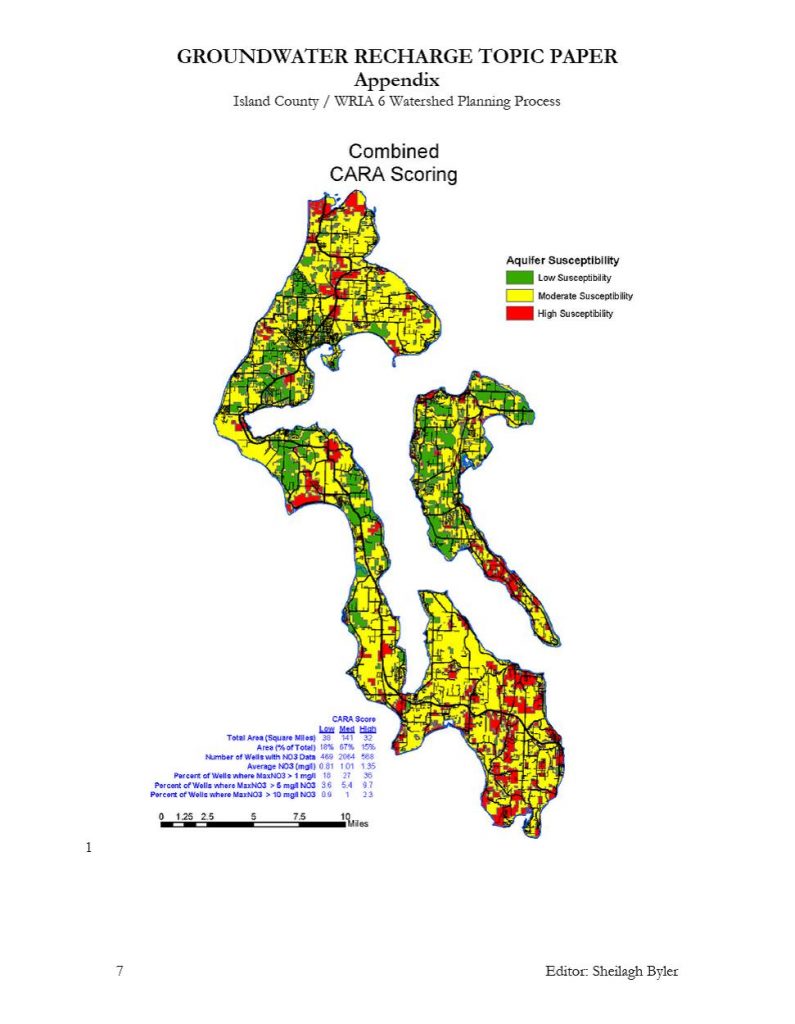
Unfortunately, not all is good in the aquifer hood.
According to a report released by the Washington State Department of Ecology, “increasing demands for water from ongoing population growth, declining stream flows and groundwater levels… have put Washington’s water supplies at risk.” Whidbey is by no means immune to this water depletion; in fact, seawater intrusion and our lack of rain fall in comparison to the rest of Western Washington puts us in a pretty tight spot.
So, what does this have to do with the blonde lawns of Whidbey (I think you can guess).
The summer months, when there is little rain, poses a particularly difficult dilemma for island aquifers. Between keeping ourselves hydrated in the summer sun, watering plants, animals, and filling the pool in the backyard we use A LOT of water.
This increase of use and lack of resource hits hard on our aquifers and our wallets! Many newcomers to Whidbey are shocked when that first summer water bill comes in. The rules of supply and demand are no strangers to Whidbey Island water.
So how can we save our aquifers (and our wallets)? By going blonde!
Grass is far more durable than people sometimes realize. More times than not the golden grass that takes over Whidbey in the summer will be green again by next spring. Blonde lawns DON’T mean dead grass.
So, save yourself time, money, hassle and save our precious resources. Let your lawn go blonde!
Resources:
- https://www.islandcountywa.gov/Planning/Pages/critaq.aspx
- https://fortress.wa.gov/ecy/publications/documents/1111011.pdf
You might also like:

GeoCaching on Whidbey Island
Geocaching on Whidbey Island

Geocaching on Whidbey Island
Why is Whidbey Island the Perfect Place?
It is no secret that Whidbey Island is an astonishingly beautiful place. It’s the kind of atmosphere that draws you outside to enjoy the many state parks and breathtaking beaches. Countless trails dot the landscape all across the island. These trails and parks are what make Whidbey Island the perfect place for one very special activity: geocaching.
View this post on Instagram
What is Geocaching?
Geocaching is a hobby that has been around for almost twenty years, following the significant improvements on the global positioning system. The concept of the game is simple; go to a location indicated on your app/GPS, find the hidden treasure, re-hide and repeat. Geocaching’s simple, yet successful, concept attracts millions from across the globe to get outside and participate. On Whidbey Island alone there are over 300 caches!
View this post on Instagram
From the Geocachers:
We asked a few Geocachers about the draw to the hobby and they gave us a wealth of knowledge.
Sandra, a long term Geocacher, expressed “so many activities today [are] related to being indoors and sedentary in nature,” but she believes breaking that trend is what brings people to the hobby.
“Geocaching [is] directly related to being outside, the benefits are exercising your brain and your body! I’ve also been introduced to wonderful like-minded people who enjoy adventures.”
Bill, a fellow Geocacher, echoes every word of Sandra’s beliefs in the benefits of Geocaching. Asked why he started he simply said, “it was a way to get out!” As a retired man Bill is grateful to have geocaching for a hobby. Its something that keeps him active, helps him meet new people and discover new places.
So how easy is it to get into Geocaching?
Step 1: Download the App
This is the easiest part! Both iTunes and Google Play offer Geocaching as a phone app. All you need to do is search for it and download.
Step 2: Set Up a Profile
Setting up a profile allows you to save those caches you have already found and will start to develop statistics after you’ve been participating for a while.
Step 3: Start Finding Caches!
The app will immediately give you directions to the caches nearest you. You will follow it to the location and after that you are mostly left to find the treasure.

We Gave it a Try:
We decided to give it a try ourselves and it was great! We discovered there was a geocache right next to our Coupeville office. When we got a little lost and confused, we found out there was a helpful hint to guide the way. After a little snooping we found a tiny pill box with the visitor log!


Overall it was a pretty great experience and we can’t believe there are SO MANY more caches to find and places to discover on Whidbey Island! Sandra stated it best, “Whidbey Island is a magical place to live and geocache in… I loved discovering the “Mother of All Erratics” in the Saratoga Woods near Langley, (as well as) new trails and Dugualla State Park on North Whidbey, and secret places in Deception Pass State Park. We have lived on Whidbey almost 38 years and all of those places and more were discovered through geocaching!”
Go get out there and explore!
You Might Also Like:

QR Codes Connecting Us to History

The Gray Whales Return to Whidbey
Fourth of July Celebration on Whidbey Island

Fourth of July Celebrations on Whidbey Island
Carnivals, parades, BBQ’s, music, and of course huge firework shows make an incredible Fourth of July celebration on Whidbey Island. There are small events up and down the island but the two hot spots for firework shows and lots of activity are Oak Harbor and Freeland.



Freeland Celebrations:
The celebration begins in Freeland on July 3rd with their annual “Celebrate America” event at Freeland Park. Starting mid-afternoon there will be face painting, bounce houses, music, and live entertainment for you to enjoy! This year the event will feature a magic show, circus tricks, martial arts demonstrations, a dance team, and a Neil Diamond tribute band. At the end of the day, the party will go out with a bang with the largest fireworks show on Whidbey Island beginning around 10:20 pm. For a full schedule of events click here! https://whidbeycamanoislands.com/event/celebrate-america-2018/.
Oak Harbor Celebrations:
In Oak Harbor, Independence Day festivities take over the whole town! The carnival will be open June 29th through July 4th with rides, classic carnival food, games, and so much more! You can purchase your carnival tickets ahead of time here ( https://oakharborchamber.chambermaster.com/eventregistration/register/7591 ) to avoid long lines at the event. On July 4th the party continues with a day that is jam-packed with activities. It all starts with the annual Rotary Pancake Breakfast, grand parade down Bayshore Drive, and throughout the day you will be able to check out the street fair on Pioneer as well as enjoy live music at Smith Park. Finally, to wrap up an eventful day, you won’t want to miss the firework show that starts at dark. (Rumor has it that it will be the tallest show ever!)
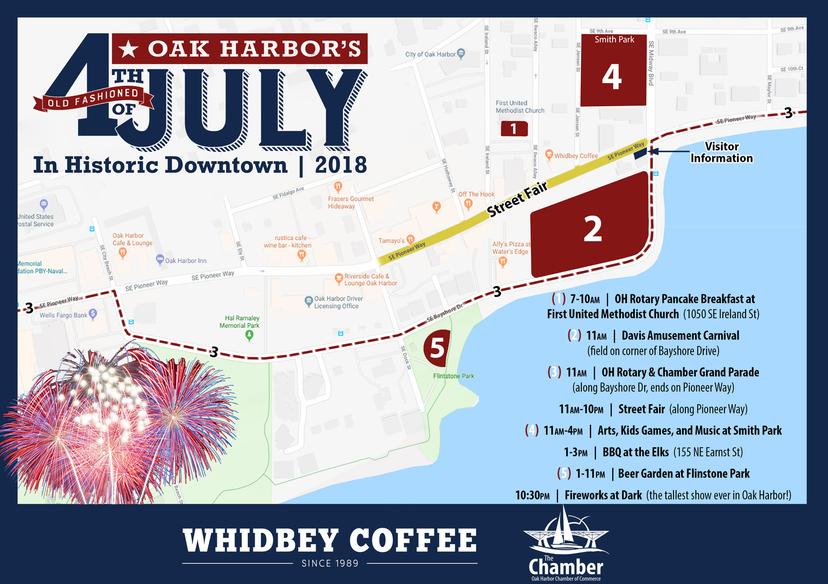
We can’t wait to take part in the fun this year! If this is your first year experiencing the bustle to take place on the island, you won’t be disappointed! If you have been, we want to know what your favorite part is!
You might also be interested in:



#mc_embed_signup{background:#fff; clear:left; font:14px Helvetica,Arial,sans-serif; width:100%;}
/* Add your own MailChimp form style overrides in your site stylesheet or in this style block.
We recommend moving this block and the preceding CSS link to the HEAD of your HTML file. */