Facebook
 X
X
 Pinterest
 Copy Link
01
New construction
Newly completed or actively marketed builder homes, including homes that may be ready now and properties still under construction.
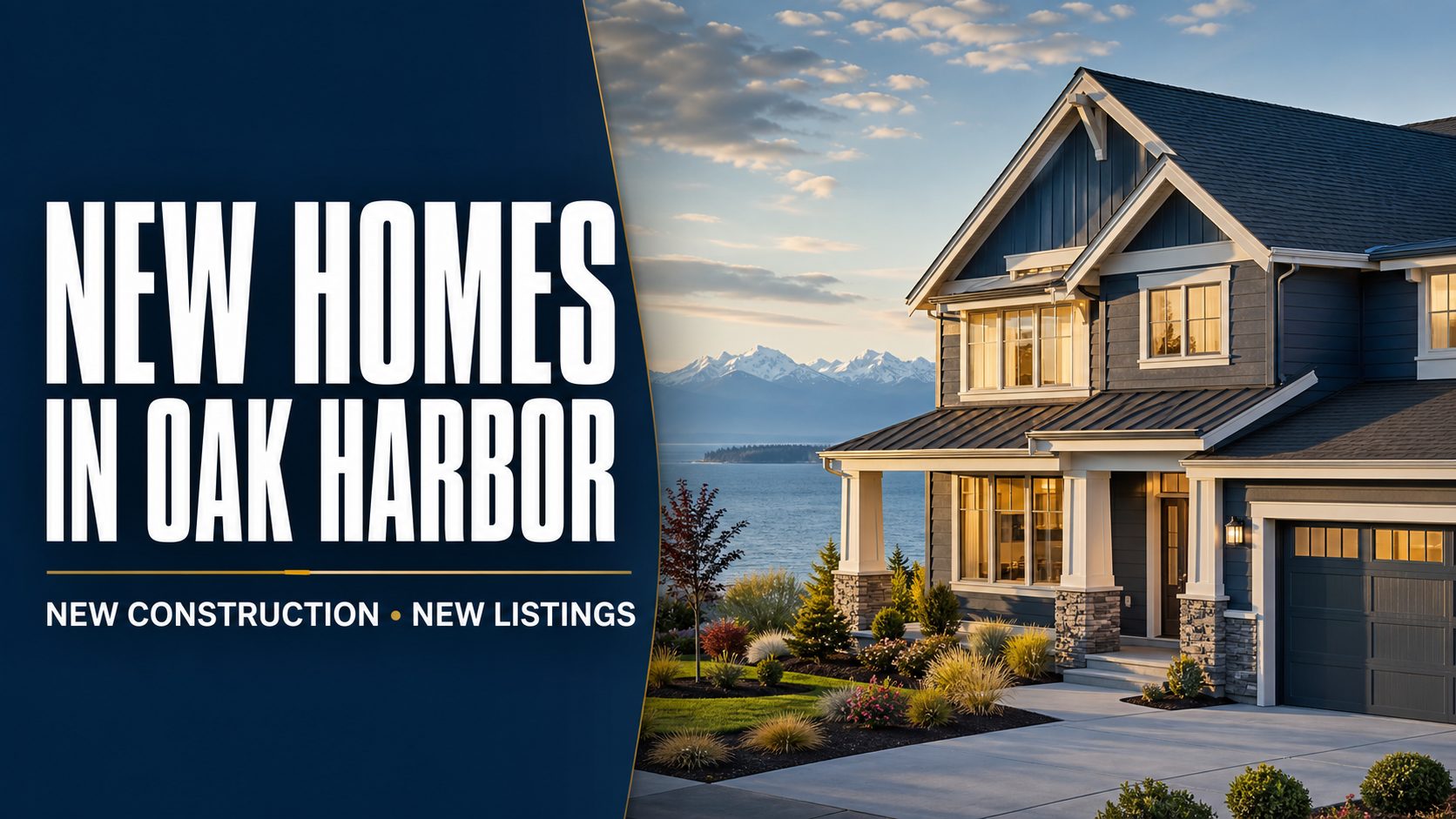
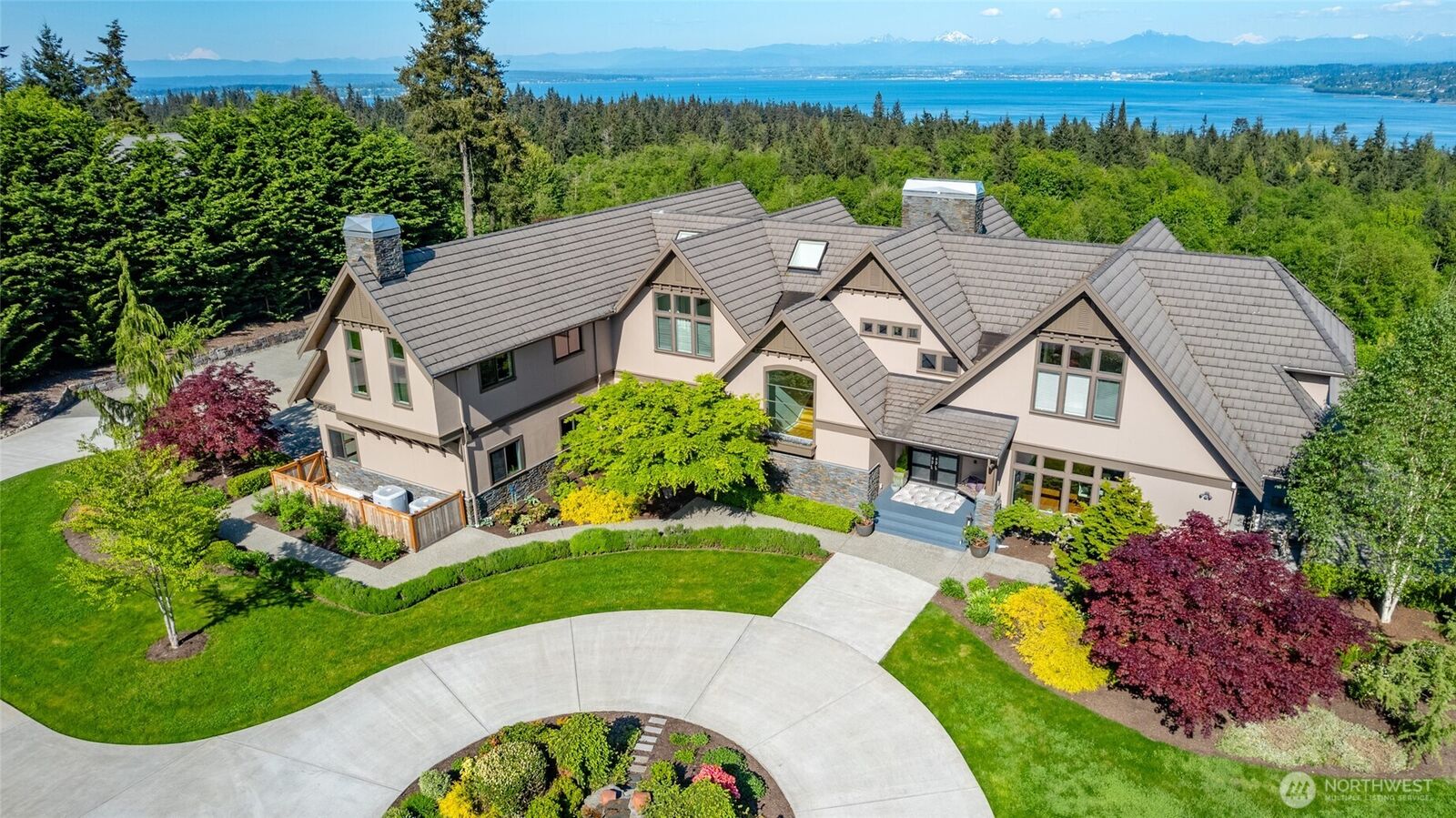
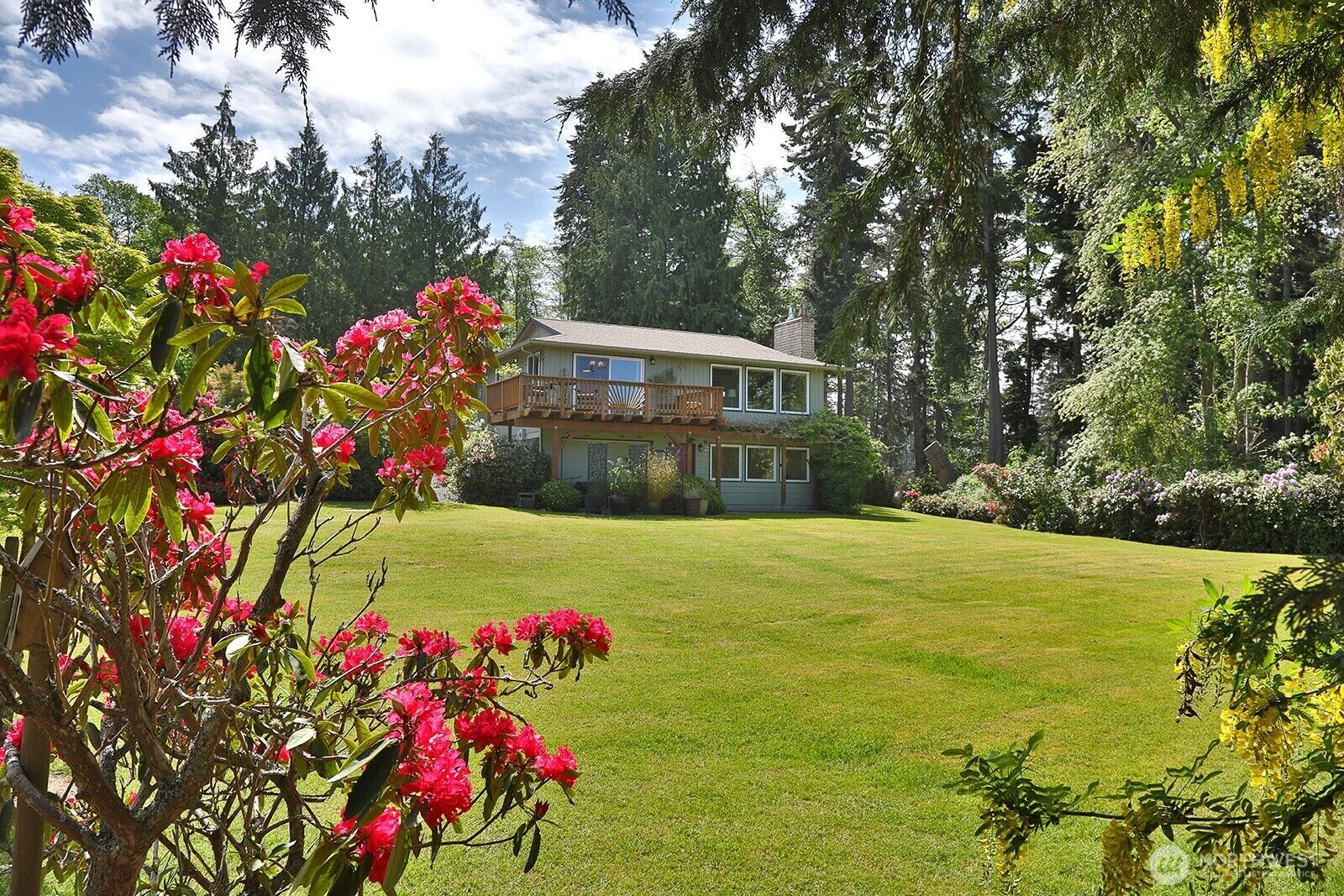
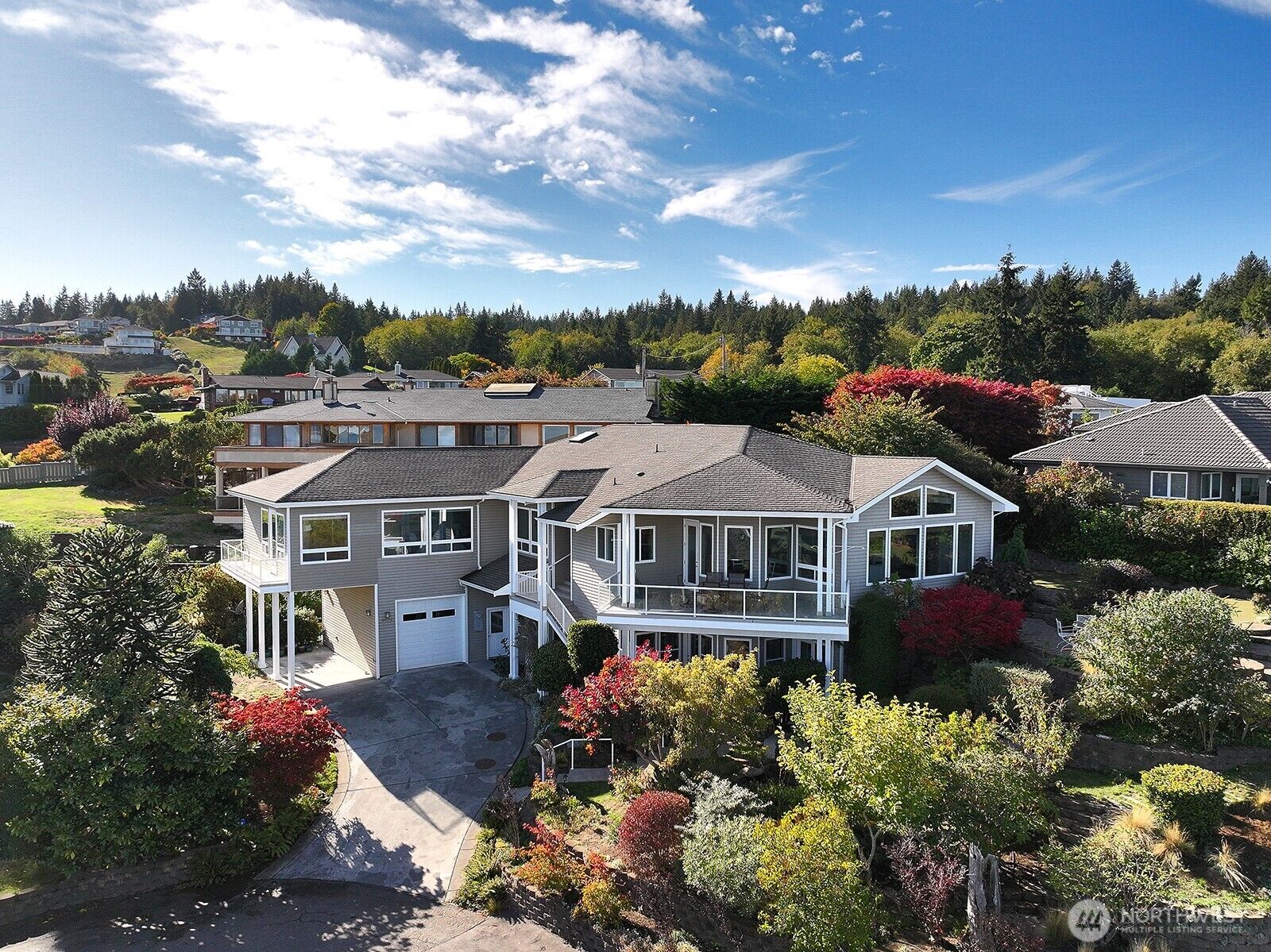
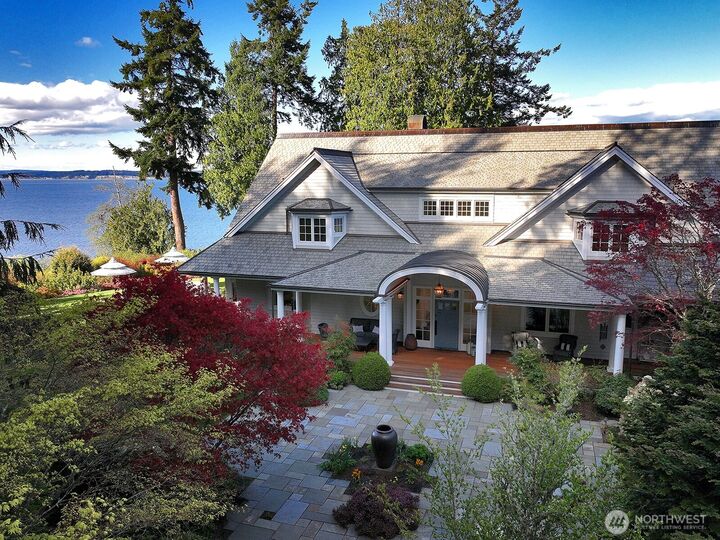
Explore new homes for sale in Oak Harbor, WA, including new construction, recently listed homes and move-in-ready properties in the largest city on Whidbey Island.
Start with current listings, then compare neighborhoods, utilities, NAS Whidbey aircraft activity, off-island travel and other details that can materially affect your decision to buy a home in Oak Harbor.
Buyers use the phrase in several ways. Separating the options makes the search more useful and reduces time spent sorting through properties that do not match your timing or goals.
Newly completed or actively marketed builder homes, including homes that may be ready now and properties still under construction.
Existing or recently built properties that have newly entered the market. The primary search is sorted so newer activity rises.
Homes of any age that may meet a buyer’s condition and timing requirements without waiting for a construction schedule.
These links use live Windermere Whidbey search filters and exclude pending listings. Confirm important features and location details for each property.
The best search starts with how you want the property and location to function—not simply a neighborhood name.
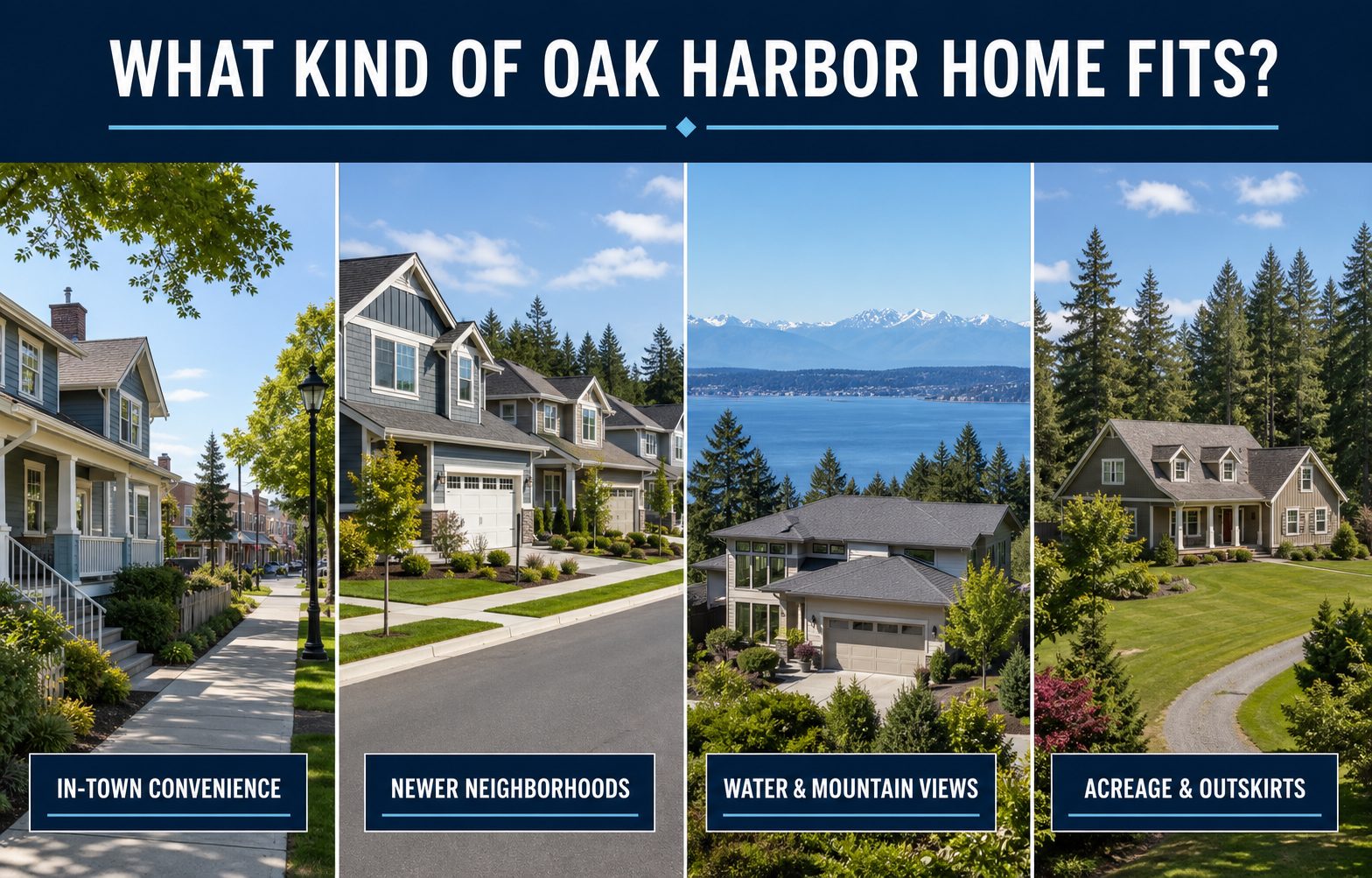
Homes in the compact city offer more direct access to shopping, schools, parks, medical offices and the waterfront. Compare traffic, lot size, parking and the exact utility connections.
Newer subdivisions and active construction appear around the west and southwest sides of the city. Compare builder terms, completion status, lot orientation, nearby development and commute routes.
The north side can be convenient for NAS Whidbey Island and SR 20. Aircraft activity varies by location, so review the applicable disclosure and experience the area at different times.
View direction, tree growth, neighboring parcels, weather exposure, bluff conditions and shoreline rules can matter as much as the view shown in listing photos.
Larger or more wooded properties outside the compact city may use wells, septic systems, private roads or shared maintenance agreements. Travel time and broadband should be checked at the address.
An Oak Harbor mailing address or IDX search can include property outside incorporated city limits. Verify jurisdiction, zoning, utilities and permitting authority for every address.
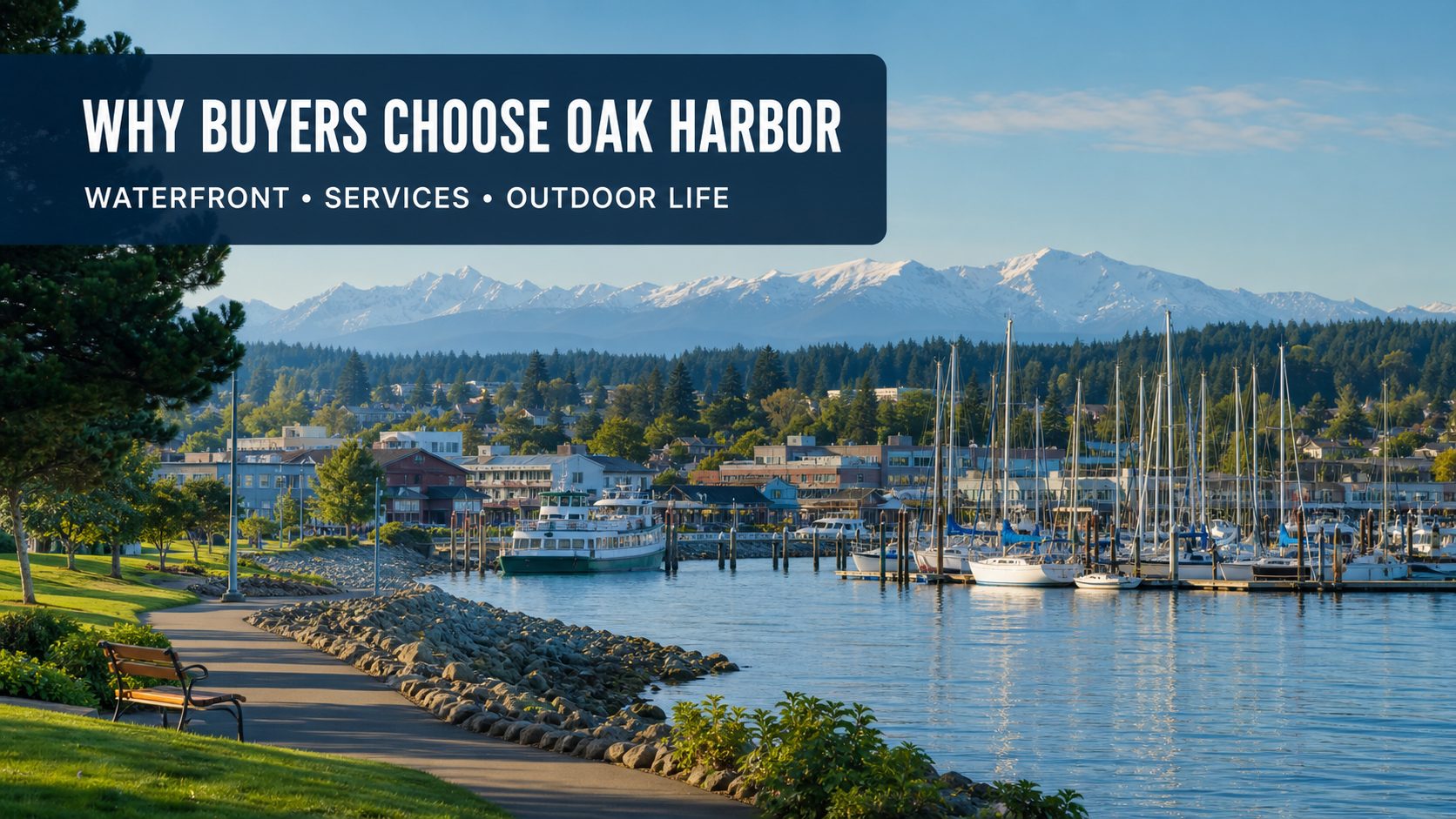
Oak Harbor has the island’s largest concentration of shopping, schools, medical offices and daily services, while retaining a manageable small-city scale.
The city provides more than 30 parks, public shoreline, a marina and waterfront trails, with Deception Pass and other North Whidbey destinations nearby.
SR 20 crosses Deception Pass to the mainland, while ferry routes connect Whidbey with Mukilteo and Port Townsend. Wind, salt exposure and winter travel conditions still matter.
Homes sharing the same mailing city can have very different utility, access, maintenance and regulatory considerations.
Builder registration and buyer-representation policies vary. Involve your broker before or during the first community or model-home visit.
Review completion timing, deposits, financing incentives, escalation provisions, included finishes, landscaping and warranty terms.
New construction is not the same as independently inspected construction. Discuss appropriate inspections and final walkthroughs.
SR 20 crosses Deception Pass and provides Oak Harbor’s direct road connection toward Fidalgo Island, Anacortes and the mainland. Bridge work, collisions and seasonal traffic can affect travel time.
Trips toward Seattle commonly use SR 20 north or the Clinton–Mukilteo ferry to the south. The Coupeville–Port Townsend route provides Olympic Peninsula access and accepts vehicle reservations.
WhidbeyHealth Medical Center in Coupeville is the island’s critical-access hospital, with additional services across Whidbey. Buyers with specialized-care needs should compare current providers and off-island travel requirements.
It can mean either. This page separates active new-construction listings from the broader active Oak Harbor inventory, which includes newly listed and move-in-ready homes.
A search may include in-town neighborhoods, newer west and southwest developments, north-side properties and homes outside incorporated city limits that use an Oak Harbor mailing address. Verify jurisdiction and utilities for each address.
Availability changes, but active new-construction listings can be found through the focused search on this page. Confirm completion timing, included finishes and builder terms with your broker.
All are possible within the broader search area. City-served properties may have municipal water, sewer and stormwater services, while some properties outside those systems use wells or septic.
Review the applicable airport-environs or aircraft-noise disclosure and official AICUZ information. When practical, visit the property at different times because aircraft activity and perceived noise vary by location and schedule.
SR 20 crosses Deception Pass to the north. Ferry routes connect Clinton with Mukilteo and Coupeville with Port Townsend; the Coupeville–Port Townsend route accepts vehicle reservations.
Buyers should discuss independent inspections and final walkthroughs with their broker and inspector. A newly built home is not automatically the same as an independently inspected home.
Browse active listings or ask Windermere Whidbey for help comparing properties, locations and purchase considerations.

Whidbey Island seller strategy
In this market, the answer is often yes. Not always. Not automatically. But if the goal is to get a qualified buyer across the finish line, a closing-cost credit can do more work than a price reduction.
The short version: With mortgage rates still weighing on buyer budgets, helping with cash-to-close may be more powerful than shaving the same amount off the list price.
A recent Keeping Current Matters article raised the national version of this question. But Whidbey is not a national average with ferry access. Our market is local, segmented, and occasionally a little dramatic in the way only island real estate can be.
For Whidbey sellers, the better question is not, “Am I giving something away?” It is, “Which move helps the buyer enough to get the deal done while still protecting my net?”
This is not some strange new negotiation creature wandering out of the woods. According to NWMLS data provided for area 811 - South Whidbey, 45 of 126 residential and condo listings that closed in the 180 days ending June 15, 2026 included seller concessions.
That means seller help with buyer costs is not rare. It is showing up in roughly one out of three recent South Whidbey residential and condo closings. The details still matter, but the strategy is clearly on the table.
A price reduction can look satisfying on paper. It is clean, visible, and easy to understand. But for a buyer dealing with today’s mortgage rates, the monthly payment change from a modest price cut may not feel big enough to solve the actual problem.
Buyer closing costs are different. A seller credit can reduce the cash a buyer needs at closing. That can be the difference between “we like the house” and “we can actually buy the house.” Very technical real estate term: useful.

If a $10,000 price reduction does not move the buyer’s payment enough to matter, but a $10,000 credit helps them cover closing costs, the credit may be the stronger negotiating tool.
The seller still needs to look at net proceeds, loan rules, appraisal risk, competing offers, and overall deal strength. But emotionally resisting the word “credit” can cost a seller a perfectly workable sale.
Whidbey is not one market. South Whidbey, Central Whidbey, and North Whidbey can behave differently at the same time. Waterfront, acreage, in-town homes, condos, view properties, and homes needing work can all draw different buyer pools.
That is why a blanket rule does not work. In one segment, a seller may need to create breathing room for the buyer. In another, a well-priced home in excellent condition may still have enough demand to hold firm.
The best strategy is not “always offer closing costs.” The best strategy is knowing when a credit solves the buyer’s real problem better than a price cut does.
A seller-paid closing-cost credit may be worth considering when showings are happening but offers are thin, buyers are giving positive feedback but hesitating on affordability, competing listings are sitting, or inspection and repair conversations are becoming deal friction.
It can also be useful when the home is priced correctly but the buyer pool is payment-sensitive. That is a very real thing right now. Buyers may like the house, like the location, and still feel squeezed by the amount of cash needed to close.
Some homes do not need to lead with a credit. If the listing is fresh, priced well, beautifully prepared, and getting strong activity, offering concessions too early can be like bringing a casserole to a dinner party that already has too much food. Kind, but maybe unnecessary.
In stronger segments, it may be better to wait for buyer feedback before adjusting the strategy. The question is not whether sellers should be flexible. The question is whether flexibility is solving a real market problem.

Before choosing a price reduction or a closing-cost credit, sellers should ask four questions: What is the current showing activity? What are buyers saying? What similar homes are competing with us right now? And what does each option do to our net proceeds?
If a closing-cost credit helps the buyer more than a price reduction and keeps the seller’s net in an acceptable range, it may be the cleaner path to a sale. Not flashier. Not more dramatic. Just more effective.
In many cases, yes, especially when the buyer is qualified but stretched by cash-to-close. A seller credit can remove more friction than a small price reduction, but the right move depends on price point, condition, location, competing listings, and the seller's net proceeds.
NWMLS data provided for 811 - South Whidbey shows that 45 of 126 residential and condo listings closed with seller concessions in the 180 days ending June 15, 2026, or about 36%.
Sometimes. A price reduction may only modestly change a buyer's monthly payment, while a closing-cost credit can directly reduce the cash a buyer needs to close. That can matter a lot in a higher-rate market.
No. Strong listings with excellent condition, pricing, location, and early activity may not need to offer a credit upfront. The strategy should be based on feedback, showing activity, competition, and the seller's goals.
Local real estate conditions vary by price segment, property type, condition, location, financing, and micro-market. Seller concessions, price reductions, and negotiation strategies should be evaluated with a local expert and a clear net sheet. NWMLS concession data referenced above was provided for South Whidbey residential and condo closings in the 180 days ending June 15, 2026.
Whidbey's market shifted in May, but not in the tidy, spreadsheet-friendly way that makes everyone nod and move on. Some buyers got more choices. Some sellers still had leverage. Some price bands perked up. Others hit the snooze button and asked for five more minutes.
The useful story is local and uneven: South Whidbey, Central Whidbey, and North Whidbey are not wearing the same outfit to this market. If you are buying or selling, the islandwide average is a starting point, not a strategy.
Animated local comparison by Whidbey submarket. Hover for exact values.
South Whidbey ended May with 120 active residential and condo listings, slightly below 124 at the same point last year. That is not a flood of inventory. It is more like someone cracked a window and let a little air in.
Central Whidbey is where the inventory story gets louder. Active listings rose 43.6% year over year, from 39 to 56. New listings were up too, and pendings rose alongside them. Translation: buyers saw more options, but they were not alone in noticing.
North Whidbey had the same active listing count as last year, 116, but May new listings, pendings, and closed sales were all lower than May 2025. It is still the highest-volume part of the island, but buyers appear more choosy. The market has not stopped. It has started reading the fine print.
Median active price moved in different directions by area. South Whidbey's median active price was $889,000, down 1.0% from last May. Central Whidbey's was $730,000, down 7.0%. North Whidbey moved higher, up 11.5% to $622,475.
Hover points for annual median sale prices, 2013 through 2026 YTD.
This is where the islandwide average starts acting like it knows more than it does. A waterfront Greenbank property, a Holmes Harbor home with flexible living space, a Mutiny Bay retreat, and a North Whidbey neighborhood home are all technically "Whidbey real estate." They are not the same market in practice.
That matters for pricing. It matters for offers. It matters for how long a listing should sit before a price adjustment becomes a conversation instead of a confession.
South Whidbey had 102 year-to-date sales compared with 97 a year earlier, while new listings rose from 215 to 241. Central Whidbey had 61 year-to-date sales compared with 56 last year, with new listings up sharply. North Whidbey had fewer year-to-date sales and fewer new listings than last year, which tells a different story from Central entirely.
Choose a view and submarket. Hover bars for exact values.
The price-band charts show why "the market is up" or "the market is slow" is too blunt to be helpful. South Whidbey had more activity in some upper brackets and fewer sales in others. Central Whidbey added supply across several ranges. North Whidbey softened in lower brackets while still showing life around the middle of the market.
That is not a contradiction. That is Whidbey. Around here, the details do not ride in the back seat; they drive.
Buyers should be encouraged, but not cocky. There are more options in some pockets, and selective sellers may be more willing to talk. But the best-positioned homes can still move quickly, especially when condition, location, and price all show up wearing the same jersey.
Watch the boring things. Days on market. Price changes. Competing inventory. Condition. Inspection risk. Whether the view is truly a view or just a charming peek if you stand on one foot in February.
Sellers should not panic, but they should respect the market. Pricing too high and waiting for the perfect buyer can work when inventory is starved. In a more selective market, that strategy starts to look like leaving the ferry line to "find a shortcut."
A strong seller plan should start with a micro-market review: nearby sales, active competition, price-band movement, condition, view or waterfront premiums, and how buyers are behaving right now for your specific property type.
Averages are only a starting point. Price segments, property types, condition, location, waterfront or view attributes, acreage, neighborhood, and micro-markets can move differently. Before making a pricing, offer, or timing decision, talk with a local Whidbey expert about your specific property or search.
It depends on the area and price point. The June Facts & Trends reports described South Whidbey as neutral in May 2026, Central Whidbey as a buyer's market, and North Whidbey as a seller's market. That is why a submarket-specific read matters.
Prices are mixed by area and by property type. South Whidbey and Central Whidbey had lower median active prices than last May, while North Whidbey's median active price was higher. Median sale price trends also vary by submarket.
Whidbey Island has very different housing segments, including waterfront homes, view properties, wooded acreage, in-town homes, condos, and neighborhood homes. Buyer pools and inventory levels can be very different from South Whidbey to Central Whidbey to North Whidbey.
No. Islandwide averages can provide context, but pricing should be based on your specific property, condition, location, view or waterfront attributes, recent comparable sales, current competition, and the price segment you are in.
Data supplied by the NWMLS and local Windermere Whidbey market report materials. Neither the board nor its MLS guarantees its accuracy, and the data may not reflect all real estate activity in the market. Listing facts were checked against the linked listing pages on June 10, 2026.
Written by Si Fisher
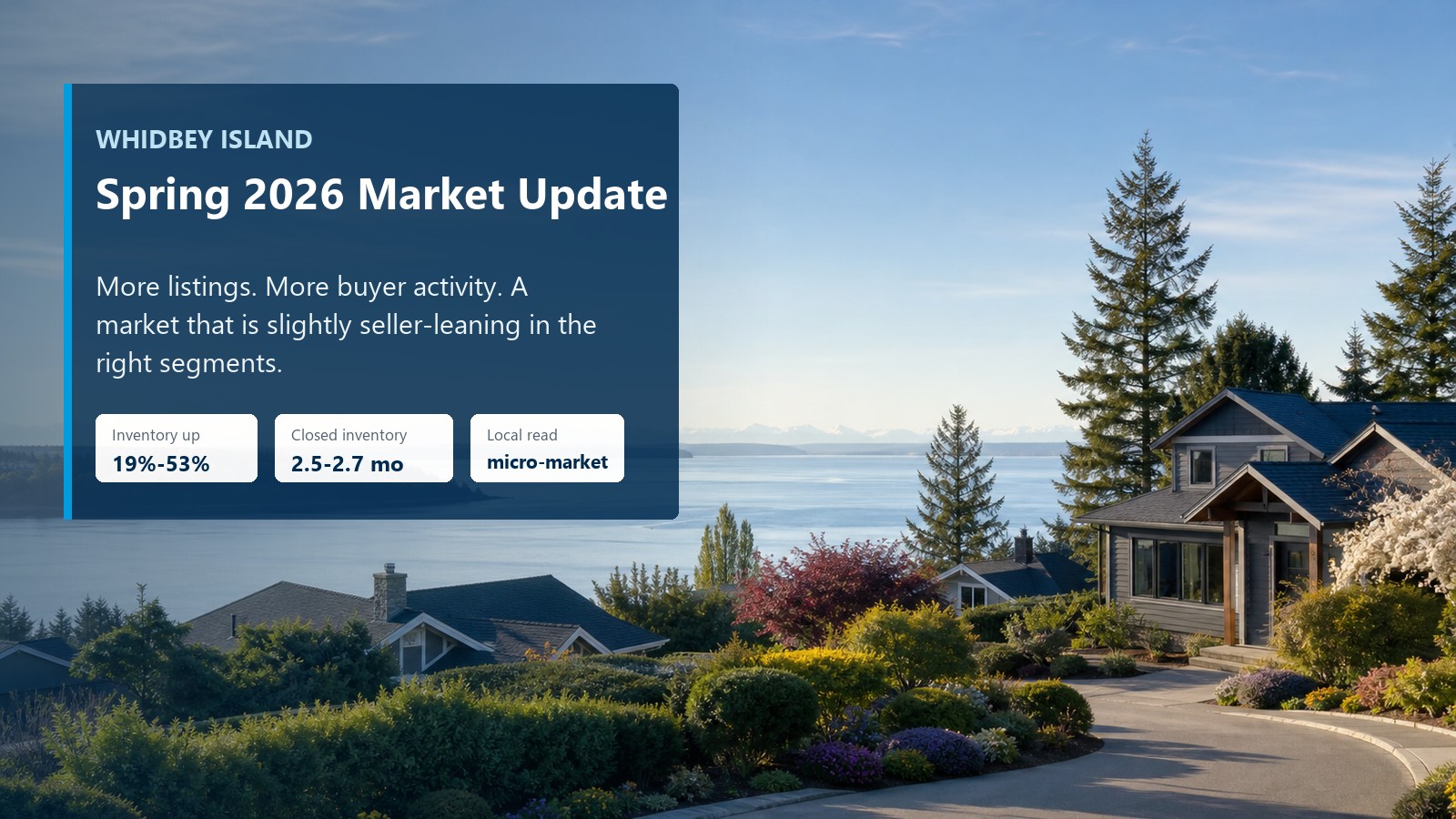
Whidbey Island’s spring real estate market is waking up. Over the last 30 to 60 days, more homes have come to market across South, Central, and North Whidbey. At the same time, buyer activity has also picked up, which means the story is more nuanced than simply saying buyers have more choices or sellers have all the leverage.
Based on April 2026 local MLS activity, the Whidbey market is best described as more balanced than overheated, but slightly seller-leaning in the right segments. Move-in ready homes, strong locations, and properties that match active buyer demand can still move quickly. Other homes, especially those that need work, are priced ahead of the market, or sit in slower price bands, may face a more selective buyer pool.
That distinction matters. A broad island-wide market report can show the general direction, but your specific result depends on the micro-market around your property: price range, condition, neighborhood, view, acreage, ferry access, lifestyle features, and current competing inventory.
Images and graphics in this article are editorial market visuals created for this update. Current listing examples are used for market context only; listing details and availability can change quickly and should be confirmed with a Windermere Whidbey broker.
The most visible change is inventory. In April, the number of homes for sale rose 40.6% on South Whidbey, 53.3% in Coupeville-Greenbank, and 19.3% on North Whidbey. That is the spring market doing what spring often does: giving buyers more to look at and giving sellers a more active audience.
But the demand side moved too. South Whidbey closed sales rose from 17 in March to 36 in April. Coupeville-Greenbank sales rose from 14 to 17. North Whidbey closed sales held steady at 40, while pending sales jumped from 41 to 61.
That is why this market does not read like a simple buyer’s market, even with more choices available. More listings are entering the market, but enough buyers are still stepping forward to keep well-positioned properties competitive.
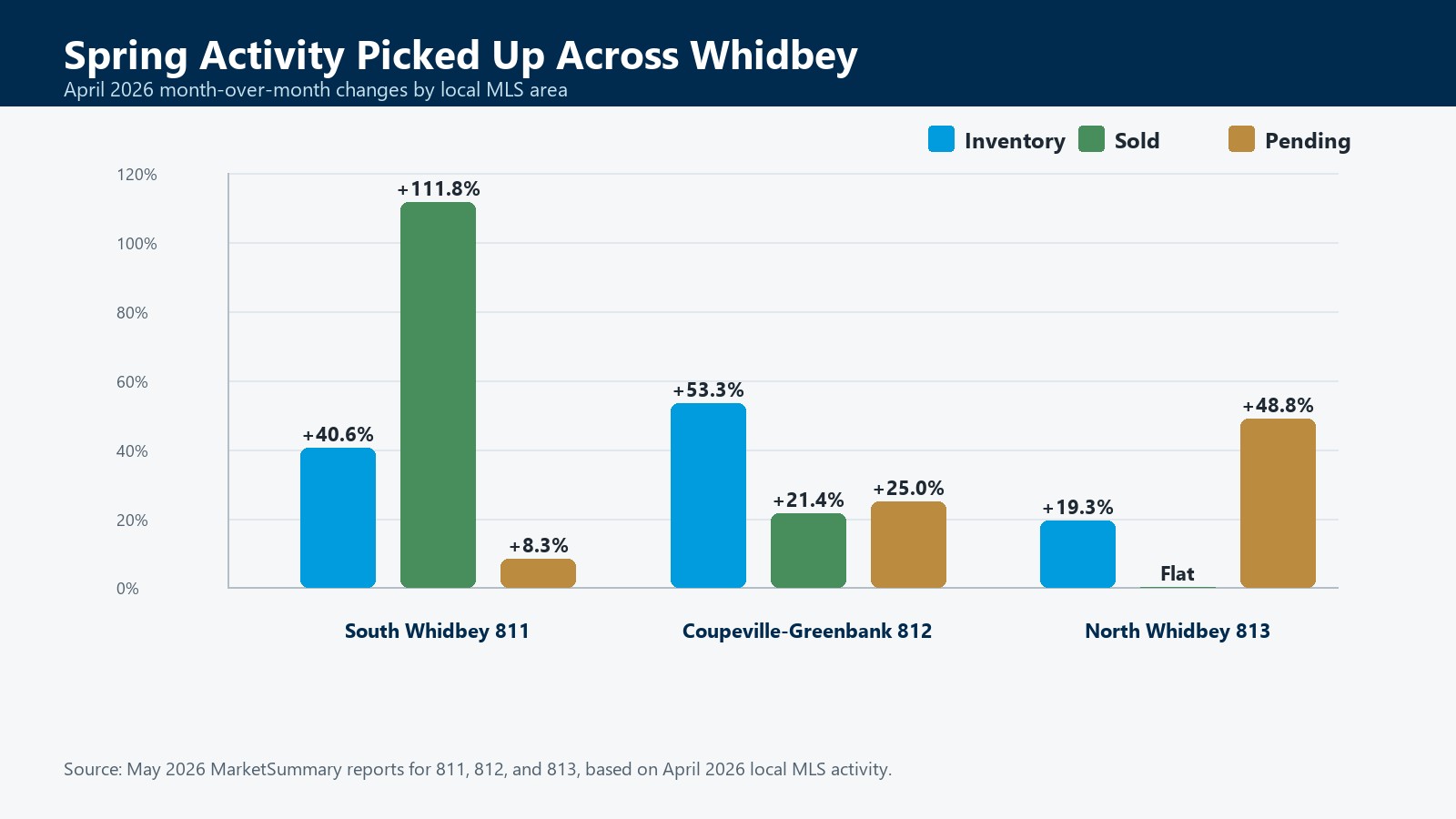
| Whidbey Area | Inventory Change | Sold Change | Pending Change | Closed-Sales Inventory |
|---|---|---|---|---|
| South Whidbey 811 | Up 40.6% | Up 111.8% | Up 8.3% | 2.7 months |
| Coupeville-Greenbank 812 | Up 53.3% | Up 21.4% | Up 25.0% | 2.7 months |
| North Whidbey 813 | Up 19.3% | Flat | Up 48.8% | 2.5 months |
More inventory gives buyers more choices, but it does not automatically shift negotiating power to buyers. The key question is whether new listings are being absorbed by buyer demand.
In April, closed-sales months of inventory was below three months in all three local areas: 2.7 months on South Whidbey, 2.7 months in Coupeville-Greenbank, and 2.5 months on North Whidbey. By that measure, the market still leans toward sellers.
However, pending-sales inventory softens the picture in parts of the island. South Whidbey’s months of inventory based on pended sales was 3.7 months, and Coupeville-Greenbank was 3.1 months, both closer to neutral. North Whidbey was tighter at 1.6 months based on pended sales.
So the more useful read is this: Whidbey is not in a frenzied seller’s market, but it is also not a market where buyers can assume every seller is under pressure. The balance depends heavily on the property.
The pricing data is another reminder to be careful with broad conclusions. Average sold price rose in all three areas in April: up 6.4% on South Whidbey, 20.0% in Coupeville-Greenbank, and 8.3% on North Whidbey. Average sold price per square foot also rose in all three areas.
At the same time, median sold price declined slightly in all three areas. South Whidbey’s median sold price dipped 4.0%, Coupeville-Greenbank dipped 2.2%, and North Whidbey dipped 0.7%.
That difference between average and median is important. It suggests that the mix of homes selling in April influenced the headline numbers. A few higher-priced sales can lift averages even while the midpoint of the market is steady or slightly lower.
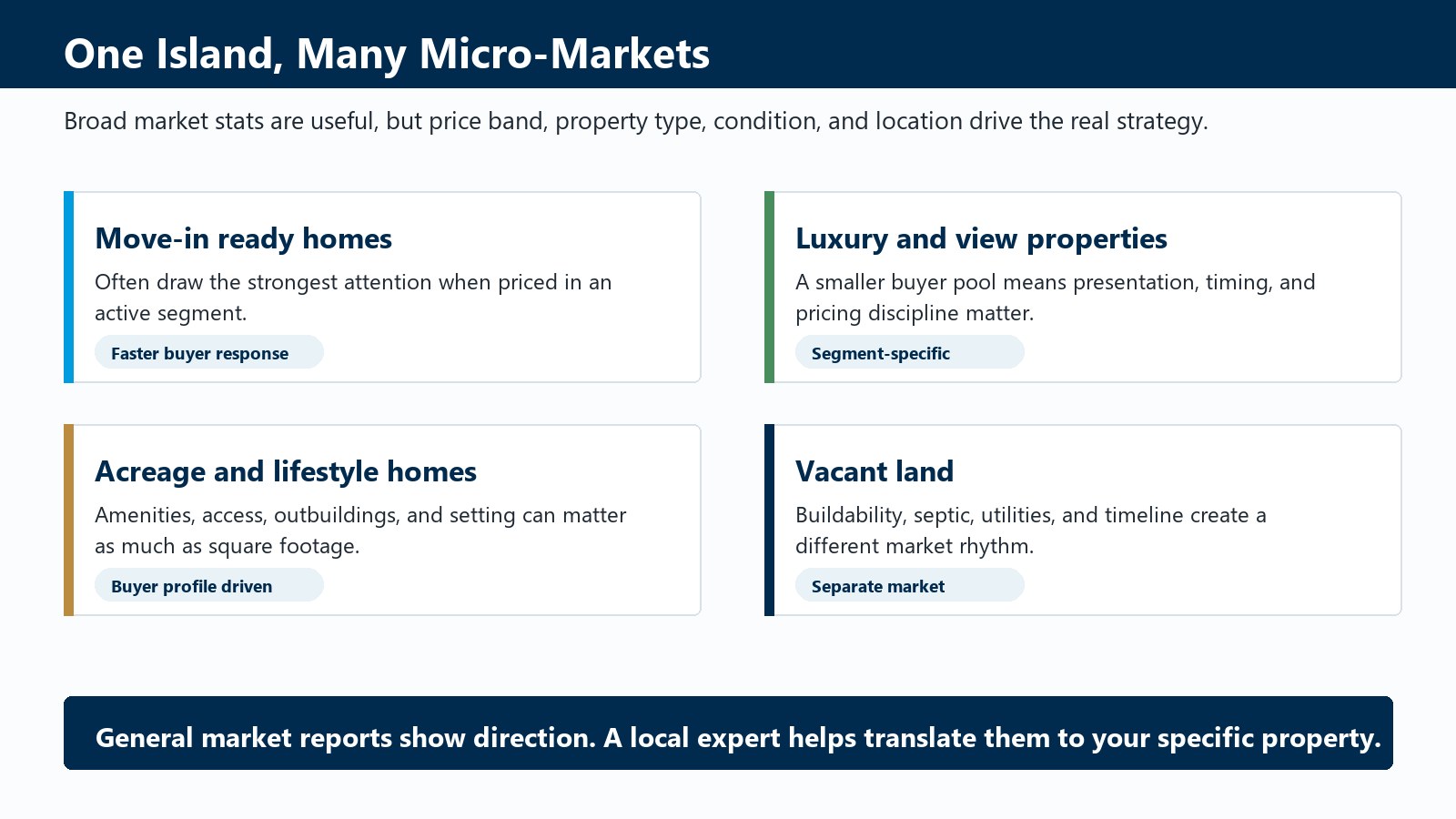
For sellers, that means pricing should be specific, not generic. For buyers, it means a broad headline may not tell you what is happening in the price band you are actually shopping.
Most local brokers would still describe the market as more balanced than a classic seller’s market, but slightly seller-leaning for move-in ready homes in specific segments. A well-prepared home in the right price range can still attract strong attention. A property with condition, pricing, access, or location challenges may need a more patient and strategic plan.
A look at selected Windermere Whidbey active listings shows how many different markets can exist on the island at the same time. These examples are not meant to suggest one universal trend; they show why property type and buyer profile matter.
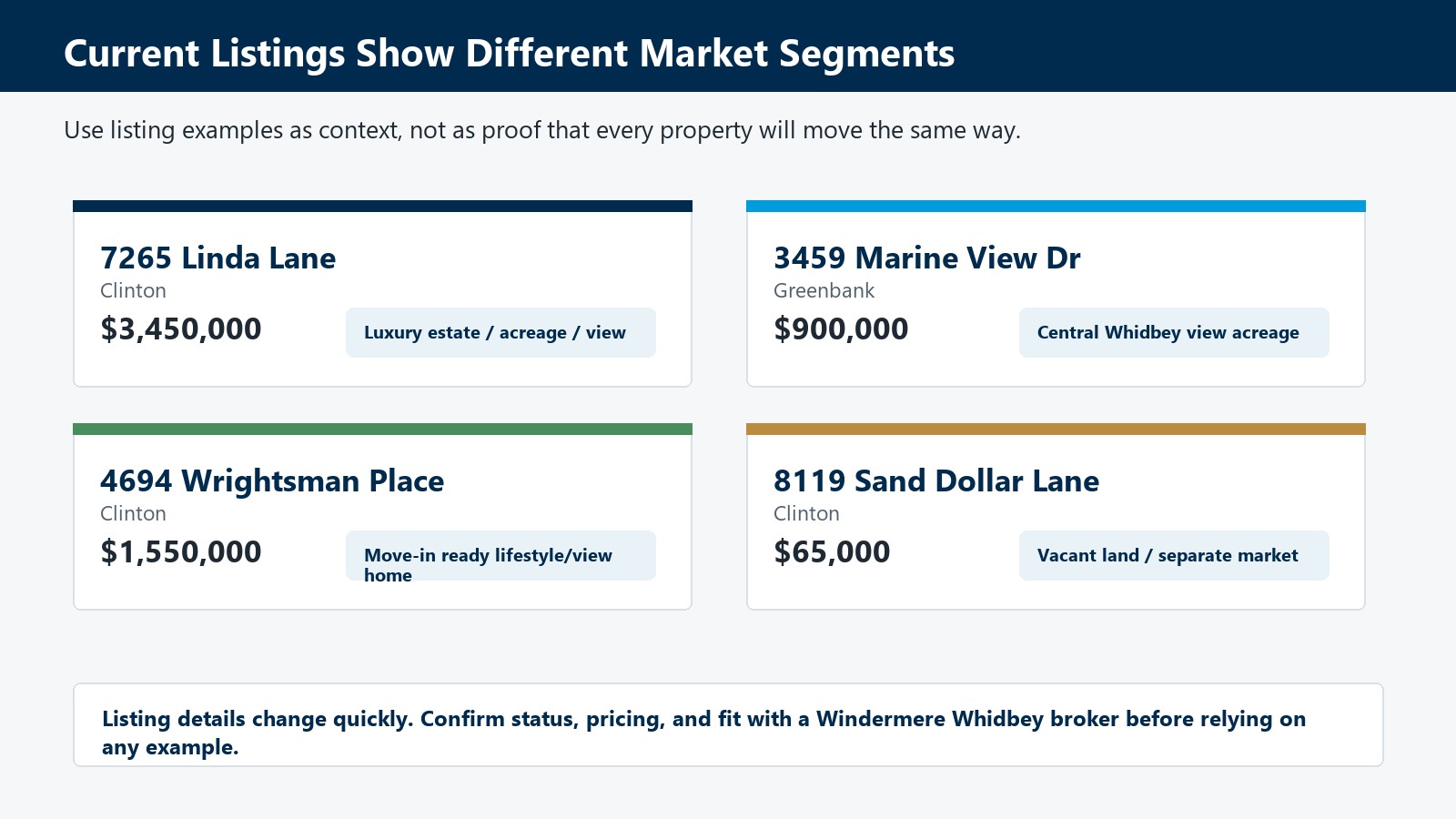
Listing details and availability can change quickly. These examples were drawn from the Windermere Whidbey active listings page and should be confirmed before making decisions.
If you are considering selling this spring or early summer, the good news is that buyer activity is present. The better news is that buyers are responding to homes that feel well-prepared, well-priced, and easy to understand.
That does not mean every property should be priced aggressively. In a more balanced market, buyers compare options carefully. Presentation, condition, photography, pricing strategy, and launch timing all matter.
The strongest seller position is usually created before the home goes live: understanding nearby competition, identifying the likely buyer pool, preparing the property for that buyer, and pricing with enough discipline to generate early interest.
For buyers, the spring market is offering more options than the winter market did. That is helpful, especially if you have been waiting for more variety in location, lifestyle, acreage, view, or price point.
Still, more options do not mean every good listing will sit. If a home is move-in ready, well-located, and priced in a competitive segment, it may still require a clear plan and a timely offer.
The best buyer strategy is to know your segment before you write. A buyer looking at North Whidbey homes near the median price is not in the same market as a buyer comparing South Whidbey luxury estates, Central Whidbey acreage, or vacant land.

Whidbey Island’s spring 2026 market is active, but it is not uniform. Inventory is up, demand is present, and the market is slightly seller-leaning in the right pockets. At the same time, buyers have more choices than they did earlier in the year, and sellers still need to be thoughtful about pricing and preparation.
If you are trying to understand what this means for your home, your search, or your next move, the most important question is not just “What is the Whidbey market doing?” It is “What is happening in my specific micro-market right now?”
Windermere Whidbey brokers work in these micro-markets every day. If you are thinking about selling, buying, or simply trying to understand the value and timing around a specific property, a local conversation can help you separate the broad trend from the details that matter most.
Based on April 2026 closed-sales months of inventory, South Whidbey, Coupeville-Greenbank, and North Whidbey all showed seller-leaning conditions. But the market feels more balanced than overheated, and results vary by price range, condition, location, and property type.
Yes. April inventory rose month over month across all three Whidbey submarkets reviewed: South Whidbey, Coupeville-Greenbank, and North Whidbey.
Sometimes, but not always. Buyers have more choices than they did earlier in the year, but buyer activity has also increased. Well-prepared homes in desirable segments may still attract strong attention.
Whidbey Island includes many different property types, from move-in ready homes and view properties to acreage, luxury estates, condos, and land. Each segment can move at a different pace, so broad market averages should not be applied too casually to one specific property.

For many Whidbey Island homeowners, the question is not simply “Should I sell?” It is “Does this home still fit the life I want now, and the life I may need a few years from now?”
That question can come up quietly. Maybe the stairs feel a little steeper than they used to. Maybe the yard takes more time than it gives back. Maybe family is farther away, healthcare appointments are becoming more frequent, or the house that once felt perfectly sized now feels like more space than you want to manage.
It can also come from the opposite direction. You may love your neighborhood, your garden, your view, your community, and your routines. On Whidbey Island, those roots matter. Staying may be the right answer. Selling may be the right answer. Sometimes the best first step is not making a decision immediately, but getting a clearer picture of what each path would actually require.
Image and listing note: The editorial lifestyle images in this guide are visual representations of next-chapter living on Whidbey Island, not documentary photos of specific homeowners or homes. Active listings change quickly. The homes featured below were selected as examples of residential-style options that may fit different next-chapter needs, such as main-floor living, lower-maintenance layouts, flexible guest space, or move-in-ready comfort. Always confirm current status, pricing, availability, and property details with a Windermere Whidbey agent.

A home that worked perfectly ten or twenty years ago may not match your next chapter in the same way. That does not mean anything is wrong with the home. It simply means your life may be asking different things from it now.
For Whidbey Island homeowners, this often comes down to a few practical questions:
The goal is not to talk yourself into moving. It is to be honest about whether your home is still supporting your life, or quietly asking more from you than you want to give.
You do not have to figure it out alone. A local Windermere Whidbey agent can help you compare your current home, your likely market value, your next-step options, and what a realistic move would look like on Whidbey Island.
Connect with a Windermere Whidbey agent or browse current Whidbey Island homes for sale.
Staying can be a strong choice when your home still fits your daily life, your support network is nearby, and the property can adapt without becoming a burden. For many island homeowners, the emotional value of staying is real: familiar neighbors, established gardens, known ferry rhythms, favorite walking routes, and the comfort of a place that already feels like home.
Staying may make sense if:
On Whidbey, this decision also depends heavily on micro-location. A home outside town with acreage may be peaceful and private, but it may also mean more driving, more outdoor maintenance, and more responsibility during winter weather. A home near Langley, Coupeville, Freeland, or Oak Harbor may offer easier daily access, but less privacy or space. Neither is automatically better. The question is what will serve your next chapter best.

Selling may be worth exploring when the home is starting to create stress, expense, or limitations that are unlikely to improve. This is especially true if you are already avoiding parts of the home, delaying repairs, worrying about stairs, or feeling tied to maintenance you no longer enjoy.
Signs it may be time to look at options include:
One of the most helpful things a homeowner can do is run the numbers before the decision becomes urgent. A local pricing conversation can show what your home may be worth today, what improvements might matter before listing, and what kinds of replacement homes are realistically available in your desired price range.
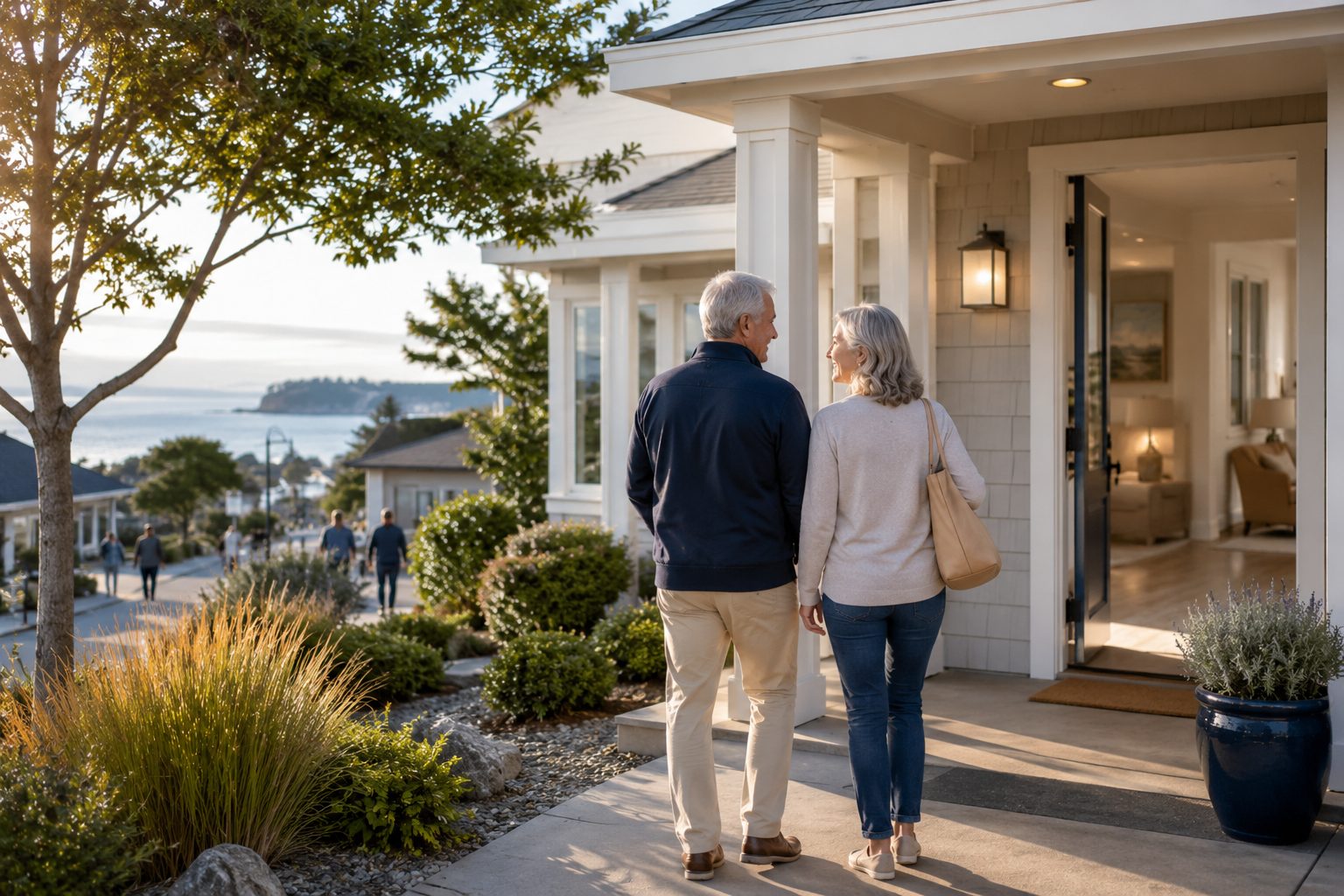
Downsizing is not always about moving into the smallest possible home. For many Whidbey homeowners, the better word is right-sizing: choosing a home that fits the way you actually want to live now.
That might mean:
For some homeowners, the ideal next home is not dramatically smaller. It is simply easier: fewer stairs, newer systems, better layout, less upkeep, more convenient location, or more flexible living space.
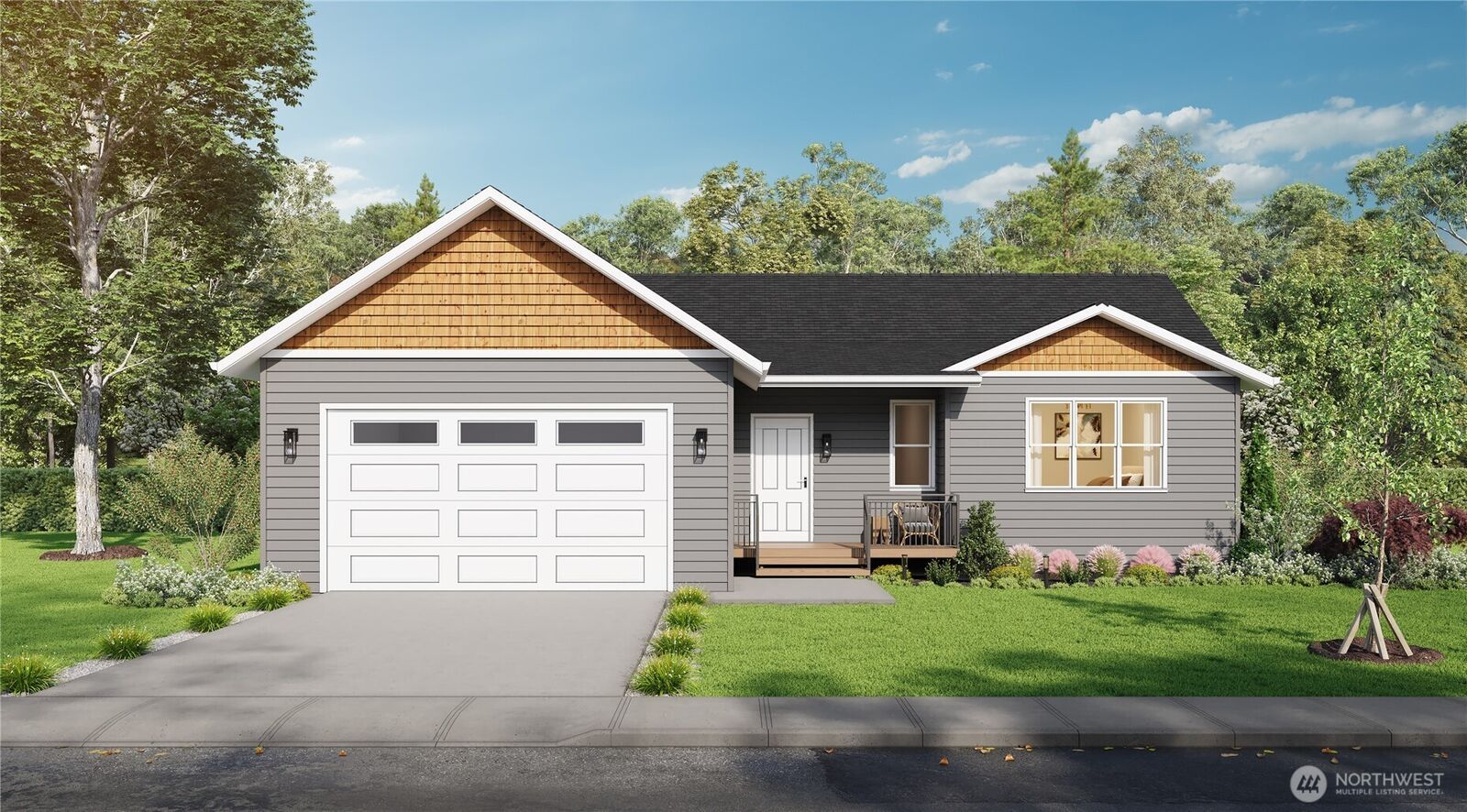
1806 Twin Oaks Lane, Freeland is an active 3-bedroom, 2-bath residential listing with approximately 1,695 square feet, a single-level layout, new construction, and a location near Freeland amenities.
For buyers thinking about easier living, this type of home can be appealing because it combines a fresh build, one-level design, and central South Whidbey convenience without moving off island.
Sometimes the right answer is not selling. It is modifying the home you already own. Before assuming you need to move, consider what targeted changes could make your current home safer, more comfortable, and easier to maintain.
Possible updates include:
The key is comparing renovation cost against long-term fit. A $20,000 improvement that helps you comfortably stay for ten years may be a great investment. A much larger remodel on a home that still has major location, stair, or maintenance drawbacks may be less practical.
Whidbey Island adds a few local layers to the stay-or-sell decision. A home that looks perfect on paper may feel different depending on ferry access, winter driving, proximity to services, or how much land and shoreline care it requires.
If you rely on the Clinton ferry, make regular mainland medical appointments, or have family visiting from off island, location matters. A beautiful private setting may still be worth it, but the travel pattern should feel realistic, not exhausting.
Being closer to Coupeville, Freeland, Oak Harbor, or local clinics may become more important over time. Even small reductions in driving can make daily life easier.
Island homes can face salt air, wind, trees, drainage issues, septic systems, wells, bluff considerations, and storm cleanup. If maintenance is starting to feel like a second job, that matters.
Do not underestimate the value of neighbors, routines, favorite businesses, faith communities, clubs, beaches, trails, and familiar town rhythms. The right real estate decision should support your life, not just your square footage.
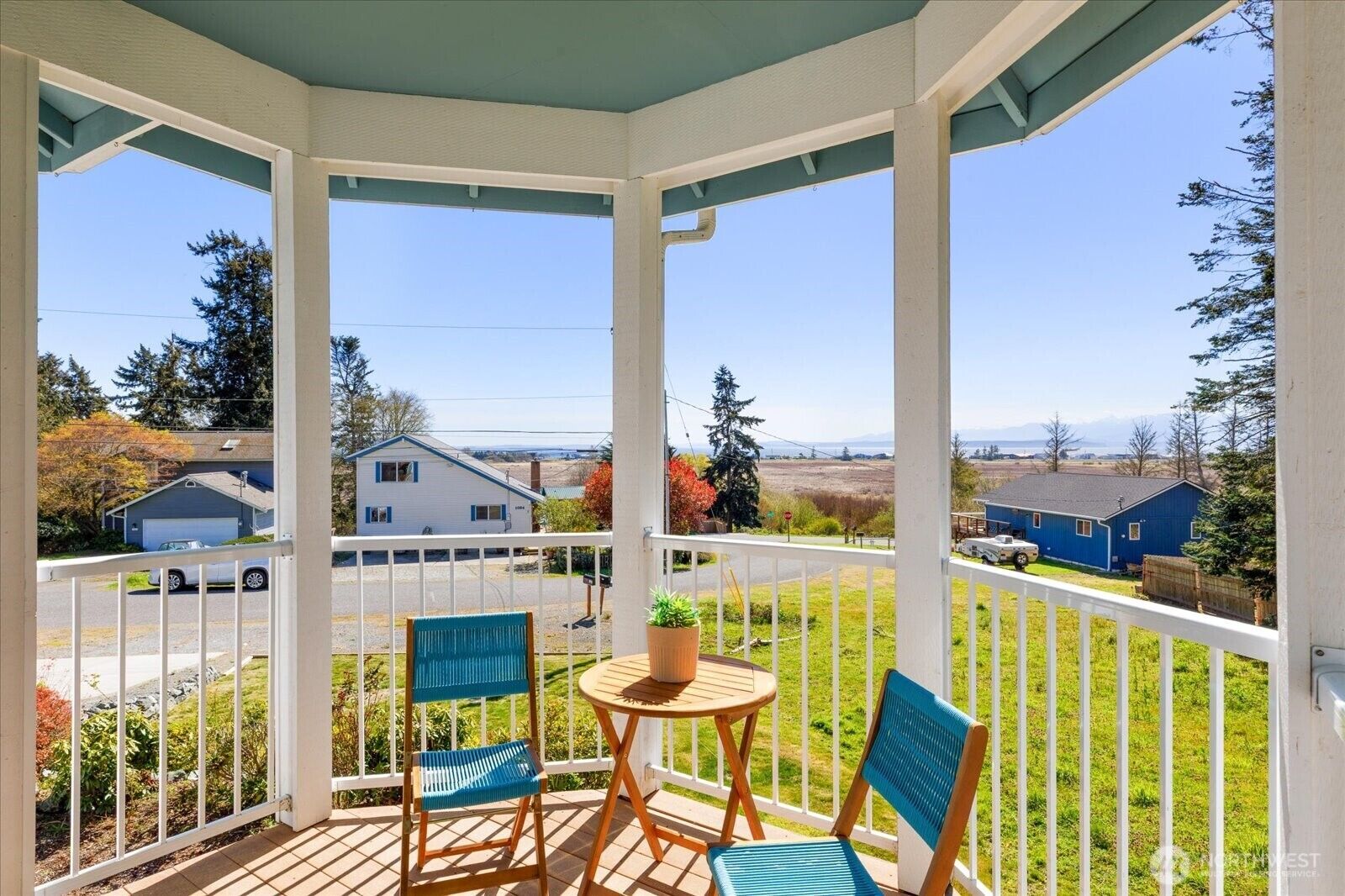
1041 Halsey Drive, Coupeville is an active 2-bedroom, 2-bath residential listing with approximately 1,500 square feet, views of Admiralty Inlet and the Olympic Mountains, and community amenities in Admirals Cove.
For someone who wants a more manageable footprint without giving up the feeling of Whidbey scenery, this type of home shows how “smaller” can still feel special.
Many long-time Whidbey homeowners have built meaningful equity. That equity can create choices, but only if you understand what it can realistically do for you.
A market review can help you estimate:
This is where local expertise matters. Whidbey values can shift sharply based on town, view, waterfront, acreage, condition, ferry proximity, and lifestyle appeal. A generic online estimate may miss the details that actually drive buyer interest here.
If you are trying to decide whether to stay or sell, these questions can help clarify the next step:
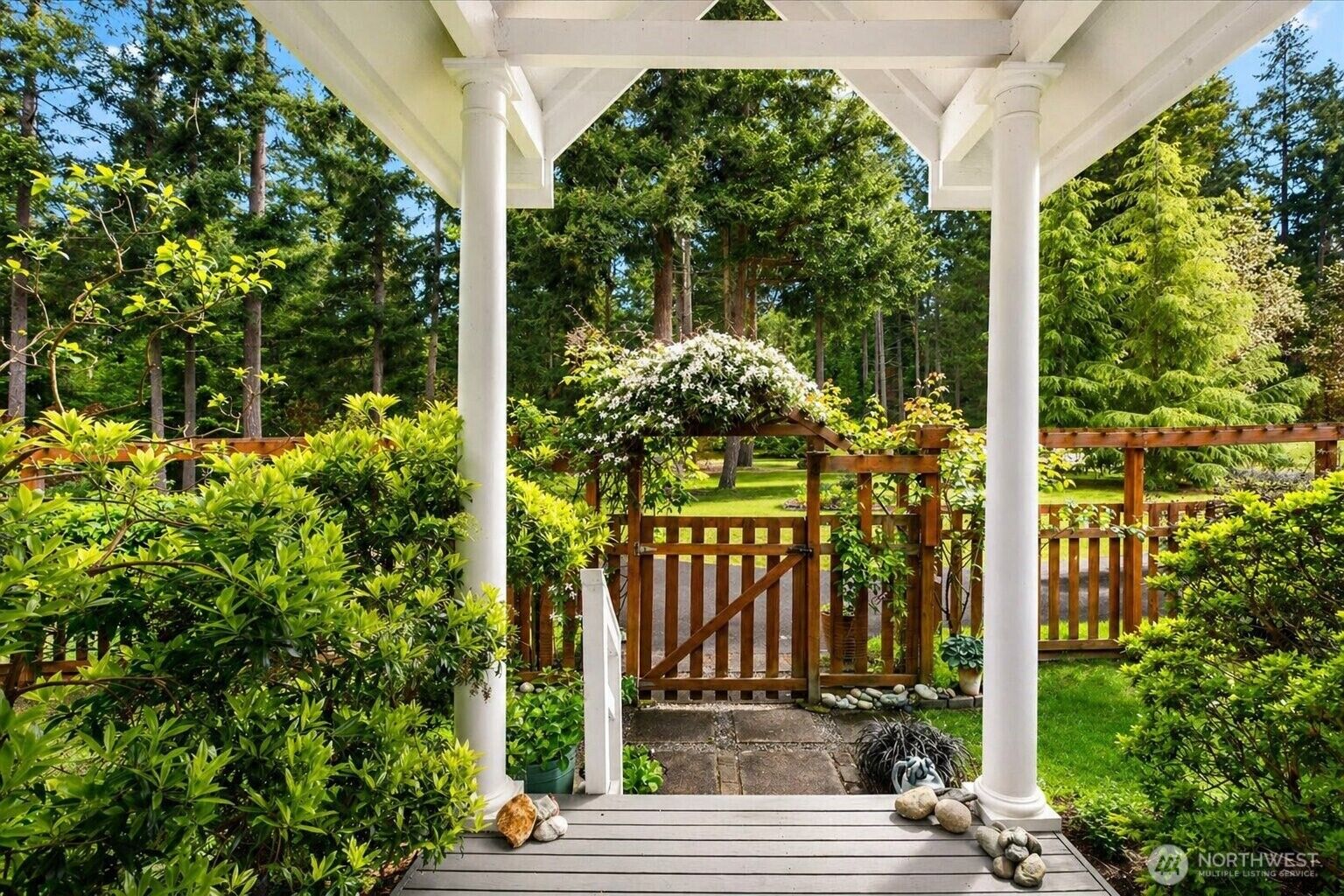
5427 Bayview Road, Langley is an active 3-bedroom, 4-bath residential listing with approximately 5,056 square feet, a main-level primary suite, flexible guest spaces, and a central South Whidbey location near Bayview, Langley, Freeland, and the Clinton ferry.
This is not a downsizing example. It is a good reminder that some next-chapter buyers still want room for family, hobbies, hosting, or extended stays while prioritizing main-floor comfort and island convenience.
If selling becomes the right path, the goal is to make the process feel calm, organized, and strategic. That usually starts before the home is listed.
A good pre-listing plan may include:
For longtime homeowners, this can feel emotional. A home may hold decades of holidays, family visits, garden seasons, pets, projects, and memories. The right agent should understand that selling is not just a transaction. It is a transition.
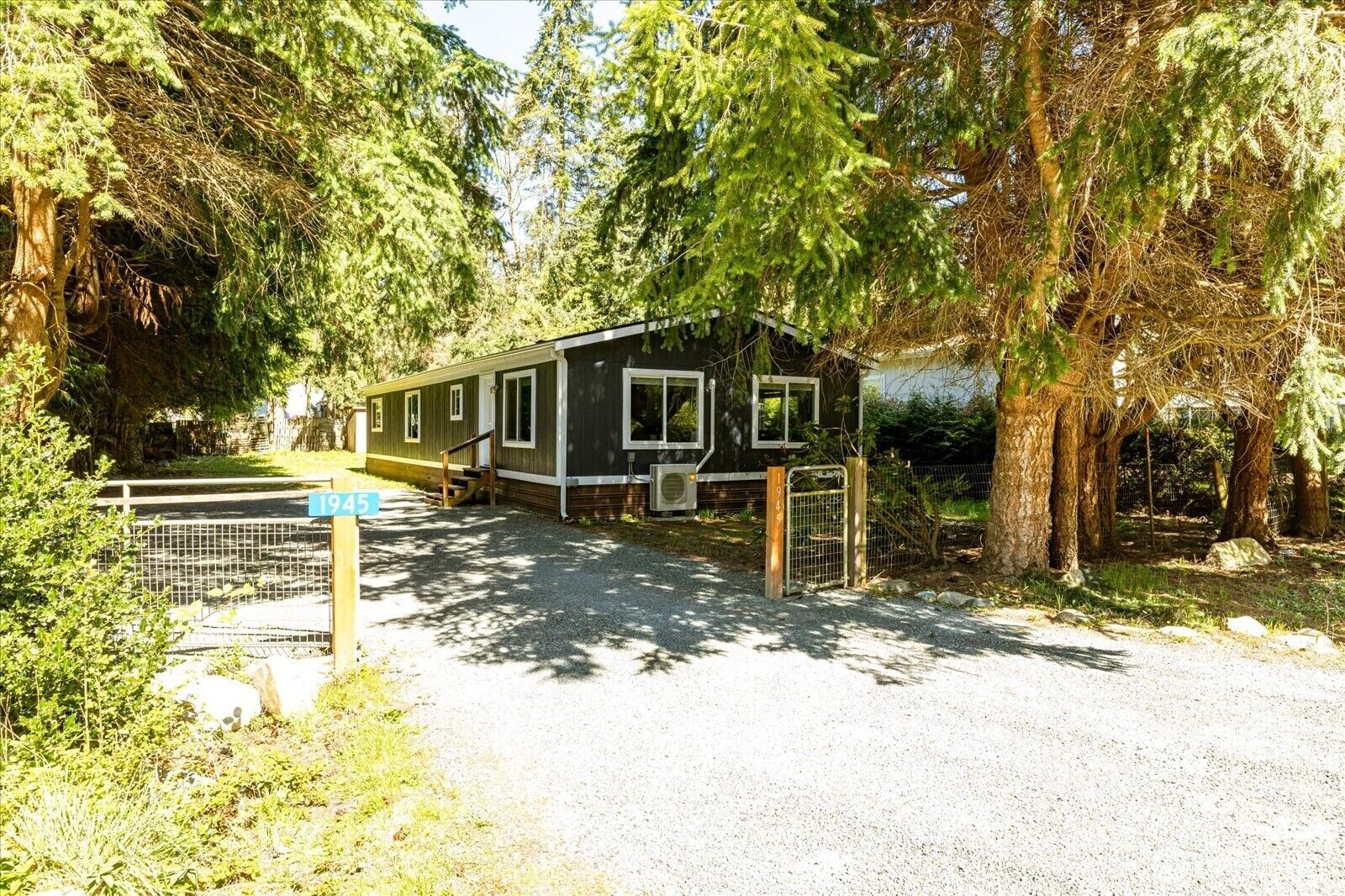
1945 Beachwood Drive, Freeland is an active 3-bedroom, 2-bath listing with approximately 1,712 square feet, a single-level layout, refreshed finishes, and a peaceful evergreen setting near Freeland amenities and beaches.
For buyers looking for a full-time residence, weekend place, or simpler island setup, this type of home can offer comfort without the scale or upkeep of a larger estate property.
You do not have to make the stay-or-sell decision all at once. A thoughtful first step is simply to gather information:
For some homeowners, that conversation confirms that staying is the right answer. For others, it opens a path toward a simpler, safer, or more flexible home. Either way, clarity is valuable.

Whether you are considering aging in place, downsizing, moving closer to town, or simply understanding your options, Windermere Whidbey can help you make a local, practical, pressure-free plan.
Talk with a local Windermere Whidbey agent about your home, your goals, and what your next chapter could look like.
You can also explore current Whidbey Island listings to see what kinds of homes may fit the life you want next.
Start by looking at daily fit, not just market conditions. If the home is safe, manageable, financially comfortable, and still supports your lifestyle, staying may make sense. If maintenance, stairs, location, healthcare access, or isolation are becoming concerns, it may be time to compare selling and right-sizing options.
No. Many Whidbey homeowners are better served by right-sizing, which means choosing a home that fits their next chapter. That may mean single-level living, less yard work, a newer home, a more convenient location, or flexible guest space rather than simply choosing the smallest property.
Sometimes, but not always. Small safety, comfort, and maintenance improvements may make staying realistic. Larger renovations should be weighed against your long-term needs, current market value, and what it would cost to buy a better-fitting home.
Consider ferry access, winter driving, proximity to healthcare and groceries, septic or well maintenance, storm cleanup, stairs, yard care, waterfront or bluff responsibilities, and whether your support network is close enough for the years ahead.
Yes. A good local agent can help you understand your home’s current market value, likely buyer expectations, possible preparation items, and what replacement homes may cost. That information can help you decide whether to stay, remodel, sell soon, or simply plan ahead.

Buyer Guide · Whidbey Island Real Estate
Whidbey Island is easy to fall in love with.
The beaches, the towns, the slower rhythm, the trees, the views, and the feeling of being just a little outside the rush of everything else are all very real. But for out-of-area buyers, it is important to understand that buying on Whidbey is not always as straightforward as buying in a more typical suburban or urban market.
Septic systems, private wells, ferries, bluff and waterfront considerations, private roads, insurance questions, and meaningful differences between one Whidbey community and another can all affect the buying experience. That is exactly why local guidance matters here.
Systems
Septic and wells are common
You may be evaluating systems many off-island buyers rarely deal with directly.
Access
Ferries, roads, and distance matter
A home’s daily convenience can change dramatically depending on where it sits.
Property Type
Waterfront and rural homes carry extra nuance
Insurance, maintenance, and ownership realities can vary widely.
Local Context
Micro-markets really matter here
Langley, Freeland, Clinton, Greenbank, Coupeville, and Oak Harbor are not interchangeable buyer experiences.

Many out-of-area buyers begin with the right instinct: they search listings, compare photos, check prices, and start narrowing down locations. But on Whidbey Island, that is only part of the story. A home can look perfect online and still come with questions that matter a great deal once you begin looking more closely.
That does not mean buying here is risky by default. It means the due diligence is often more local, more property-specific, and more nuanced than buyers first expect. The more clearly you understand those differences, the better decisions you can make.
On Whidbey, many homes are not connected to the kinds of utility systems buyers from larger cities or denser suburbs may be used to. Septic systems and private wells are common, and understanding their condition, capacity, maintenance history, and inspection status can make a meaningful difference in how confident you feel about a property.
The Windermere buyer guide reinforces this well: buyers should be thinking not just about the home itself, but also about inspections, water testing, septic review, and how those pieces fit into the overall process. This is one of the first places where local expertise becomes valuable. A local broker is more likely to help you ask the right questions early — not after you are already emotionally attached to a home.
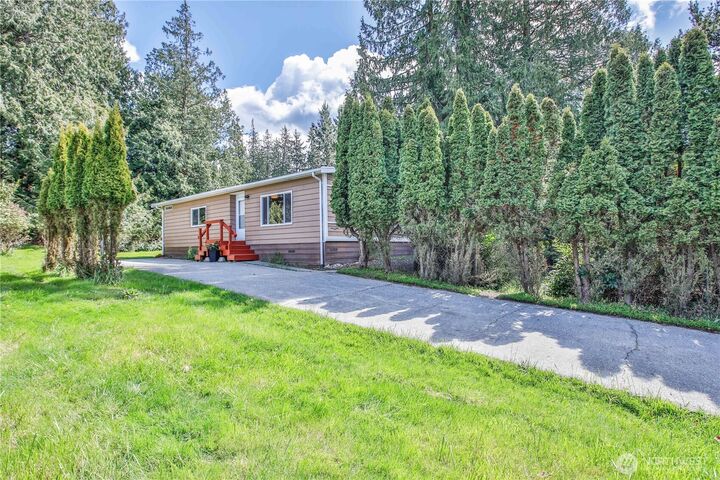
Featured Listing: 3239 Mardell Drive, Langley — $399,000
This Langley-area home highlights something buyers often discover on Whidbey: neighborhood amenities, beach access, lot feel, and community setup can affect value and lifestyle just as much as bedroom count or square footage.
That is where local guidance helps turn a listing from “interesting online” into “a real fit or not.”
Not every Whidbey property lives the same way day to day. Commute habits, ferry use, private-road access, weather exposure, and distance to the towns or services you care about can all influence whether a home feels easy, isolated, convenient, or more work than expected.
For some buyers, that is part of the appeal. For others, it becomes a surprise. Understanding not just the home, but how the location functions in real life, is one of the biggest advantages of working with someone who knows the island firsthand.

Whidbey properties can differ dramatically depending on whether they are inland, wooded, waterfront, bluffside, part of a private community, or served by systems and access routes that are less common elsewhere. Insurance questions, maintenance expectations, and property-specific due diligence can shift quickly based on those factors.
Two homes with similar square footage and price points may carry very different ownership realities. That is exactly why local context matters so much more than simply comparing listing specs side by side.
At the upper end of the market, the stakes on due diligence only rise. Complex properties can bring privacy, views, acreage, and extraordinary appeal — but they also increase the value of asking better questions before moving forward.
That is one reason truly local representation matters across every price bracket.
This is not a market where buyers can assume nothing is happening and they have unlimited time to figure everything out later.
The takeaway is simple: buyers who understand the local landscape are in a better position to move with confidence when the right home appears.
One of the easiest mistakes for out-of-area buyers is assuming that Whidbey works as one unified experience. It does not. Langley feels different from Freeland. Freeland feels different from Greenbank. Clinton, Coupeville, and Oak Harbor each come with their own rhythms, conveniences, tradeoffs, and property patterns.
The right fit is not just about the prettiest listing. It is about matching lifestyle, access, property type, and expectations to the part of the island that actually supports how you want to live.

This Coupeville listing shows why local comparison matters. A well-maintained, newer home in one part of the island can offer a very different day-to-day ownership experience than a beach-community cottage, acreage property, or bluffside home somewhere else.
Buyers benefit when someone helps them compare more than just price and photos.
This is the part many buyers underestimate. A good local broker is not just there to unlock doors or send listings. On Whidbey Island, the right broker can help you ask smarter questions sooner, notice potential blind spots, compare communities more accurately, and understand what really matters for the kind of home you are considering.
That kind of guidance is especially valuable if you are coming from out of area. The more unique the market, the more local knowledge becomes a practical advantage rather than a nice bonus.
If you are serious about buying on Whidbey Island, one of the smartest first steps is connecting with a broker who knows the island’s communities, property types, and practical ownership realities. You can start here: meet the Windermere Whidbey agents.
Whidbey buyers often need to evaluate septic systems, private wells, ferry and access realities, waterfront or bluff considerations, private roads, and meaningful differences between towns and neighborhoods. Those factors can change the buying experience more than many out-of-area buyers expect.
Buyers should ask about inspection status, maintenance history, water testing, system condition, and how those systems fit into the overall purchase process. These questions matter because many Whidbey homes rely on systems buyers may not deal with regularly elsewhere.
Yes. Ferry use, road access, commute patterns, weather exposure, and distance to services can all shape whether a property feels convenient, remote, easy, or more demanding than expected.
A local broker can help buyers ask smarter questions earlier, compare communities more accurately, spot property-specific issues, and understand practical ownership realities that are not always obvious from listing photos alone.
Whidbey Island can be an extraordinary place to buy a home. But the buyers who tend to feel best about their decisions are usually the ones who take the local differences seriously from the beginning. Ask better questions, get more specific guidance, and work with someone who understands the island well enough to help you see beyond the listing photos.
Written by Si Fisher
Listing Spotlight · Lagoon Point · Greenbank
Some homes are really about the life around them.
This one is about beach days, sunset walks, bikes in the neighborhood, and the kind of easy Whidbey rhythm that makes people want to stay longer than planned. Set in the Lagoon Point community in Greenbank, this updated home offers a welcoming base for summer living, visiting family, fishing memories, and everyday access to one of the island’s most appealing westside coastal lifestyles.
With private community beach access, a private boat launch, fresh interior updates, and even a subtle peek-a-boo water-and-mountain view from the primary bedroom, the property balances practicality with atmosphere. It feels like the kind of place where weekends quietly become traditions.
Property
$599,000
3 bed · 1.75 bath · 1,556 sq ft
0.289 acres
Lifestyle
Private beach amenities + boat launch
Built for easy access to the best of Lagoon Point living
Feel
Walkable, bike-friendly neighborhood energy
A relaxed setting for everyday island routines and visiting family
Updates
Fresh paint, updated flooring, new kitchen appliances
A turnkey starting point with clean modern comfort
What makes this property compelling is not just the house itself, but how easily it connects daily life to the shoreline, the neighborhood, and the simple pleasures that make Whidbey feel like Whidbey.
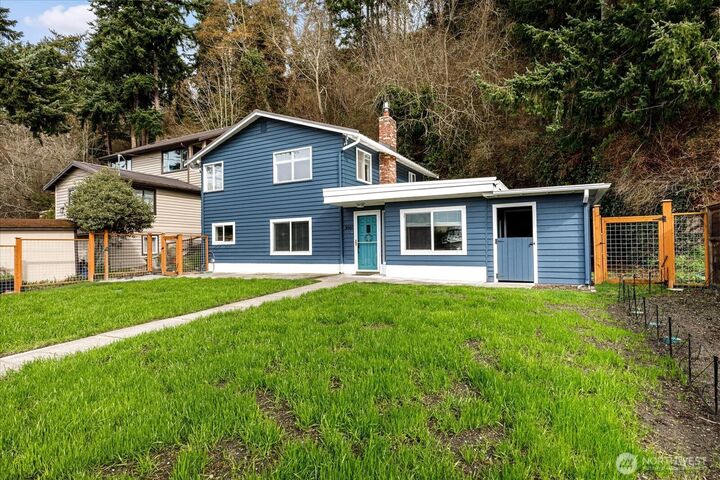
Some properties win on spectacle. This one wins on rhythm. Lagoon Point is the kind of place where access matters — access to the beach, to the water, to sunset light, to neighborhood walks, to easy bike rides, and to the sort of laid-back coastal routine that can make an ordinary week feel more restorative.
That lifestyle value is the real story here. The home gives you a comfortable, updated foothold inside a community that offers more than four walls can by themselves.
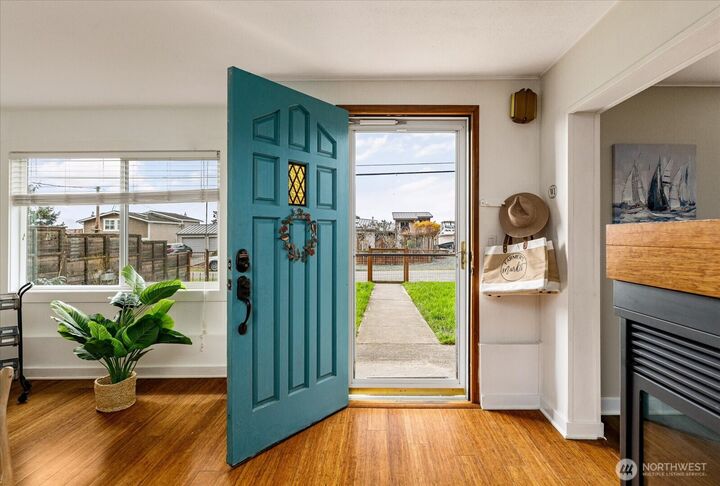
New kitchen appliances, updated flooring, and fresh interior paint help the home land exactly where many buyers want it to: welcoming, clean, and ready to enjoy without a heavy first chapter of projects.
It feels like a place you can settle into quickly and start using the way you hoped.
There is an easy emotional picture here: kids or grandkids visiting, bikes in the neighborhood, fishing off the beach, sunset walks, and days that stretch a little longer in summer. That is the kind of lifestyle this property supports naturally.
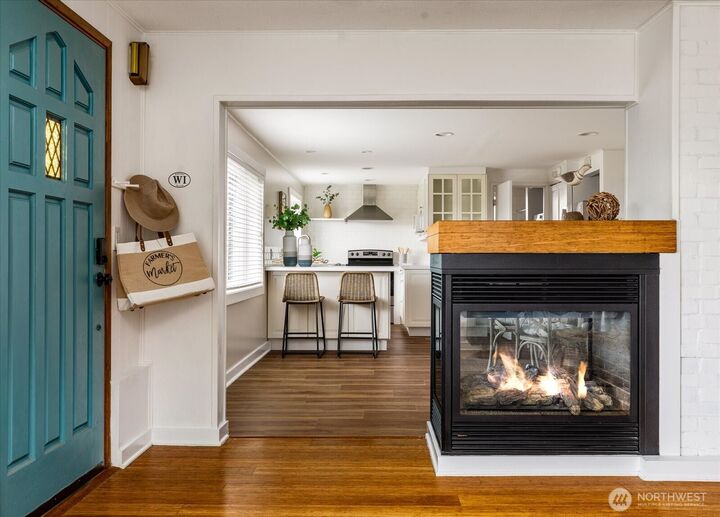
For many buyers, the attraction of Whidbey is not only scenic beauty. It is the feeling of being closer to the water, closer to the seasons, and closer to a slower pace. This home captures that feeling in a way that still feels approachable. It is not trying to be an estate. It is trying to be lived in well.
The private community beach offers a front-row relationship with passing boats, changing skies, and the kind of westside shoreline atmosphere people imagine when they think about settling into island life.
Short-term-rental potential adds another layer of appeal here for buyers thinking beyond personal use alone.
It should stay secondary to the lifestyle story, but it is still a meaningful practical advantage for the right buyer.
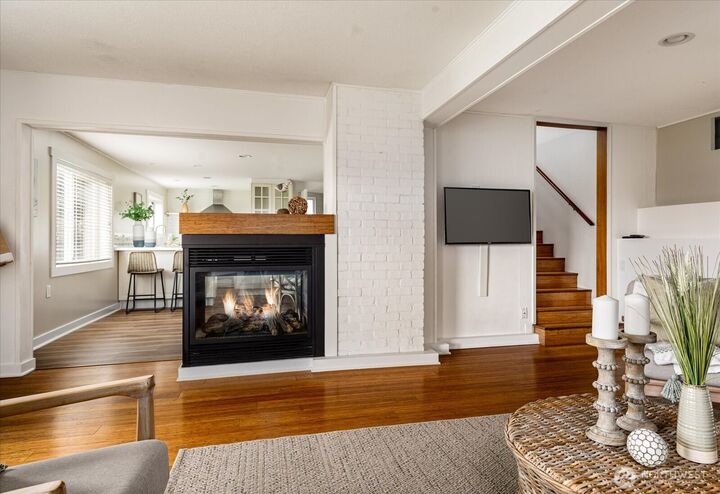
Beyond the neighborhood itself, this location keeps you connected to more of the island’s everyday pleasures. Freeland, Greenbank, Coupeville, and Langley are all part of the broader rhythm here — local restaurants, farmers markets, small-town stops, and the sense that life can stay both relaxed and full.
For a buyer looking for an easy island base with real lifestyle upside, that balance matters.
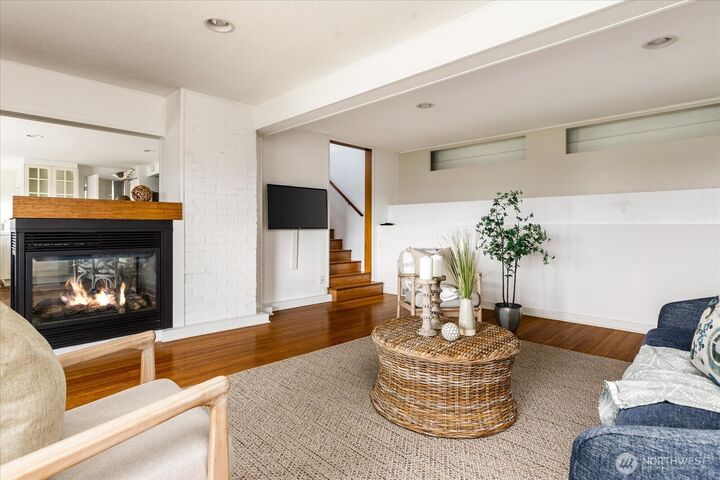
If this home speaks to you but is not quite the one — or if you are reading this after it has already moved — you can keep exploring active properties across Whidbey Island here: browse Whidbey Island homes for sale.
Lynne Hunsaker
Windermere RE/South Whidbey
(206) 313-6624
See the full listing details here: 3661 Shorewood Avenue, Greenbank
Its strongest appeal is the lifestyle around it: private beach amenities, a boat launch, walkable and bike-friendly neighborhood character, fresh updates, and easy access to the best of Lagoon Point living.
The home offers 3 bedrooms, 1.75 baths, and approximately 1,556 square feet on a 0.289-acre lot.
The listing highlights new kitchen appliances, updated flooring, and fresh interior paint for a turnkey feel.
You can see the complete listing page and full photo gallery here: 3661 Shorewood Avenue listing page.
Written by Si Fisher
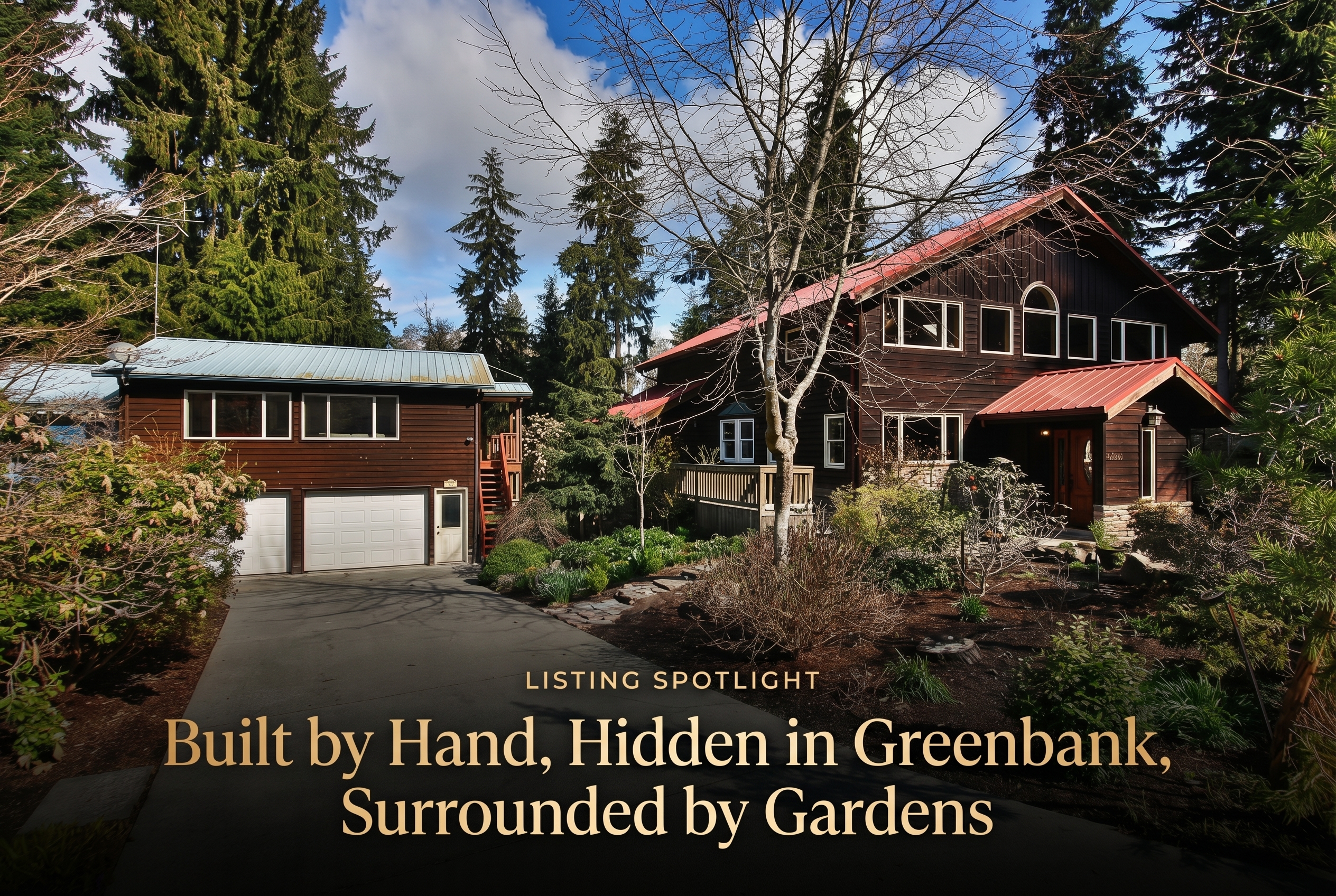
Listing Spotlight · Greenbank, Whidbey Island
Some homes read like real estate. Others read like a life’s work.
Hidden in Greenbank on 8.3 private acres, this remarkable Whidbey property feels less like a listing and more like an inheritance of care — a custom timber-frame home built by Bill and Mary Stipe, bordered by protected land, shaped by decades of intention, and rooted in one of the most extraordinary private rhododendron garden settings on Whidbey Island.
It is rare to find a home where the structure, the land, and the story all deepen each other at once. Here, timber milled by hand, proud-peg joinery, a Russian masonry heater, a 600-square-foot ADU, two substantial shops, and a botanical collection with real pedigree come together in a property that feels both deeply personal and almost impossible to replicate. Before you explore the details, step into the tour below and into a home that feels like its own private world.
Property
$1,425,000
2 bed · 3 bath · 2,651 sq ft
8.3 private acres
Craft
Custom timber frame
Built in 1999 with hand-milled timbers and proud-peg joinery
Grounds
Rare rhododendron gardens
A botanical estate with remarkable Whidbey garden character
Flexibility
ADU + wood shop + metal shop
A rare mix of guest, creative, and utility space
There are homes with acreage, and then there are properties with authorship. This one carries the unmistakable mark of people who built with care, lived with intention, and shaped the land as thoughtfully as the house itself.

The timbers came from this land and another Greenbank property. Bill Stipe milled them himself, prepared CAD drawings, and had the frame cut to his exact specifications before the home was assembled like a Lincoln Log structure. The pegs are still proudly visible. There is no generic luxury language needed here — the house tells you what it is.
That difference matters. In a market where many homes blur together, this one carries visible evidence of the people who made it. It feels shaped rather than merely finished.
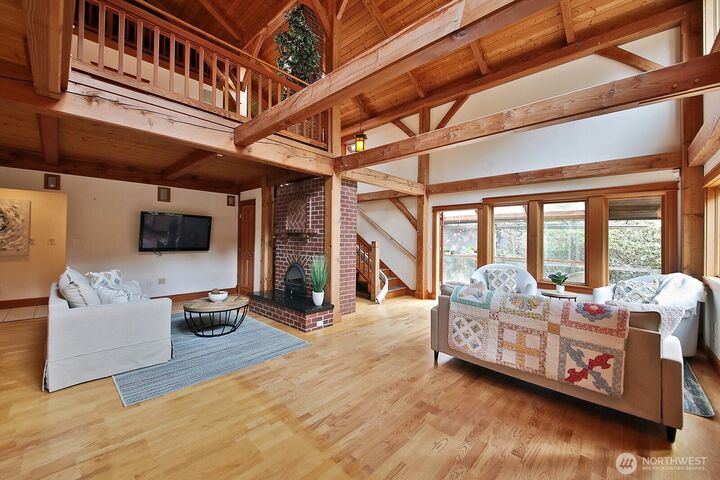
Visible joinery, hand-milled timber, and a Russian masonry heater all reinforce the same impression: this is a home made by people who cared about how it would live, not just how it would look.
The structure feels grounded, warm, and intentional in a way that is increasingly rare.
The grounds are not an afterthought here. They are part of the property’s identity. Bill, a former caretaker at Meerkerk, spent more than 30 years building what has become one of the most extensive private rhododendron collections in the world, with species tied to Australia, New Zealand, China, Japan, and the UK.
This is not just a Whidbey garden estate. It is also a rare rhododendron property — the kind of place that speaks to buyers who care about botanical richness, rarity, and a landscape with real horticultural depth.
Add magnolias, ginkgoes, tamaracks, maples, and Himalayan rhododendrons that most people would only expect to see deep in mountain country, and the estate starts to feel like its own world.
This is not simply a home with mature landscaping. It is a private rhododendron garden estate with real horticultural depth, shaped over decades and enriched by one of the most distinctive botanical stories on Whidbey Island.
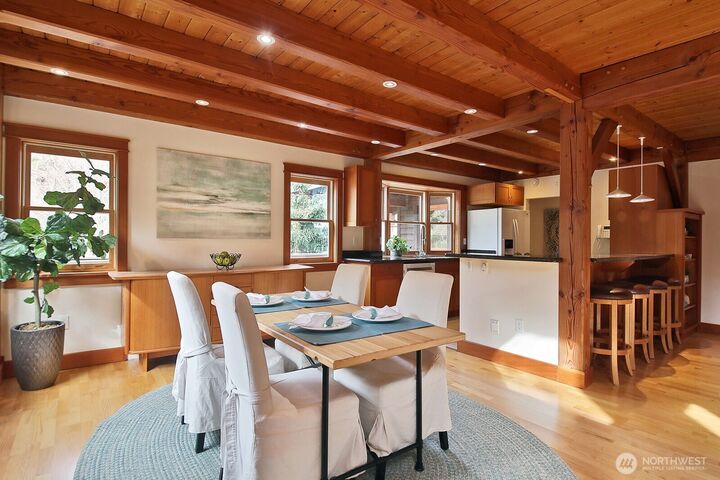
Next to the home is a detached structure with a two-car garage and EV charger, plus a 600-square-foot ADU with one bedroom, one bath, a kitchenette, and wall heaters. Attached to that are two substantial workspaces: a wood shop and a metal shop.
That kind of flexibility makes the property more than beautiful — it makes it deeply usable. Guest accommodation, creative work, hobbies, multigenerational living, serious workshop needs: this estate can hold more kinds of life than a typical acreage property.
Bordering both Nature Conservancy land and military land, the property gains a layer of privacy that is difficult to manufacture later.
That makes the setting feel more secure, more insulated, and more enduring than a typical acreage listing.
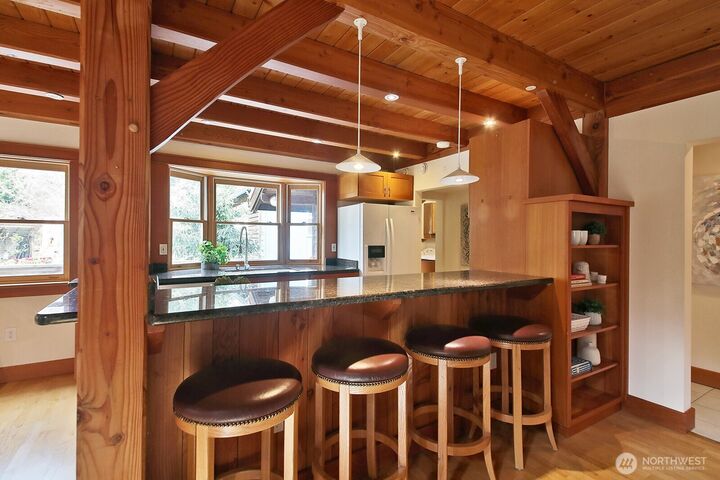
If this home speaks to you but is not quite the one — or if you are reading this after it has already moved — you can keep exploring active properties across Whidbey Island here: browse Whidbey Island homes for sale.
Part of the appeal here is that the property feels inseparable from its place. Greenbank has a quieter, more spacious energy than some other parts of the island, and a home like this lets that character expand. This is not just a private residence. It is a setting for a slower, more intentional version of Whidbey life.
Sandra Stipe
Windermere Real Estate South Whidbey
See the full listing details here: 2970 Smugglers Cove Road, Greenbank
This home stands out for its handcrafted timber-frame construction, proud-peg joinery, Russian masonry heater, extraordinary rhododendron gardens, ADU, shops, and highly private setting.
The property sits on 8.3 acres in Greenbank on Whidbey Island.
Yes. The property includes a detached garage with EV charger, a 600-square-foot ADU, and attached wood and metal shops.
You can see the full listing page, photo gallery, and property details here: 2970 Smugglers Cove Road listing page.
Written by Si Fisher

If you have been watching South Whidbey real estate this spring and getting the feeling that buyers are starting to move faster again, the data suggests that instinct is not coming out of nowhere. This is not a reckless “everything is suddenly on fire” market call, but it is a strong case that the South End may be tightening faster than many casual observers realize.
The most useful way to read this market right now is not through one dramatic headline. It is by looking at what is happening with new listings, pendings, price bands, days on market, and the difference between everyday homes and the luxury tier. When you do that, South Whidbey starts to look less like a sleepy spring market and more like a place where timing may matter again for both buyers and sellers. If you are trying to understand the bigger island context, Windermere Whidbey’s Whidbey Island area guide is a helpful starting point, and for South End lifestyle context specifically, it also helps to explore places like Freeland, Langley, and Clinton.
45
Mar 2025
61
Mar 2026
South Whidbey added 35.6% more new listings than the year before, which means sellers are clearly coming into the market.
22
Mar 2025
24
Mar 2026
Pending activity also rose, up 9.1%, which matters because it suggests buyers are absorbing at least part of that new supply.
92
2025
71
2026
Average time on market improved from 92 to 71 days, a meaningful sign that the market is moving faster overall than it was a year ago.
The strongest evidence is not one isolated stat. It is the combination of more listings, more pendings, faster average movement, and stable-to-rising pricing in the most active parts of the market. South Whidbey added 61 new listings in March 2026 versus 45 in March 2025, but pendings also increased from 22 to 24. That is why this market feels different from a simple “inventory is rising, therefore buyers have all the power” story.
Put differently: the market is not just adding supply. It is also adding absorption. That does not automatically create a frenzy, but it does create conditions where the best-prepared buyers may need to move faster and the best-positioned sellers may gain more leverage.
As Windermere broker Alicia Dietrich put it: “I want to echo the words of Dave Ramsey, ‘now is the time to act’. I feel like the market is ready to explode.”
The recent South Whidbey signals are starting to show: more movement, more urgency, and a stronger spring pulse than a casual headline reader might expect.
The more active part of the South Whidbey market right now appears to be the non-luxury side. Under-$1M sold volume is up 17.2%, while $1M+ sold volume is down 30.8%. That is one reason broad “luxury island market” assumptions can mislead people.
$749K
2025
$875K
2026
Active listing median pricing is up 16.8% year over year.
Sellers in the mainstream market are capturing a higher share of original asking price than they were a year ago.
It does not say every South Whidbey listing will now sell instantly. It does not say buyers have no leverage. And it definitely does not say the luxury segment is moving with the same momentum as the broader owner-occupant market. In fact, the luxury tier is one of the clearest reminders that not all demand is equal right now.
South Whidbey’s $1M+ sold count is down year over year even as under-$1M activity has improved. That means the market is tightening, but selectively. The right takeaway is not panic. It is precision.
If you want to know where the real spring energy is, start by watching the upper-middle market before you watch luxury. That is where the volume story is stronger right now.
If you have been assuming spring inventory would automatically make South Whidbey easier, the better answer is: maybe, but not by much in the most desirable and practical price bands. More listings are a real benefit, but if pendings continue to rise with them, the usable window for hesitation may stay shorter than expected.
Buyers do not necessarily need to panic, but they should be better prepared than they were in a slower-feeling stretch. Financing readiness, clearer priorities, and faster decision-making may matter more if the South End continues on this trajectory.
For sellers, the takeaway is not to overprice and assume the market will rescue the listing. The right lesson is that good homes, well-positioned in the active price bands, may be entering a better leverage window than they had earlier. Rising inventory can create anxiety, but it can also mask a stronger truth: if buyers are absorbing well-located and well-priced homes quickly enough, the best listings may still command serious attention.
This is where local strategy matters. A seller in Langley or Freeland should not assume their outcome will match a luxury property or a slower segment farther away. South Whidbey is active, but selectively active.
When South Whidbey starts tightening, the market often feels different before the headlines catch up. That is one reason local listing strategy, timing, and neighborhood-level context matter so much more than generic regional real-estate chatter.
The best honest answer is yes, it looks like it may be. The data does not support blind hype, but it does support growing momentum. More listings are coming on, yet pendings are also climbing, average market time has improved versus last year, and the strongest activity appears to be concentrated where many real buyers actually shop.
That does not mean every segment is equally hot. It does mean the South End is giving off more spring-acceleration signals than a lazy market narrative would suggest. For buyers, that means waiting too casually could become more expensive. For sellers, it means strategic timing may be improving right now.
Not in a blanket, every-home-is-flying sense. But current data does show stronger spring momentum, including more new listings, more pendings, and faster average movement than last year.
Yes. Pending activity and under-$1M sold activity both suggest buyers are still engaging, especially in the more practical and competitive price bands.
No. The data suggests luxury is moving more selectively, while the more active pressure is showing up more clearly below the $1M threshold and in the upper-middle market ranges.
Buyers should be prepared and decisive. Sellers should focus on pricing, preparation, and neighborhood-specific strategy instead of assuming broad market headlines tell the whole story.
If you want to understand how these market shifts apply to your price range, property type, or neighborhood, Windermere Whidbey can help. In a market like this, the biggest advantage is not panic or hype — it is local clarity.
Written by Si Fisher

If the Whidbey market feels confusing right now, you are not imagining it. Some homes still move quickly and close near asking, while others linger long enough to make buyers and sellers wonder whether the market has quietly changed. The truth is more nuanced: Whidbey is not frozen, but buyers are more selective, pricing matters more, and North and South Whidbey are not behaving exactly the same way.
This is where generic housing headlines stop being useful. Locally, the better question is not whether the market is “hot” or “cold.” It is why one property gets momentum immediately while another stalls. For buyers, that affects negotiating power. For sellers, it affects timing, pricing, and expectations from day one.
Nationally, one of the biggest consumer housing stories right now is that buyers have become more selective. Inventory has improved in many markets, mortgage rates are still elevated enough to make people cautious, and shoppers are comparing every listing more closely. That same pattern shows up on Whidbey, but with island-specific twists.
On Whidbey, limited inventory still supports values, especially when a property lines up with what buyers actually want: realistic pricing, strong condition, useful layout, and a location that fits their life. But that does not mean every listing gets the same response. In a more selective market, the difference between “compelling” and “close enough” is much wider.
What the latest local data shows: buyer activity is still very real in South Whidbey, but outcomes are getting more selective.
Why it matters: This is not a market where everything is stalling. South Whidbey still has active buyers, faster current market movement, and strong pricing discipline — but that momentum is concentrating around the homes buyers see as worth acting on.
The simplest answer is that buyers are comparing value more critically than they did when almost everything felt urgent. A home can still move fast on Whidbey, but usually because several factors align at once.
In a market where buyers are watching affordability closely, pricing errors stand out faster. South Whidbey’s current active price is still high, but not every listing can command a premium just because inventory is relatively limited. If the asking price is built on last year’s optimism instead of this month’s competition, buyers notice.
A home that feels turnkey, well-maintained, and easy to understand will often beat a prettier-on-paper property that comes with uncertainty. That matters even more in areas where buyers are balancing island lifestyle goals with monthly payment pressure.
Well-photographed, well-prepared listings still create emotional momentum. When a home looks clean, bright, and aligned with Pacific Northwest buyer expectations, it earns stronger early attention. When it feels dated, confusing, or overpromised, it can sit even in a market that is still producing closings.
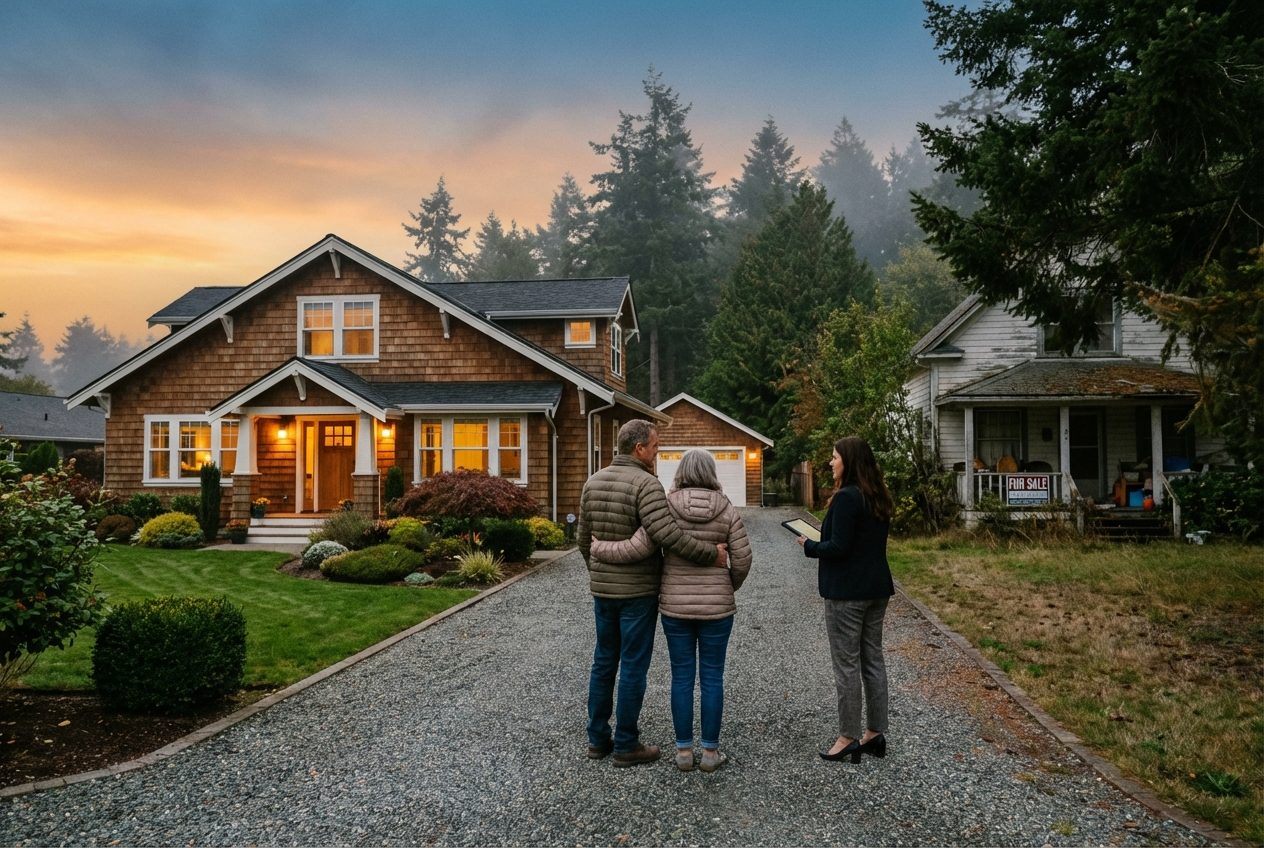
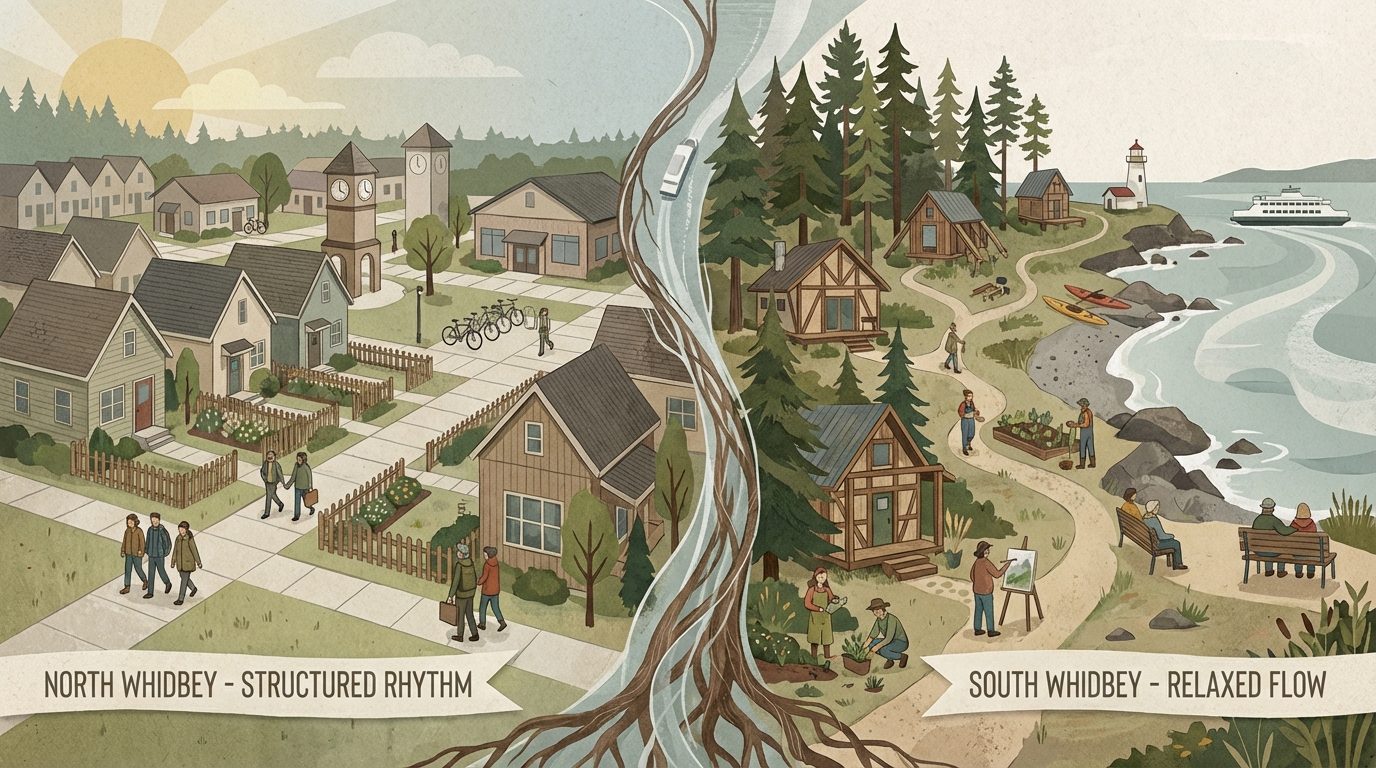
One of the easiest mistakes people make is talking about Whidbey as if it behaves like a single market. It does not. South Whidbey and North Whidbey often move at different speeds, attract different buyers, and respond differently to inventory shifts, price sensitivity, and lifestyle demand.
That is why a homeowner in Langley or Freeland should be cautious about drawing conclusions from broad island averages alone. If your property competes in South Whidbey’s buyer pool, the local interpretation matters more than the generic island headline. The same goes for buyers trying to decide whether conditions feel more negotiable in one part of the island than another. If you want better local context, it helps to compare current market conditions with the broader Windermere market trends and then ground them in the specific South Whidbey communities that match your search.
If a South Whidbey listing has been sitting, look beyond the raw days-on-market number. Price, condition, ferry convenience, view quality, and whether the layout fits full-time living can all matter more here than an island-wide average suggests.
For buyers, this kind of uneven market can actually be useful. If a listing is sitting because it is mispriced or poorly presented, there may be more room for negotiation than broad seller-market headlines suggest. But if a home is well-positioned and aligned with what the local buyer pool wants, waiting too long can still cost you.
This is especially true if you are trying to compare community fit as much as price fit. Someone deciding between South Whidbey lifestyle options may want to look more closely at Langley, Freeland, or the broader Whidbey area guide before assuming every part of the island offers the same tradeoffs.
For sellers, the takeaway is not “the market is bad.” It is that the market is less forgiving. Strong homes are still getting traction. But buyers are no longer giving every listing the benefit of the doubt.
If your goal is to sell well rather than simply list high, pricing, prep, and positioning need to work together from the start. That is where local interpretation matters. In an uneven market, a smart launch often matters more than a dramatic later price cut. If you are trying to understand how your home would likely compete in today’s environment, the next step is not guesswork — it is a sharper local strategy conversation.
If you are buying, selling, or trying to understand where your home fits in today’s market, a local read matters more than a generic headline. Contact Windermere Whidbey for a grounded conversation about pricing, timing, and what your corner of the island is really doing right now.
Usually because buyers are being more selective. Pricing, condition, layout, and location fit all matter more when affordability is tighter and shoppers are comparing every listing more carefully.
In many ways, yes, but not in a blanket sense. Current South Whidbey data still shows meaningful pending activity and strong sale-to-list discipline, but sellers cannot assume every property will move automatically.
Sometimes. A lingering listing can create negotiating room, but only if the issue is pricing or positioning rather than a deeper problem with the property itself.
No. The buyer pools, price points, pace, and motivations can differ enough that the two markets are often better understood separately.
Written by
Si Fisher.


Want to join the Windermere Team?
Click here for Freeland / Langley
Windermere Real Estate/South Whidbey

© 2023 Windermere real estate